Kubeh
.png)
Kubeh on West Village's 6th Avenue is one of New York's few dedicated kubeh restaurants, serving hand-rolled dumplings in the Kurdish, Iranian, and Syrian tradition alongside kuku sabzi and tahini-roasted eggplant. A Michelin Plate holder since 2024, it sits at the accessible end of the city's Middle Eastern dining spectrum, with a room decorated in old-world heirloom pieces that reads more like a considered home than a restaurant.
 Discover on Pearl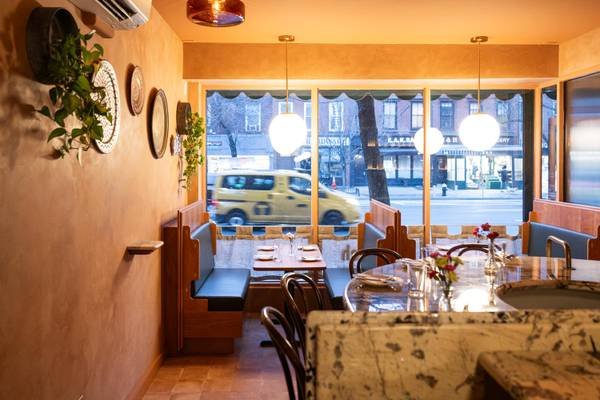
A Room That Earns Its Quiet
The stretch of 6th Avenue running through the West Village and into Greenwich Village is dense with restaurants competing on volume and visibility. Kubeh, at number 464, does neither. The interior is small and deliberately composed, with old-world heirloom objects on the walls that give the space the feeling of a personal collection rather than a designed atmosphere. Where many contemporary Middle Eastern restaurants in New York lean into geometric tile work or minimalist plaster, this room works through accumulation of domestic detail. It reads less like a dining destination and more like a place someone actually lives and eats, which is precisely the point for a cuisine rooted in the communal kitchens of Kurdish, Iranian, and Syrian immigrant women.
That framing matters because the physical container at Kubeh is doing editorial work. The space signals that what follows at the table belongs to a domestic tradition, not a modernist reinterpretation. New York has several strong Middle Eastern addresses, including Al Badawi, Ayat, and Mesiba, each staking out its own regional angle. Kubeh's claim is specificity: the namesake dish, a hand-rolled dumpling rarely found in American restaurants, is the organizing principle of the menu and of the room itself.
The shortlist, unlocked.
Hard-to-book tables, cellar releases, and concierge-planned trips.
Get Exclusive Access →The Dish That Defines the Category
Kubeh, the dumpling, occupies a complicated position in Middle Eastern cuisine. It is associated primarily with Iraqi Jewish, Kurdish, and Levantine communities, and its preparation varies significantly by region, with different outer shells, broths, and fillings depending on origin. In the United States, it appears occasionally as a side item in larger Israeli or Lebanese menus, but rarely as a menu centerpiece. The scarcity is partly logistical: hand-rolling kubeh is labor-intensive, and the dish requires both technique and cultural familiarity to execute correctly.
Chef and owner Melanie Shurka traveled to Israel specifically to learn from immigrant women of Kurdish, Iranian, and Syrian descent before opening the restaurant, which positions the menu as documented rather than interpreted. That research grounding is evident in the hand-rolled kubeh available filled with either meat or mushrooms. The 2024 Michelin Plate recognition confirms that the execution meets a standard beyond neighborhood credibility. Among the city's Middle Eastern options, a Michelin Plate at a $$ price point is a signal worth taking seriously, placing Kubeh in a peer tier alongside accessible but carefully executed addresses rather than the high-spend category occupied by tasting-menu formats.
The Menu Beyond the Dumplings
The supporting menu draws from the same regional span as the kubeh itself. Kuku sabzi, a Persian herb and leek frittata, is one of the dishes specifically recognized by Michelin's editorial notes for the restaurant. It represents the egg-based, herb-heavy tradition common across Iranian home cooking, and it arrives as a demonstration of restraint: the dish has few components and relies entirely on the quality of the greens and the timing of the cook. Tahini-drizzled roasted eggplant is the other anchor, a preparation found in various forms from Jerusalem to Beirut, and one that rewards a kitchen with access to good tahini and patience with the roasting process.
For dessert, baklava holds its expected place on the menu, but Michelin's editors specifically flag the warm gluten-free brownie with whipped cream and Turkish coffee ice cream enhanced with cardamom as the more interesting finish. Turkish coffee ice cream represents a specific flavor tradition connecting the Eastern Mediterranean and the Levant, and the cardamom addition locates it further toward the Gulf and Persian registers. It is a dish that works as a summary of the menu's geographic range.
For context on how this compares to Middle Eastern dining outside New York, see Bait Maryam in Dubai or Baron in Doha, where regional traditions meet different local dining cultures.
West Village Context and Peer Positioning
The West Village has a well-established pattern of small, independent restaurants with loyal followings that resist the scale pressures common elsewhere in Manhattan. Kubeh fits that pattern precisely. The $$ pricing puts it in a range accessible to regular rather than occasional diners, and the Google review score of 4.4 across 902 ratings indicates a consistent experience rather than a viral spike. A large review count at a sustained average is generally a more reliable signal than a high rating with few data points, and for a small restaurant in a food-dense neighborhood, 902 reviews suggests it has been feeding the same streets for long enough to build a genuine constituency.
In a city where Middle Eastern food ranges from the fast-casual falafel of Mamoun's to the more elaborate formats at destinations elsewhere in the boroughs, Kubeh occupies the considered middle: a sit-down, detail-oriented room with a focused menu and a specific culinary argument to make. It is not trying to do what Astoria Seafood does for the Queens seafood tradition, nor is it competing on the tasting-menu terms of the city's starred rooms like Alinea in Chicago or The French Laundry in Napa shape the leading of their categories. It is making a quieter, more durable argument about a specific dish and the people who make it.
For more across the city's dining spectrum, see our full New York City restaurants guide, as well as hotels, bars, wineries, and experiences guides for New York City. For comparison across the US restaurant scene, Emeril's in New Orleans, Lazy Bear in San Francisco, Single Thread Farm in Healdsburg, and Providence in Los Angeles each represent how regional American dining builds identity around a specific culinary tradition.
Planning Your Visit
Kubeh is at 464 6th Avenue, New York, NY 10011, in the West Village. The price range is $$, making it one of the more accessible Michelin Plate addresses in the city for Middle Eastern cooking. Booking details and current hours are leading confirmed directly via the restaurant. The Google rating of 4.4 from 902 reviews reflects a sustained neighborhood reputation rather than a momentary spike.
The shortlist, unlocked.
Hard-to-book tables, cellar releases, and concierge-planned trips.
Get Exclusive Access →Frequently Asked Questions
What It’s Closest To
A quick peer reference to anchor this venue in its category.
| Venue | Cuisine | Awards | Notes |
|---|---|---|---|
| Kubeh | Middle Eastern | Chef/owner Melanie Shurka traveled to Israel to learn the art of making kubeh (d… | This venue |
| Le Bernardin | French, Seafood | Michelin 3 Star | French, Seafood, $$$$ |
| Atomix | Modern Korean, Korean | Michelin 2 Star | Modern Korean, Korean, $$$$ |
| Masa | Sushi, Japanese | Michelin 3 Star | Sushi, Japanese, $$$$ |
| Per Se | French, Contemporary | Michelin 3 Star | French, Contemporary, $$$$ |
| Eleven Madison Park | French, Vegan | Michelin 3 Star | French, Vegan, $$$$ |
Need a table?
Our members enjoy priority alerts and concierge-led booking support for the world's most difficult tables.
Get Exclusive AccessThe shortlist, unlocked.
Hard-to-book tables, cellar releases, and concierge-planned trips.
Get Exclusive Access →