
Kitahama Choji belongs to Osaka’s serious curry tier: compact, counter-friendly, and selected for Tabelog Curry WEST “Tabelog 100” in 2020, 2023, and 2024. The appeal is not luxury theatre but discipline: a small room, a focused curry identity, and the kind of low-waste dining rhythm that suits Kitahama’s office-and-river district.
Pearl is the En Primeur Club membership app — saves, bookings, and concierge access live there. Same editors, same standards.
- Address
- Japan, 〒540-0039 Osaka, Chuo Ward, Higashikoraibashi, 5−3 高麗橋双葉ビル 3F
- Phone
- +81 80-9604-2016
- Website
- instagram.com
 Saves & bookings on Pearl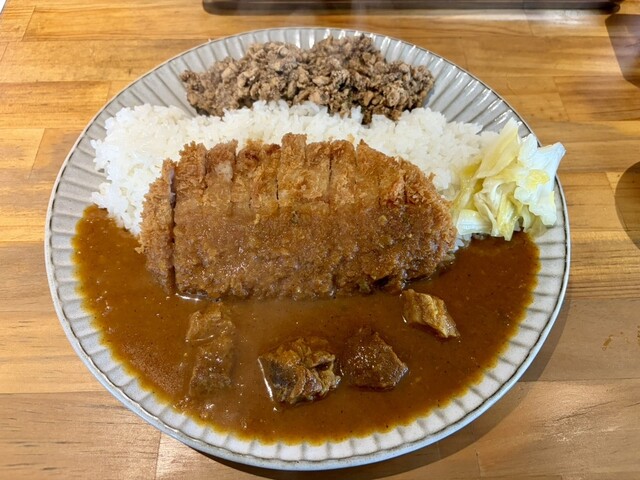
The approach to Higashikoraibashi is quieter than Osaka’s neon shorthand. Around Kitahama, the city turns to banks, bridges, offices, and older commercial buildings, a setting that suits curry better than spectacle. A third-floor address changes the tempo: less street-front display, more purposeful arrival. In this part of Osaka’s dining culture, curry is not a casual fallback but a specialist category with its own following, regional lists, and price discipline.
Kitahama Choji sits in that serious everyday tier. Its recognition on Tabelog Curry WEST “Tabelog 100” in 2020, 2023, and 2024 matters because western Japan’s curry field is crowded with small operators, lunch-counter specialists, and hybrid rooms that blur restaurant, bar, and neighbourhood canteen. Selection across multiple years signals consistency, not a single burst of attention. In Osaka, that is often the useful marker: the city rewards places that handle repeat custom, solo diners, and weekday demand without turning the room into a performance.
Osaka curry, measured by repeatability rather than ceremony
Japan’s curry culture is too broad for simple labels: school-lunch curry, kissaten curry, spice-curry shops, cutlet-heavy comfort plates, and chef-led variations that borrow from South Asian technique without copying it wholesale. Osaka has been especially receptive to spice curry, partly because its casual dining culture leaves room for specialists who do one category with conviction. The format rewards economy: a limited core offer, steady prep, low table-turnover friction, and little dependence on imported luxury ingredients.
That is where sustainability becomes practical rather than decorative. Small curry restaurants can keep waste down because the model favours repeatable production and a narrow lane. The environmental story is not a purity slogan; it is embedded in the business form. A compact room, counter seating, limited private-use expectations, and a sauce-led category create a dining rhythm with fewer excesses than menu-sprawling restaurants. In a city where many meals are built around speed and volume, focused curry can express restraint with unusual discipline.
The comparison set clarifies the point. Yokobori, Kashmir, and Ganesh m Kitahama ten all operate inside Osaka’s curry conversation at accessible spending levels, but each points to a different reader decision: spice intensity, neighbourhood convenience, or a room that can carry both lunch and evening use. Kitahama Choji belongs on the same map, yet its repeated Tabelog Curry WEST selections place it in a narrower editorial frame: not merely a nearby curry option, but part of the city’s recognized western-Japan curry circuit.
A small-room format that fits Kitahama's office-and-solo dining pattern
Kitahama is not Namba. Its appeal is subtler: riverside blocks, legal and financial offices, after-work drinking pockets, and a lunch economy that depends on precision. Restaurants here cannot rely only on passing tourists. They need to make sense for people who know the area, return often, and read value quickly. A curry room with counter seating fits that pattern: it allows solo dining without awkwardness, keeps service direct, and reduces ceremony that would feel misplaced here.
The listed capacity of 25 seats also shapes the experience. That is not tiny by Osaka specialist-restaurant standards, but compact enough that timing matters and large-group expectations should stay modest. Private rooms and private use are not part of the offer, reinforcing the point: this is a public, efficient, small-format restaurant, not a tailored-event venue. Children are welcome, and solo dining is explicitly part of the room’s natural use case, making it more flexible than many award-listed specialist counters.
Payment is another reminder that Japan’s smaller restaurants often remain more analogue than visitors expect. Cards, electronic money, and QR payments are not accepted, so the planning burden is simple: arrive prepared. That detail is not glamorous, but it is part of eating well in Osaka. Some of the city’s stronger casual meals happen in rooms where operational discipline matters more than digital convenience.
How to place it within an Osaka itinerary
For travellers building a food-led day, Kitahama works as a quieter counterpoint to Osaka’s louder eating districts. Curry here can anchor a daytime plan around the river and business quarter rather than another loop through Dotonbori. Readers mapping a broader city circuit should use Our full Osaka restaurants guide for dining context, then widen the itinerary with Our full Osaka hotels guide, Our full Osaka bars guide, Our full Osaka wineries guide, and Our full Osaka experiences guide.
The surrounding Osaka shortlist shows how varied the city’s casual and mid-market food culture can be. A bakery stop such as 52CHO-ME BAKERY or.cafe sits on a different register from curry, while 551 Horai (551蓬莱) represents Osaka’s mass-appeal comfort-food lane. For a more restaurant-led evening, 99 Pizza Napoletana Gourmet and a canto (Italian) show how imported formats are absorbed into the city’s pragmatic dining culture rather than treated as costume.
Beyond Osaka, the category connections help readers track Japanese casual dining across cities. Curry specialists such as [Curry Senmon Ten] Maruyama Kyoju. in Sapporo show how regional curry scenes differ, while [ki:] in Kyoto.know in Kumamoto, (Shoku) Vietnam in Kawasaki. 鮪と炭火焼き うお炭 秋葉原店 in Tokyo, and -Grilled beef Sukiyaki- KAMAKURA TANUKIAN 鎌倉 たぬき庵 in Kamakura underline Japan’s range of specialist formats. Overseas Japanese-leaning rooms such as Jōdo Saké Bar in Los Angeles and Onigiri Time in Pasadena sharpen the contrast: Osaka’s curry culture is less about export polish than daily utility, narrow focus, and sustained local approval.
The editorial case for Kitahama Choji is clear: it belongs to a recognized Osaka curry circuit without behaving like a luxury trophy meal. Its strength is the alignment between category and context. Curry, counter seating, modest scale, repeat recognition, and a business-district location all point in the same direction. For travellers who judge a city by its specialist everyday rooms, that combination carries more weight than decorative ambition.
At-a-Glance Comparison
Nearby venues at a similar price tier for orientation.
| Venue | Cuisine | Price | Notes |
|---|---|---|---|
| Kitahama ChojiThis venue — the venue you are viewing | Donburi-style Japanese curry | $$ | Not listed |
| Ramen Chonmage Osaka Tenroku | Japanese Ramen | $$ | Tenjinbashi |
| Yuni yumo | Modern Japanese Izakaya Counter | $$ | Kita |
| Mannen Curry | Japanese Curry | $$ | Chūō |
| Sangourmand | A5 Wagyu Hamburger Steak & Omurice Yoshoku | $$ | Kita |
| Yakiniku fujimoto Umeda ohatsu tenjin ten | Yakiniku (Japanese BBQ) | $$ | Kita |
Recognition history
Dated appearances from independent guides and award organizations, with the underlying list record or original source where available.
Tabelog 100 #14 · No. 14
Tabelog · Tabelog 100 - Curry - WEST - 2024
Continue exploring
More in Osaka
Restaurants in Osaka
Browse all →




Bars in Osaka
Browse all →

Hotels in Osaka
Browse all →




Wineries in Osaka
Browse all →
At a Glance
- Solo
- After Work
- Casual Hangout
- Standalone
Current opening hours
- Monday
- 11:30 AM–3 PM
- Tuesday
- 11:30 AM–3 PM
- Wednesday
- 11:30 AM–3 PM, 6–9 PM
- Thursday
- 11:30 AM–3 PM, 6–9 PM
- Friday
- 11:30 AM–3 PM, 6–9 PM
- Saturday
- 11:30 AM–3 PM
- Sunday
- Closed
Hours can change for holidays and private events. Last verified .