Huangjia Eel Noodles is a Tainan institution built around one of southern Taiwan's most culturally rooted dishes: braised eel over rice noodles, a preparation that traces its origins to the city's centuries-old canal trade and wet-market cooking traditions. In a city where street-food credibility is measured in generations, not guidebook stars, this is a name that locals cite without hesitation.

Pearl is the En Primeur Club membership app — saves, bookings, and concierge access live there. Same editors, same standards.
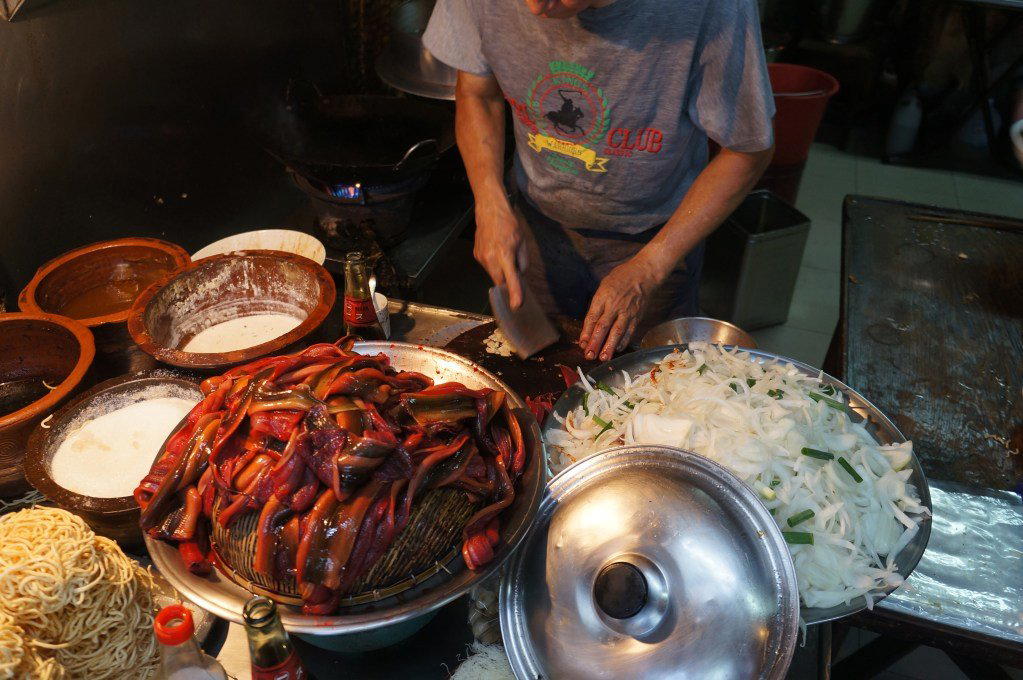
Where Tainan's Eel Noodle Tradition Takes Shape
Tainan's food identity was not built in restaurant dining rooms. It was built in lanes, morning markets, and stalls that have been running the same preparation across three or four family generations. The city's eel noodle tradition belongs to that lineage: a dish rooted in the tidal flats and aquaculture ponds of the Tainan coast, where freshwater eel was once abundant and braising over charcoal was the practical cooking method of the working waterfront. That context matters when you sit down at Huangjia Eel Noodles, because what arrives in the bowl is not a reinvention or a heritage-brand approximation. It is the continuation of a cooking logic that predates modern restaurant culture in this city.
Eel noodles occupy a specific tier in Tainan's small-eats hierarchy. They are not the city's most exported dish internationally, but among residents, a preferred eel noodle stall carries the same kind of quiet authority that a preferred beef soup stall does. A Cun Beef Soup (Baoan Road) represents one version of that authority, built on the city's morning beef-soup ritual. Huangjia occupies an analogous position in the eel noodle category: a name that circulates through local recommendation rather than tourism infrastructure.
The Dish and Its Cultural Architecture
The preparation at the center of this category follows a consistent structural logic: eel portions braised to the point where the flesh pulls cleanly from the bone, finished in a thick, slightly sweet sauce made with soy, sugar, and aromatics that vary by stall, then served over mi-tai-mu (rice vermicelli) or rice noodles with a scattering of fried shallots and sometimes a pour of garlic oil. The fried shallot element is not decorative. It acts as a textural and aromatic counterpoint to the dense, yielding eel, and its presence or absence, its freshness, is one of the small signals that separates stalls operating at full attention from those that have drifted on autopilot.
This is not a dish that broadcasts complexity. The cultural intelligence in it is compressed and quiet: the ratio of sweet to savory in the braising liquid, the degree of caramelization, whether the eel retains any resistance or collapses entirely. Tainan diners have strong opinions on these gradations, and the stalls that endure do so because they have locked in a specific interpretation and held it consistently. That consistency, accumulated over years, is the trust signal in this category, not awards or chef credentials.
For context on how Tainan's small-eats scene operates as a whole, dishes like this sit alongside preparations found at places such as A Hai Taiwanese Oden, A Ming Zhu Xing (Baoan Road), and A Hsing Congee, each anchored to a single preparation or a tightly defined category, each drawing its reputation from repetition and community memory rather than formal recognition.
Tainan's Street-Food Credibility Framework
Understanding why Huangjia Eel Noodles carries weight requires understanding how Tainan assesses food credibility. The city runs on a parallel evaluation system that operates almost independently from Michelin, 50 Best, or national food media. Longevity, neighborhood loyalty, and the willingness to queue are the primary metrics. A stall that has occupied the same corner for decades, with regulars who will cross the city on a weekday morning to eat there, has passed a test that no award panel replicates.
This is why Tainan's food scene resists the kind of tourist-legible hierarchy that cities like Taipei have developed. In Taipei, you can follow a Michelin Bib Gourmand list and receive a reasonably accurate map of the better casual eating. In Tainan, that list captures only a fraction of the relevant stalls, and the ones that local networks consistently recommend often have no formal recognition at all.
Taiwan's broader fine-dining tier, represented by venues like JL Studio in Taichung and logy in Taipei, draws on the ingredient culture and culinary vocabulary that places like Huangjia have sustained at the street level. The Taiwanese seafood and freshwater-fish traditions that appear in refined form in those tasting menus trace their origin to exactly the kind of coastal, market-adjacent cooking that eel noodle stalls represent. The connection is direct, even if the price points and formats sit at opposite poles.
How to Approach a Visit
Tainan's small-eats stalls operate on rhythms that do not always align with conventional meal times. Many of particularly established ones run from mid-morning through early afternoon and close once the day's supply is finished, which in a well-run eel stall can happen before 2pm. Arriving before noon on a weekday gives you a stronger chance of eating at your own pace; weekend mornings see higher volume from Tainan residents treating the meal as a weekly routine rather than a special occasion.
Tainan hoteliers and guesthouse owners are, as a rule, more reliably informed about stall-level food than any app-based aggregator. If you are staying in the city's older districts near the Anping or Chikan areas, the density of small-eats options means that a half-day of exploratory eating is a reasonable planning frame. The Gui Tian Hotel Capitalists Japanese Garden Restaurant occupies a different tier in Tainan's eating spectrum, offering a reference point for how the city handles both ends of the formality range.
Pricing in this category runs at the lower end of Tainan's already affordable street-food register. A bowl with a drink costs about US$5. That low barrier is not a signal of low stakes. It reflects the economic model of stall cooking, where volume and repetition sustain the business and quality is maintained through discipline rather than margin.
Booking and Cost Snapshot
Comparable venues nearby, for context on price, style, and recognition.
| Venue | Cuisine | Price | Awards | Notes |
|---|---|---|---|---|
| Huangjia Eel NoodlesThis venue — the venue you are viewing | Not listed | $$ | Not listed | Not listed |
| 阿裕牛肉涮涮鍋 | 仁德區, 台南溫體牛肉涮涮鍋 | $$ | Not listed | Not listed |
| 國華街肉燥飯 | 中西區, Traditional Tainan Minced Pork Rice | $ | Not listed | Not listed |
| Gyu Go Zou | Anping District, Taiwanese Beef Hot Pot | $$ | Michelin Plate | Not listed |
| å³çæ串çå± é å±-å°ååº | Not listed | $ | Not listed | West Central District, Taiwanese Hand-Skewered BBQ |
| Chuan Chia Congee | Not listed | $$ | Michelin Plate | Anping District, Taiwanese Milkfish Congee |

At a Glance
- Classic
- Well Known
- Casual Hangout
- Standalone
Casual, small, and rooted in traditional Tainan street-food culture.