House of Nanking
House of Nanking at 919 Kearny Street has been a Chinatown fixture for decades, operating on its own terms in a city full of polished dining rooms. The format is deliberately unconventional: servers steer, menus yield, and the pacing belongs to the kitchen. It sits at a notable remove from San Francisco's high-tasting-menu tier, occupying a category shaped more by ritual than by refinement.
Pearl is the En Primeur Club membership app — saves, bookings, and concierge access live there. Same editors, same standards.
- Address
- 919 Kearny St, San Francisco, CA 94133
- Phone
- +1 415 421 1429
- Website
- houseofnankingsf.com
- Directions
- Get directions
 Saves & bookings on Pearl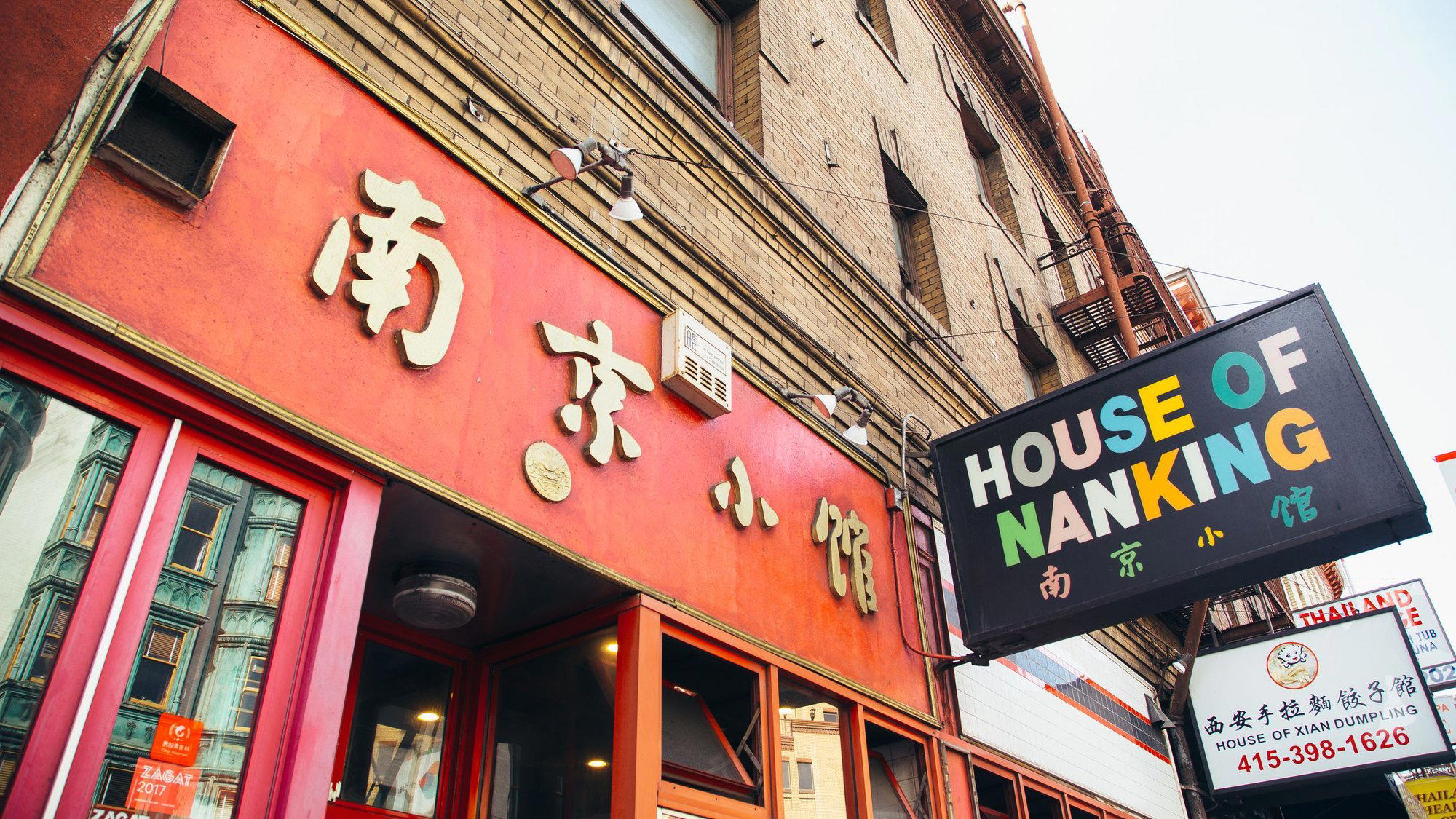
The Street, the Door, the Queue
Kearny Street runs along the edge where Chinatown meets the Financial District, and House of Nanking at 919 Kearny sits precisely at that seam. The exterior is spare, the signage modest, and the line outside on a weekend evening communicates more about the restaurant's reputation than any award citation could. San Francisco's Chinatown is one of the oldest in North America, and the dining culture that developed here over more than a century tends to reward regulars and resist the conventions of the mainstream restaurant industry. House of Nanking operates squarely inside that tradition.
Inside, the room is narrow and dense. Tables are close, turnover is intentional, and the atmosphere is defined by noise, speed, and the kind of purposeful chaos that only functions because the kitchen is running a tightly rehearsed system. This is not the register of restaurants like Benu, where French-Chinese technique unfolds in measured silence, or Atelier Crenn, where the pacing is almost ceremonial. House of Nanking asks something different of its guests: that they relinquish control.
The Ritual of Being Directed
The defining custom here is the server-led order. Menus exist, but the expectation, established over years of repeat visits by regulars and absorbed quickly by first-timers who ask the right questions, is that the server will tell you what to order. This is not performative. It reflects a kitchen that cooks what it does well on a given day, in a volume-driven format where improvisation on the diner's part slows the whole system down.
Across American dining, the server-recommendation model has become fashionable in fine-dining rooms, where a sommelier or front-of-house lead steers guests toward seasonal dishes. At places like Lazy Bear or Saison, that curation is part of a choreographed experience built around a fixed tasting format. At House of Nanking, the direction is more vernacular and less ceremonious: the server reads the table, makes a call, and moves on. The ritual is efficient rather than theatrical, which makes it feel more honest.
This model mirrors practices common in older Chinese-American restaurant culture, where the kitchen's pace and the house's preferred dishes take precedence over the individual diner's ability to construct a bespoke meal from a long menu. It is a posture that many newer restaurants in the city have moved away from, and its persistence at the restaurant gives the place a kind of institutional stubbornness that its regulars find reassuring.
Where It Sits in San Francisco's Chinese Dining Spectrum
San Francisco's Chinese restaurant scene spans a wide range, from dim sum halls in the Richmond that do high-volume weekend service to Chinatown banquet rooms still operating on Cantonese traditions that predate the post-war immigration waves. The restaurant sits closer to the neighbourhood institution end of that range, drawing from a repertoire that blends Shanghainese-leaning technique with the pragmatic adaptations that Chinese-American cooking developed in California over generations.
That places it in a different category from the tasting-menu circuit at Quince or the progressive American format at Lazy Bear, and equally distinct from the Michelin-calibrated Chinese-French synthesis at Benu. The comparison set for the restaurant is not drawn from San Francisco's $$$$ tier but from a category of long-running neighbourhood restaurants with devoted local followings and a format that has survived because it functions, not because it has been refined into something new.
For context on how other American cities have treated long-standing institution-tier restaurants alongside their fine-dining scenes, it is worth noting the model at work in places like Emeril's in New Orleans or the way Smyth in Chicago operates in relation to its neighbourhood's longer culinary history. In San Francisco, that institutional layer is substantial, and the restaurant has been part of it for long enough that its reputation is self-sustaining.
Planning the Visit
The restaurant is at 919 Kearny Street, accessible on foot from the Financial District and a short walk from several Muni lines. The standard approach is to arrive and join the queue, particularly on evenings and weekends when the line forms early. Arriving before the dinner rush, or at an off-peak hour on a weekday, substantially reduces wait time. The room turns tables at pace, so the wait, when there is one, rarely extends beyond what most regulars consider acceptable for the payoff.
For a broader San Francisco restaurant itinerary, the city's dining spans Chinatown institutions and Michelin-decorated rooms. The restaurant operates on its own terms within that ecosystem, and understanding where it sits helps set expectations correctly before arrival.
The Broader Scene It Belongs To
Across the country, the tension between neighborhood restaurants and the fine-dining circuit has produced different outcomes in different cities. In New York, some long-running restaurants in neighbourhoods like Chinatown have faded as real estate pressure mounted; others have been absorbed into a nostalgic dining tourism circuit that changes their character. In San Francisco, Chinatown's relative geographic stability has allowed places like House of Nanking to maintain their original operating logic for longer than comparable venues in other cities.
That context matters because it explains why the restaurant is not simply a cheaper alternative to restaurants like The French Laundry in Napa or Single Thread Farm in Healdsburg. It belongs to a separate tradition entirely, one where the meal's value is measured by a different set of criteria: the efficiency of the kitchen, the authority of the server, the density of flavour in dishes that have been made the same way across hundreds of service shifts.
For readers who have built their sense of American dining through venues like Providence in Los Angeles, Blue Hill at Stone Barns in Tarrytown, Addison in San Diego, The Inn at Little Washington, Le Bernardin in New York City, Atomix in New York City, Frasca Food & Wine in Boulder, or Atelier Moessmer Norbert Niederkofler in Brunico, the restaurant operates in a register that is genuinely different. The dining ritual it offers is simply structured around a different set of priorities, ones that have more to do with institutional knowledge, community function, and the authority of the house than with the guest's sovereignty over the meal.
Comparable Spots, Quickly
Comparable venues nearby, for context on price, style, and recognition.
| Venue | Cuisine | Price | Notes |
|---|---|---|---|
| House of NankingThis venue — the venue you are viewing | Shanghainese Home Cooking | $$ | Not listed |
| SO | Cantonese Seafood and Dim Sum | Not listed | South San Francisco |
| Hải Ký Mì Gia | Traditional Teochew Noodles | $$ | Tenderloin |
| Taishan Cuisine | Authentic Taishanese Cantonese | $$ | Chinatown |
| Hang Ah Tea Room | Cantonese Dim Sum | $ | Chinatown |
| Village Tea House | Chinese Dumplings & Dim Sum | $$ | SoMa |
Continue exploring
More in San Francisco
Restaurants in San Francisco
Browse all →
Bars in San Francisco
Browse all →
Hotels in San Francisco
Browse all →
At a Glance
- Well Known
- Lively
- Cozy
- Casual Hangout
- Late Night
- Open Kitchen
- Street Scene
Current opening hours
- Monday
- 11 AM–9 PM
- Tuesday
- 11 AM–9 PM
- Wednesday
- 11 AM–9 PM
- Thursday
- 11 AM–9 PM
- Friday
- 11 AM–9 PM
- Saturday
- 12–9 PM
- Sunday
- 12–9 PM
Hours can change for holidays and private events. Last verified .
Characterful and atmospheric with diner-style seating, bustling old-school Chinese vibe amid stacked supplies and quick service.