
Tabelog 100 #33
Our verdict
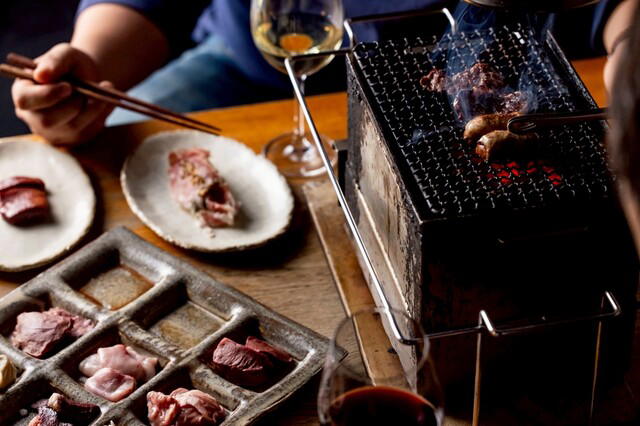
Ebisunishi’s grill culture rewards precision over spectacle, and Horumon Yaki Rukuma Tokyo sits in that serious, offal-focused lane. The draw is horumon and yakiniku in a basement room with counter seating, a drinks list that includes sake, shochu, wine and cocktails, and repeat Tabelog 100 recognition for Tokyo yakiniku.

Pearl is the En Primeur Club membership app, where members save venues, book tables and use the concierge.
The menu
What to order
- Fresh pork horumon grilled over Kishu Binchotan
- Offal sashimi and omakase horumon course
- Motsu nikomi (offal stew)
- Brains meunière (pork brains)
- Horumon ramen made with motsu-nikomi broth
- Pork offal curry
The approach to Tokyo grill dining has its own city grammar: the shift from pavement noise to grill heat, the management of smoke, and a meal built around meat cooked piece by piece. In that setting, horumon is not a side category. It is a test of sourcing, cleaning, cut, timing and confidence at the grill, and it asks more of a kitchen than standard marbled-beef service.
Tokyo yakiniku often splits into two lanes. One is the polished route, where the evening is organized around familiar cuts and a more luxury-minded idea of beef. The other is the more technical offal route, where texture matters as much as richness and a missed few seconds on the grill can change the point of the dish. Horumon Yaki Rukuma Tokyo belongs to the second camp, with tripe, yakiniku and grilled tripe defining its category rather than acting as supporting material.
Offal-led yakiniku in a city that knows its grill rooms
Horumon has always carried a sharper edge than standard yakiniku. It rewards diners who are comfortable with chew, char, fat and mineral depth, and it gives a restaurant less room to hide behind marbling. That is why recognition in this lane matters. Selection for Tabelog Hyakumeiten in 2025 places the restaurant within a competitive Tokyo field where small differences in preparation, pacing and grill control carry weight. The listing’s 3.70 score and dinner budget of JPY 10,000 - JPY 14,999 frame it as a serious specialist rather than a casual add-on stop.
The appeal supports that style. The experience sits closer to a specialist grill house than a broad, unfocused barbecue outing. Grill-side dining has a different energy in Tokyo yakiniku: it shortens the distance between cooking and eating, and makes the meal feel more tactical. Group meals can work around the same logic, but the best version of the experience is one where temperature, timing and sequence remain part of the pleasure.
The category also tells a useful story. Tripe, yakiniku and grilled tripe keep the meal grounded in Japanese grill-room habits, while the restaurant’s Tokyo recognition points to the way contemporary specialist venues now serve diners who want more than beer-and-beef simplicity. That focus matters with offal. Horumon can move between fat, char and saline intensity, and a restaurant that treats the category seriously gives it more range.
Tokyo suits the format: discreet, dense and built for focused grill dining
Tokyo can support serious dining without requiring a single formal register or a single late-night mood. A focused grill room here can feel discreet without becoming theatrical, and it can attract diners who know the difference between beef-led yakiniku and a horumon-focused kitchen. The city’s density also suits this kind of specialist restaurant, where the point is not spectacle but confidence in a narrow lane.
Within the immediate comparison set, the positioning is clear. Okonomiyaki Imari Ebisu, Tempura Motoyoshi, Le Coq, Sel Sal Sale and 天ぷら 元吉 all sit elsewhere in the broader Tokyo dining conversation. Horumon Yaki Rukuma Tokyo’s logic is more specific: horumon-led yakiniku, with the meal shaped by heat, texture and grill management rather than by a broader survey of the city’s dining styles.
That is the point of the experience. The atmosphere is not quiet luxury, and it is not a chef-biography restaurant. It is for diners who read smoke, heat and texture as part of the meal. The strongest case for going is not novelty; Tokyo has many grill rooms. The case is specificity: offal and grilled tripe in a recognized yakiniku field, with a setting that keeps the meal close to the grill rather than turning it into ceremony.
For broader Tokyo dining context, compare the city’s casual and specialist range through other Tokyo dining rooms across unnamed formats and styles. The wider city files are useful too: Our full Tokyo restaurants guide, Our full Tokyo hotels guide, Our full Tokyo bars guide, Our full Tokyo wineries guide and Our full Tokyo experiences guide. For a wider Japan and overseas Japanese-food lens, consider the way specialist grill, cafe, sake-bar and casual Japanese formats travel across different cities without confusing them with Horumon Yaki Rukuma Tokyo’s more focused Tokyo horumon identity.
Frequently asked questions
What is the atmosphere like at Horumon Yaki Rukuma Tokyo?
The atmosphere is best understood as a focused Tokyo grill-room setting, built around heat, timing and close attention to horumon rather than a broad, unfocused grill-house experience.
How much does it cost to eat at Horumon Yaki Rukuma Tokyo?
Pricing at Horumon Yaki Rukuma Tokyo is listed as JPY 10,000 - JPY 14,999 for dinner.
What are the opening hours for Horumon Yaki Rukuma Tokyo?
Opening hours are not provided in the verified venue facts. Check directly with Horumon Yaki Rukuma Tokyo before planning a visit.
What's the address for Horumon Yaki Rukuma Tokyo?
Tokyo.
What do critics highlight about Horumon Yaki Rukuma Tokyo?
Critics point to its 2025 Tabelog Hyakumeiten recognition, a Tabelog score of 3.70 and a dinner price band of JPY 10,000 - JPY 14,999. Tabelog’s own listing also emphasizes tripe, yakiniku and grilled tripe.
The Minimal Set
Comparable venues to anchor price and recognition.
| Venue | Cuisine | Price | Awards | Notes |
|---|---|---|---|---|
| Horumon Yaki Rukuma TokyoThis venue (the venue you are viewing) | Horumon-yaki (Japanese offal yakiniku) | $50–100 | Tabelog 100 #33 | Not listed |
| Okonomiyaki Imari Ebisu | Okonomiyaki & Teppanyaki Izakaya | $30–50 | Tabelog 100 #18 | JPY 4,000 - JPY 4,999 |
| Tempura Motoyoshi | Michelin-Starred Tempura Omakase | $150–200 | 2 Michelin Stars · Tabelog 100 #48 | Tempura |
| Le Coq | Yakitori Izakaya | Not listed | Tabelog 100 #47 | French |
| Sel Sal Sale | Modern Italian with Japanese Influences | $100–150 | Tabelog 100 #5 | Not listed |
Recognition history
Dated appearances from independent guides and award organizations, with the underlying list record or original source where available.
Tabelog 100 #33 · No. 33
Tabelog · Tabelog 100 - Yakiniku - TOKYO - 2025
Continue exploring
More in Tokyo
Restaurants in Tokyo
All restaurants in Tokyo →



Bars in Tokyo
All bars in Tokyo →








Details
- Lively
- Cozy
- Intimate
- After Work
- Group Dining
- Casual Hangout
- Business Dinner
- Late Night
- Standalone
- Private Dining
- Sake Program
- Beer Program
- Local Sourcing
- A La Carte
- Set Menu
- Sake
- Beer
- Shochu
Current opening hours
- Monday
- 5–11 PM
- Tuesday
- 5–11 PM
- Wednesday
- 5–11 PM
- Thursday
- 5–11 PM
- Friday
- 5–11 PM
- Saturday
- 5–11 PM
- Sunday
- Closed
Hours can change for holidays and private events. Hours as of .
A chic yet cozy basement horumon-yaki with monochrome, calm interiors, counter and small tables, creating an adult, lively atmosphere suited to offal-focused yakiniku and drinks.