Hoa Túc (District 1)

Michelin Plate
Our verdict
A two-time Michelin Plate recipient in the heart of District 1, Hoa Túc occupies a converted opium factory on Hai Bà Trưng and channels that layered history into its approach to Vietnamese cooking. The setting, a colonial courtyard with ceiling fans and terracotta tones, draws both long-term Saigon residents and first-time visitors looking for Vietnamese cuisine that has grown beyond the tourist track. At ₫₫ pricing, it holds an accessible position among the city's recognised dining addresses.

Pearl is the En Primeur Club membership app, where members save venues, book tables and use the concierge.
The menu
What to order
- Pink pomelo salad with crabmeat and shrimps
- Bò lá lốt bánh hỏi
- Soft-shell crab
- Grilled honey pork ribs
A Colonial Frame for Vietnamese Cooking That Has Kept Pace
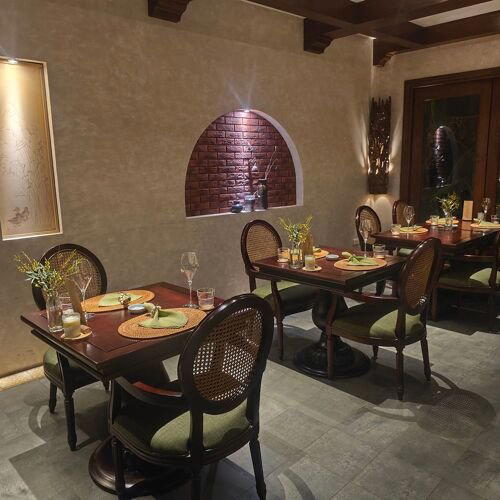
Hai Bà Trưng is not one of District 1's louder dining streets, but the address at 74/7 draws a steady crowd through a low gate that opens onto a courtyard garden. The building was originally an opium processing facility during the French colonial period, and the bones of that structure, exposed brick, wide wooden beams, ceiling fans that turn slowly over the open dining room, have been retained rather than erased. In a city where new restaurants frequently strip colonial-era buildings back to raw concrete and call it design, that restraint registers as a considered choice.
The space itself has become part of how Hoa Túc positions its cooking. Vietnamese cuisine served inside a building that carries genuine historical weight carries different expectations than the same dishes in a glass-fronted shophouse. The kitchen has, over successive years, had to decide what kind of Vietnamese food belongs in that frame, and that decision is where the evolution of this address becomes interesting.
How the Kitchen Has Shifted Over Time
When Hoa Túc first opened its courtyard to Saigon diners, the broader city was still in the early phase of what would become a significant restaurant upgrade cycle. Vietnamese cuisine in the mid-range and above was largely divided between hotel dining rooms that skewed international, and street-level specialists that had no interest in shifting register. Hoa Túc occupied an early version of a middle lane: recognisable Vietnamese dishes, served in a setting with care and some formal organisation, at prices that reflected the venue rather than the dish alone.
That positioning has been tested and reworked in the years since. Ho Chi Minh City's dining scene has grown considerably more competitive, with venues like Cục Gạch Quán establishing a strong market for heritage-inflected Vietnamese dining, and street-food specialists like Bánh Xèo 46A proving that single-dish precision at low price points can draw serious critical attention. Against that backdrop, Hoa Túc has refined its offer rather than reinvented it wholesale. The menu today emphasises regional Vietnamese cooking with production quality that justifies the ₫₫ price tier, a category that, in District 1, now represents meaningful competition.
The Michelin Plate recognition in both 2024 and 2025 confirms that the kitchen has not drifted. A Michelin Plate does not carry the grade weight of a star, but two consecutive years of inclusion signals that inspectors found consistency worth noting. In the context of Ho Chi Minh City's Michelin cohort, which includes starred venues such as Anan Saigon at a similar price point and Akuna at the ₫₫₫₫ tier, a Plate holding at ₫₫ is a signal that the value proposition is functioning. The kitchen is cooking at a level that earns external validation without pricing out the audience it was built for.
The Vietnamese Cooking Context
Vietnamese cuisine in a city like Ho Chi Minh City tends to organise itself around regional specificity. Southern cooking, rooted in sweetness and freshness, differs materially from the leaner profiles of central Vietnamese dishes or the more restrained north. Restaurants that try to represent all three regions at once often produce a diluted version of each. The better addresses in the city tend to pick a lane, or move between lanes with enough discipline that the transitions feel intentional rather than indecisive.
Across Vietnam, the conversation around what Vietnamese fine dining means has been running in parallel in Hanoi and coastal cities. Gia in Hanoi and Tầm Vị in Hanoi represent the northern end of that conversation, while La Maison 1888 in Da Nang operates in a different register entirely, French colonial luxury applied to Vietnamese ingredients. Internationally, chefs at addresses like Berlu in Portland and Camille in Orlando are extending the same conversation into diaspora contexts. Hoa Túc's position in District 1 means it operates within the source culture of that broader movement, which raises the bar for what authenticity and evolution actually require.
Restaurants like Bếp Mẹ ỉn on Le Thanh Ton Street and Bếp Người Hội An represent a slightly different neighbourhood approach, with Hội An-inflected menus and a focus on Central Vietnamese specificity. Béo Ơi occupies its own corner of the mid-range market with a more casual format.
Planning a Visit
The address, 74/7 Hai Bà Trưng, Bến Nghé, District 1, sits in the commercial and administrative core of the city, within walking distance of most central hotels and easily reachable by grab or taxi from further out. The courtyard setting means that the experience shifts depending on weather; Ho Chi Minh City's dry season, roughly November through April, makes outdoor seating considerably more comfortable than the heavy heat and sudden rains of the wet season. Arriving earlier in the evening service generally means more options in the courtyard itself. The ₫₫ pricing places it below the starred tier but above the city's casual street-food category, expect a bill that reflects a considered meal rather than a quick stop.
For the broader picture of where Hoa Túc fits in the city's dining options, see our full Ho Chi Minh City restaurants guide. If you are building a wider itinerary, our Ho Chi Minh City hotels guide, bars guide, experiences guide, and wineries guide cover the city in full. For Vietnamese cuisine tracked outside the country, addresses like 1946 Cua Bac in Hanoi, A Bản Mountain Dew in Hanoi, and Agave in Ubon Ratchathani offer useful regional comparisons.
Frequently asked questions
What's the pricing like at Hoa Túc (District 1)?
Pricing at Hoa Túc (District 1) is listed as ₫₫.
Can I walk in to Hoa Túc (District 1)?
The address at 74/7 Hai Bà Trưng sits in the commercial core of District 1, making it accessible on foot from most central hotels. That convenience, combined with two consecutive Michelin Plate listings, means the courtyard fills reliably, particularly at peak dinner hours. A reservation ahead of your visit is the safer approach, especially on weekends.
Standing Among Peers
| Venue | Cuisine | Price | Awards | Notes |
|---|---|---|---|---|
| Hoa Túc (District 1)This venue (the venue you are viewing) | Modern Vietnamese | $30–50 | Michelin Plate | Not listed |
| Anan Saigon | Modern Vietnamese Street Food Fine Dining | $50–100 | 1 Michelin Star · World's 50 Best #86 | Vietnamese Street Food, ₫₫ |
| CieL | Modern Vietnamese Fusion Fine Dining | $100–150 | 1 Michelin Star · The Best Chef One Knife | Innovative, ₫₫₫₫ |
| Coco Dining | Progressive Vietnamese Fine Dining | $150–200 | 1 Michelin Star | Innovative, ₫₫₫ |
| Long Trieu | Michelin-Starred Cantonese | $50–100 | 1 Michelin Star · La Liste Top Restaurants | Cantonese, ₫₫₫₫ |
| Bánh Xèo 46A | Traditional Vietnamese Bánh Xèo | $10–20 | Michelin Bib Gourmand | Vietnamese, ₫ |
Recognition history
Dated appearances from independent guides and award organizations, with the underlying list record or original source where available.
Michelin Plate
Michelin
Full recognition history (3 entries)
Michelin Plate
Michelin
Michelin Plate
Michelin
Continue exploring
More in Ho Chi Minh City
Restaurants in Ho Chi Minh City
All restaurants in Ho Chi Minh City →
Bars in Ho Chi Minh City
All bars in Ho Chi Minh City →
Details
- Romantic
- Elegant
- Cozy
- Historic
- Intimate
- Date Night
- Special Occasion
- Group Dining
- Courtyard
- Historic Building
- Open Kitchen
- Craft Cocktails
- A La Carte
- Small Plates
- Craft Cocktails
- Vegetarian Friendly
- Vegan Options
- Gluten Free Options
Current opening hours
- Monday
- 11 AM–10 PM
- Tuesday
- 11 AM–10 PM
- Wednesday
- 11 AM–10 PM
- Thursday
- 11 AM–10 PM
- Friday
- 11 AM–10 PM
- Saturday
- 11 AM–10 PM
- Sunday
- 11 AM–10 PM
Hours can change for holidays and private events. Hours as of .
Warm and inviting colonial-style interior with al fresco courtyard seating evoking early 1900s Parisian vibe, blending modern and traditional decor.