H&H Brazilian Steakhouse
Our verdict
H&H Brazilian Steakhouse brings the churrascaria tradition to downtown Los Angeles at 518 W 7th St, placing the communal, meat-forward format of southern Brazil into one of the city's densest dining corridors. The rodízio model, where cuts circulate tableside until the guest signals otherwise, carries a social logic that sets it apart from the à la carte steakhouse format dominant across LA's premium dining scene.

Pearl is the En Primeur Club membership app, where members save venues, book tables and use the concierge.
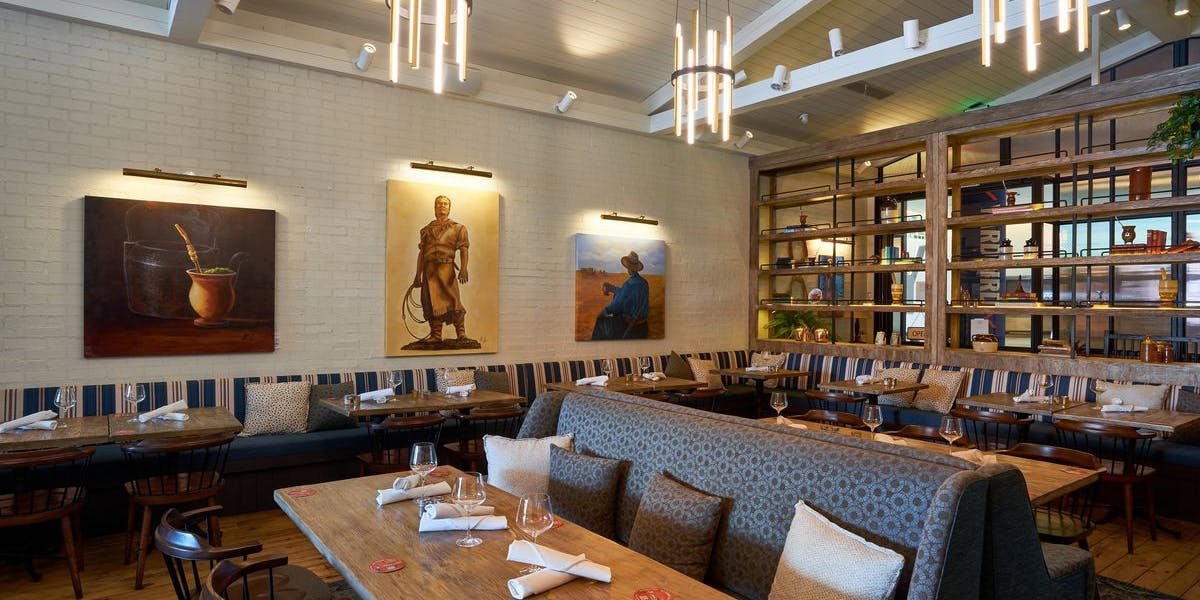
The Churrascaria Format and Where It Fits in Los Angeles
Downtown Los Angeles's restaurant corridor along 7th Street operates at the intersection of office-lunch culture and after-work dining, a stretch that draws a different crowd than the tasting-menu rooms of Mid-City or the chef-driven independents of Silver Lake. Within that context, the Brazilian steakhouse format occupies a specific and underserved niche. Most of LA's premium meat-focused dining follows the American steakhouse model: à la carte cuts, tableside preparation theater, and check averages that rival a Le Bernardin in New York City dinner without the same culinary ambition. The rodízio format, by contrast, operates on a different social contract entirely.
H&H; Brazilian Steakhouse at 518 W 7th St sits inside that alternative tradition. The churrascaria model it represents traces back to the gaucho cattle culture of Rio Grande do Sul in southern Brazil, where the practice of roasting large cuts over open fire and slicing directly onto the plate became both a ranching necessity and, eventually, a civic ritual. When the format migrated to urban Brazil and then to North America, it retained the communal logic: a fixed-price structure, continuous tableside service, and the guest's red-and-green card as the only throttle on pace and volume.
What the Rodízio Tradition Actually Means at the Table
Understanding the churrascaria experience requires separating it from the steakhouse category it superficially resembles. The two share an emphasis on beef, but the operational philosophy diverges sharply. A conventional American steakhouse, like the Gwen-style concept that places butchery craft at the center, asks the guest to select, sequence, and portion their own meal. The rodízio model inverts that dynamic: the kitchen sequences the cuts, the passadores (servers carrying the skewers) determine the rhythm, and the guest's role is receptive rather than directive.
That inversion changes the social texture of the meal. Groups eat at the same pace. Conversation doesn't pause for ordering decisions. The table's energy stays continuous rather than punctuated by menu consultation. Brazilian steakhouses that execute this well use the format's structure to generate a particular kind of ease that à la carte dining rarely achieves at comparable price points. The salad bar component, a fixture of the churrascaria tradition, adds a further layer: cold preparations, cured meats, and starches that function as counterweight to the protein-forward main service rather than as an afterthought.
In cities like São Paulo and Porto Alegre, the churrascaria operates as a default setting for celebrations, business lunches, and family gatherings simultaneously, a format flexible enough to carry different social occasions without requiring a change in venue or register. Los Angeles's Brazilian restaurant community has historically been smaller than New York's or Miami's, which makes each operating churrascaria a more significant data point about the format's durability in markets where it lacks the density to become generic.
Downtown LA's Dining Position in the City's Broader Map
The 7th Street address places H&H; in a part of downtown that has seen significant flux over the past decade. The neighborhood draws daytime foot traffic from financial and legal offices, and the proximity to the 7th Street/Metro Center station brings a lunch and early-dinner crowd that differs from the destination-dining audience that drives revenue at venues like Providence (Contemporary Seafood) in Mid-City or Somni (Molecular) in West Hollywood. That context shapes what a restaurant in this corridor needs to deliver: accessibility, volume capacity, and a format that works for groups with varying culinary familiarity.
The churrascaria is well-suited to that demand profile. It requires no prior knowledge of the menu to navigate successfully, it scales to large parties without the coordination problems that plague à la carte group dining, and the fixed-price structure eliminates the bill-splitting friction that often ends the evening on a sour note. For comparison, the tasting-menu formats that define LA's most-discussed dining rooms, places like Kato (New Taiwanese, Asian) or Hayato (Japanese), require a very different kind of commitment from their guests: advance booking weeks or months out, dietary coordination, and an appetite for sequential small portions rather than tableside abundance.
Neither format is superior in absolute terms. They answer different questions. The churrascaria answers the question of how to feed a large, mixed group with efficiency and generosity. The omakase or tasting-menu format answers a different question about depth of attention and singular culinary perspective. Across the US, the most ambitious dining rooms, from Alinea in Chicago to The French Laundry in Napa and Blue Hill at Stone Barns in Tarrytown, operate at the rarefied end of that spectrum. The Brazilian steakhouse format occupies a different but legitimate register: communal, generous, and rooted in a specific regional food culture.
The Brazilian Steakhouse Across American Cities
The churrascaria's expansion across American cities followed a relatively consistent pattern: Miami and New York established the format in the 1990s and early 2000s through both independent operators and the growth of chains like Fogo de Chão, which now operates across dozens of US markets. Cities with smaller Brazilian diaspora communities, including Los Angeles, supported fewer locations, which means individual operators carry more of the format's representation locally. Independent churrascarias in smaller markets tend to either differentiate on quality of sourcing and cut selection or compete on price against the national chains. The middle ground, adequate quality at chain prices, is a difficult position to hold.
For reference, venues like Addison in San Diego, Bacchanalia in Atlanta, and The Inn at Little Washington in Washington operate at the fine-dining apex of their respective markets, where the format itself (tasting menu, farm-to-table, classical French) carries significant prestige. The Brazilian steakhouse format operates at a different prestige register, but one with its own internal hierarchy: the quality of the picanha, the handling of the fraldinha, and the accuracy of the salt crust matter as much to a knowledgeable regular as the sourcing narrative matters to a fine-dining guest. Our full Los Angeles restaurants guide maps where the churrascaria format sits relative to the city's other meat-focused dining options.
Planning Your Visit
Address: 518 W 7th St, Los Angeles, CA 90014. Reservations: Booking policy not confirmed; walk-in availability likely given the format, but group visits of six or more should attempt advance contact. Getting there: The 7th Street/Metro Center station is directly adjacent, making this one of the more transit-accessible dining addresses in downtown LA. Dress: No dress code confirmed; the downtown weekday crowd defaults to business casual. Hours: Not confirmed; check directly before visiting.
Frequently asked questions
What do people recommend at H&H; Brazilian Steakhouse?
The churrascaria format means the kitchen, not the guest, drives the sequence of cuts, so the recommendation calculus differs from an à la carte steakhouse. In the Brazilian rodízio tradition, picanha (leading sirloin cap) is the reference cut that most regulars use to assess a churrascaria's quality, alongside the fraldinha (bottom sirloin flap) and costela (beef ribs). For comparison with the city's other meat-focused dining, venues like Osteria Mozza (Italian) and Lazy Bear in San Francisco illustrate how different culinary traditions handle protein-forward menus with their own internal logic.
Is H&H; Brazilian Steakhouse reservation-only?
Brazilian steakhouses in the US that operate a continuous rodízio service model generally accommodate walk-ins more readily than fixed-seating tasting-menu rooms, because the format's throughput is managed by service pace rather than strict seat-turn scheduling. Downtown LA's weekday lunch period is typically the most competitive window for walk-in availability at 7th Street addresses. For groups, advance contact is advisable regardless of format. Comparable planning considerations apply at other downtown LA dining addresses and are covered in our full Los Angeles restaurants guide.
How does H&H; Brazilian Steakhouse compare to other meat-focused dining in Los Angeles?
The rodízio format at H&H; places it in a different competitive tier than LA's premium steakhouses or chef-driven meat programs. Where venues operating à la carte ask guests to select individual cuts at individual prices, the churrascaria's fixed-price continuous service model shifts the value proposition toward volume, variety, and group suitability. Within Los Angeles's downtown dining corridor, this positions H&H; as one of the few operators representing the southern Brazilian gaucho tradition, a culinary heritage distinct from the American chophouse or the Japanese wagyu formats that dominate the city's high-end meat dining. For a broader view of how LA's restaurant scene maps across cuisines and price tiers, see our coverage at EP Club's Los Angeles guide, which includes entries from Atomix in New York City-tier tasting rooms down to neighbourhood-level specialists.
What It’s Closest To
Comparable venues nearby, for context on price, style, and recognition.
| Venue | Cuisine | Price | Awards | Notes |
|---|---|---|---|---|
| H&H Brazilian SteakhouseThis venue (the venue you are viewing) | Brazilian Churrasco Steakhouse | Not listed | Not listed | Not listed |
| Sonoritas - DTLA | Sonoran-Style Taqueria | $20–30 | Not listed | Downtown |
| Terracotta | Korean-Asian Fusion with Japanese Influences | $50–100 | Not listed | Wilshire Center |
| Lapaba | Korean-Italian Fusion Pasta Bar | $50–100 | Michelin Bib Gourmand | Wilshire Center |
| The Benjamin Hollywood | Classic American | Not listed | Not listed | Melrose |
| Lielle | California Bistronomy | $150–200 | 1 Michelin Star | South Robertson |
Continue exploring
More in Los Angeles
Restaurants in Los Angeles
All restaurants in Los Angeles →
Bars in Los Angeles
All bars in Los Angeles →
Hotels in Los Angeles
All hotels in Los Angeles →
Wineries in Los Angeles
All wineries in Los Angeles →

Details
- Lively
- Elegant
- Group Dining
- Celebration
- Open Kitchen
- Extensive Wine List
- Organic
- Local Sourcing
- A La Carte
- Buffet
- Halal
Current opening hours
- Monday
- 11:30 AM–10 PM
- Tuesday
- 11:30 AM–10 PM
- Wednesday
- 11:30 AM–10 PM
- Thursday
- 11:30 AM–10 PM
- Friday
- 11:30 AM–10 PM
- Saturday
- 11:30 AM–10 PM
- Sunday
- 11:30 AM–9:30 PM
Hours can change for holidays and private events. Hours as of .
Elegant steakhouse atmosphere with moderate noise levels and premium dining ambiance.