Hammerhead's Seafood Kitchen & Market occupies a corner of Ottawa Street North in Hamilton's east end, operating as both a retail seafood market and a working kitchen. The dual format places it in a distinct tier among Hamilton's dining options: somewhere between a fishmonger and a neighbourhood restaurant, where the supply chain and the plate share the same address.
Pearl is the En Primeur Club membership app — saves, bookings, and concierge access live there. Same editors, same standards.
- Address
- 74 Ottawa St N, Hamilton, ON L8H 3Z1, Canada
- Phone
- +19059239293
- Website
- eathammerheads.ca
- Directions
- Get directions
 Saves & bookings on Pearl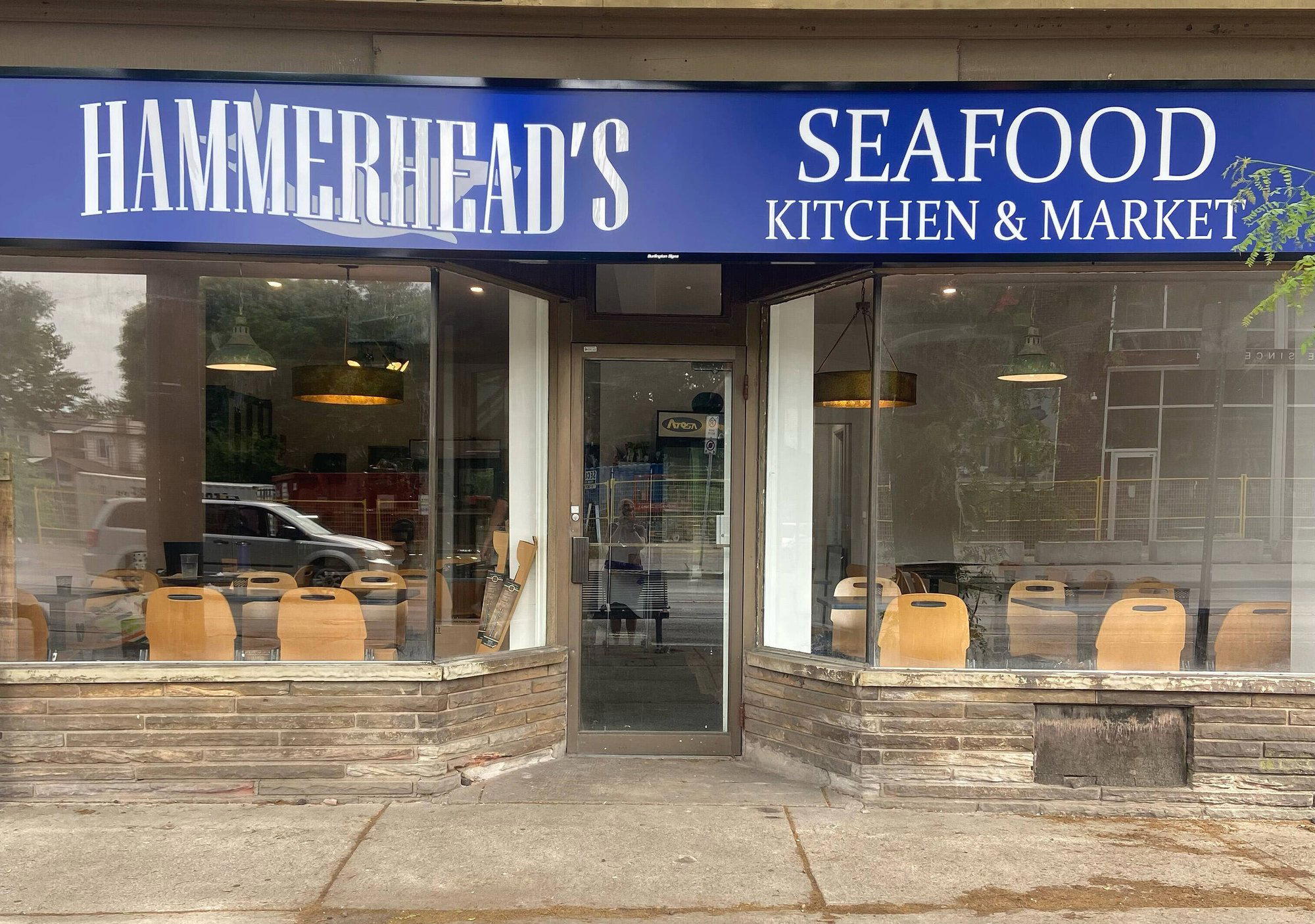
Ottawa Street and the Market Kitchen Format
Ottawa Street North has spent the better part of a decade repositioning itself as Hamilton's most eclectic commercial strip, drawing independent food operators who couldn't afford King Street rents and didn't want the foot traffic that came with them. The street runs through the city's east end with a mix of vintage dealers, fabric shops, and food businesses that have accumulated rather than been planned. Hammerhead's Seafood Kitchen & Market at 74 Ottawa St N is a gluten-free seafood kitchen and market in Hamilton, Ontario, with a casual, walk-in-friendly setup and a price point around $20 per person.
The market-kitchen format has a longer history in coastal cities than in landlocked Ontario, where fresh seafood retail has traditionally meant a supermarket fish counter or a specialty grocer in a higher-income suburb. When the format appears in a mid-sized inland city, it signals something specific about the operator's sourcing relationships: you cannot run a working retail seafood counter without direct supplier access, because the economics of waste don't allow for the markups that cover spoilage at lower volumes. That Hammerhead's operates both sides of the business at this address is, in itself, a logistical credential.
Seafood Culture in an Inland City
Hamilton's relationship with seafood has always been mediated by geography. Sitting at the western end of Lake Ontario, the city has freshwater fishing heritage, but saltwater seafood arrived via Toronto's wholesale networks, which meant that quality and freshness were functions of distribution rather than proximity. The rise of direct cold-chain logistics over the past fifteen years changed that calculus for independent operators across Ontario, making it possible for a kitchen in Hamilton to receive product that competes with what arrives at Toronto restaurant docks on the same morning.
This context matters when placing Hammerhead's within Hamilton's dining scene. The city's restaurant development through the 2010s skewed heavily toward contemporary small plates, craft beer, and globally-inflected comfort food, categories that suited the demographic moving into the lower city's revitalised neighbourhoods. Seafood-focused restaurants, particularly those anchored by a retail component, sat outside that trend. Venues like Berkeley North and Bardo Locke built their identities around contemporary plating and curated drink programs, while Bermuda Bistro and B-Side Social leaned into neighbourhood accessibility. A seafood kitchen with a market counter occupies different territory from all of them.
The Dual-Format Proposition
The market-plus-kitchen structure creates a dynamic that single-format restaurants don't encounter: the retail side functions as live quality signalling. When a customer buys raw product at the counter and takes it home, they are implicitly benchmarking what the kitchen serves against what they could cook themselves. That relationship demands consistency across both channels, which is a harder operational standard than a restaurant that controls presentation entirely on its own terms.
Across North America, the venues that have made this format work most durably tend to cluster around a few common features: transparent sourcing language, a menu that shifts with supply rather than against it, and a physical layout that makes the market and kitchen feel integrated rather than compartmentalised. The approach places Hammerhead's in a reference set that stretches well beyond Hamilton, toward operators who take the fishmonger tradition as seriously as the cooking tradition. For Canadian context on what serious seafood sourcing looks like at the fine dining end of the spectrum, Tanière³ in Quebec City and Narval in Rimouski represent how rigorously the country's better kitchens now treat provenance. Internationally, Le Bernardin in New York City remains the benchmark for what technical precision applied to seafood looks like at its most formal; Hammerhead's operates in a register that is several tiers more casual, but the underlying question about sourcing integrity is the same regardless of format.
Hamilton's Dining Spread and Where Seafood Fits
Hamilton's dining options have diversified considerably since the city's cultural-moment coverage peaked around 2015 to 2018. The restaurant base now includes enough range that a visitor or local with a specific craving, whether for Greek fusion at Apllada or contemporary Canadian cooking, can find a considered option rather than settling for the closest available.
Within that spread, seafood as a dedicated category remains underrepresented relative to what a city of Hamilton's size typically supports. This is partly the geography problem already described, and partly a demand-side question: the demographic that has driven Hamilton's restaurant growth over the past decade skews toward value-at-scale rather than premium ingredient categories. A seafood kitchen and market occupies a slightly different economic register than most of the city's celebrated openings. That is not a criticism; it describes the specific gap that this kind of operator fills. For comparison, Ontario's wine country has produced kitchen-farm hybrid operations like Restaurant Pearl Morissette in Lincoln and rural operators like Eigensinn Farm in Singhampton that similarly blur the line between production and service, though in agricultural rather than aquatic contexts. The structural logic across these formats is similar even when the product category differs.
Getting There and Planning Your Visit
Ottawa Street North is accessible by Hamilton Street Railway bus service, and street parking along the corridor is generally available outside of peak weekend afternoon hours when the strip draws browsers as well as destination diners. The east end location puts the venue away from the King Street and James Street North clusters that attract most out-of-town visitors, which tends to mean the crowd skews more local. Those coming from Burlington might cross-reference Barra Fion in Burlington as a nearby alternative, while visitors from further afield comparing southern Ontario options could look at The Pine in Creemore for a different register of ingredient-led cooking in the region.
The market component means the operation may follow different rhythms than a direct restaurant, with supply-dependent availability affecting both retail stock and kitchen menus.
Cost Snapshot
Comparable venues nearby, for context on price, style, and recognition.
| Venue | Cuisine | Price | Notes |
|---|---|---|---|
| Hammerhead's Seafood Kitchen & MarketThis venue — the venue you are viewing | Crown Point, Gluten-Free Seafood Kitchen | $$ | Not listed |
| HAMBRGR Crown Point | Crown Point, Gastropub Burgers | $$ | Not listed |
| Piano Piano Hamilton | Not listed | $$ | King Street East, Polished Italian - Pizza & Pasta |
| East Side Mario's | Not listed | $$ | Upper James St, Italian-American Pasta & Pizza |
| HAMBRGR King William | Not listed | $$ | Downtown Hamilton, Gourmet American Burgers |
| The Harbour Diner | Not listed | $$ | James Street North, American Comfort Diner |
Continue exploring
More in Hamilton
Restaurants in Hamilton
Browse all →

Bars in Hamilton
Browse all →

Hotels in Hamilton
Browse all →


At a Glance
- Casual
- Cozy
- Casual Hangout
- Family
- Open Kitchen
Current opening hours
- Monday
- Closed
- Tuesday
- 12–8 PM
- Wednesday
- 12–8 PM
- Thursday
- 12–8 PM
- Friday
- 12–8 PM
- Saturday
- 12–8 PM
- Sunday
- Closed
Hours can change for holidays and private events. Last verified .
Casual takeout spot with limited indoor seating, energetic atmosphere, and outdoor tables for nice weather.