Granit - La Mécanique des Frères Bonano

Granit - La Mécanique des Frères Bonano holds a Michelin star (retained through 2024 and 2025) and operates from a rural address in Colombières-sur-Orb, deep in the Hérault. The cooking engages closely with the surrounding Languedoc terrain, placing it in a cohort of destination restaurants where the journey itself is part of the proposition. A Google score of 4.8 from 680 reviews suggests consistent execution across a substantial number of sittings.
 Discover on Pearl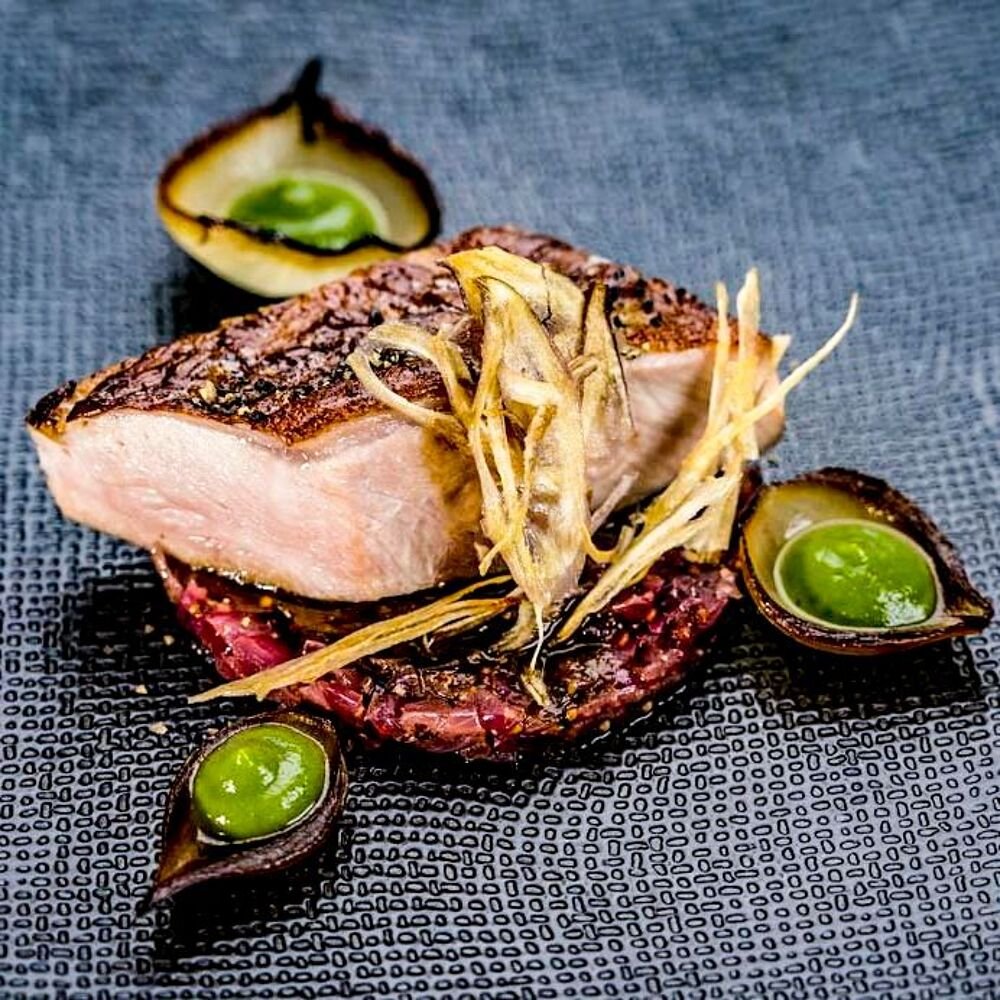
A Destination in the Hérault Garrigue
The road into Colombières-sur-Orb does not prepare you for a Michelin-starred kitchen. The Hérault interior is scrubland country: limestone ridges, wild herbs baking in summer heat, river valleys cutting through stone. Lieu-dit La Mécanique Sainte-Colombe sits within this landscape not as an anomaly but as a direct expression of it. That tension — between rural remove and serious culinary ambition — is the defining characteristic of what the Bonano brothers have built here, and it places Granit in a specific, deliberately small category of French fine dining where distance is a filter rather than a barrier.
France has a tradition of restaurants that demand the journey. Bras in Laguiole set the template for terroir-anchored destination cooking in the Aubrac. Auberge du Vieux Puits in Fontjoncouse operates from a village of fewer than a hundred souls in the Corbières. Flocons de Sel in Megève ties its identity to Alpine altitude and the ingredients altitude makes possible. Granit belongs to this lineage: the star is not evidence of a city restaurant transplanted to the countryside, but of cooking that could only make sense in this particular place.
What the Terroir Puts on the Table
The Languedoc-Roussillon is among France's most biodiverse food regions, a fact that urban dining guides underreport. The garrigue , the scrubland ecosystem of thyme, rosemary, juniper, and cistus , runs directly up to the kitchen's supply chain. The Orb valley produces stone fruit, olives, and wine grapes at elevations that introduce genuine diurnal temperature variation, giving produce a concentration that flatland equivalents rarely match. The Hérault's rivers and the Mediterranean coast, reachable within an hour, feed a seafood economy that connects mountain cooking to maritime ingredients without strain.
Granit's category of Modern Cuisine, at the €€€€ price point, signals a kitchen that treats this material seriously rather than rustically. Modern Cuisine in the French Michelin context means technique applied to regional ingredients: it is not the fussy internationalism of a hotel dining room, nor the folkloric simplicity of a village table. The closest regional peer in sensibility, though operating from a coastal city, is AM par Alexandre Mazzia in Marseille, where Southern French and Mediterranean ingredients are processed through an idiosyncratic creative intelligence. Granit operates from a different geographic base but within a similar conviction that the South has culinary logic worth taking seriously on its own terms.
The Star in Context
A single Michelin star, held across both 2024 and 2025, places Granit in the competent-to-serious tier of French fine dining rather than the rarefied summit occupied by houses like Mirazur in Menton or Alléno Paris au Pavillon Ledoyen in Paris. That is not a slight. A single star sustained across consecutive years at a rural address in a département not traditionally associated with gastronomic tourism is a different kind of achievement than a third star in a capital. It implies that Michelin's inspectors are returning, that consistency is real, and that the kitchen has not treated the first award as a ceiling.
The 4.8 Google score from 680 reviews adds a second data layer. At that volume, a near-perfect average is statistically meaningful. It suggests that the restaurant's proposition , remote location, premium pricing, serious cooking , is converting first-time visitors into advocates rather than generating the polarised response that often accompanies high-expectation rural dining.
For comparison within the broader French one-star cohort, other notable single-star addresses in rural or semi-rural France include Auberge de l'Ill in Illhaeusern (though the Ill family holds multiple stars) and Troisgros - Le Bois sans Feuilles in Ouches. Granit's peer set, however, is more precisely the southern French destinations and the new wave of terroir-first kitchens pushing into underrepresented regions. Internationally, the archetype has parallels at Frantzén in Stockholm, where Nordic sourcing philosophy and rural-to-urban reverse logic have analogous resonance, though the scale and context differ significantly.
Sourcing as the Structural Argument
In destination restaurants of this type, ingredient sourcing is rarely incidental. The physical remove from major supply chains means the kitchen must either commit to local sourcing or absorb significant logistical costs to import elsewhere. Colombières-sur-Orb's position in the Hérault interior makes the former the rational and philosophically coherent choice. The garrigue herbs, the Orb valley stone fruit, the cheeses of the Aveyron and Lozère borderlands just to the north, the wines of the Faugères and Saint-Chinian appellations within a short drive: the raw material available within a tight radius is substantial.
This matters beyond the locavore argument. When a kitchen at the €€€€ level draws from immediate geography, the tasting menu becomes a specific document of a place at a moment in its growing season. That is a different proposition from restaurants where sourcing is global and seasonal variation is managed by substitution. At Paul Bocuse - L'Auberge du Pont de Collonges, tradition is the organizing principle; at Assiette Champenoise in Reims or Au Crocodile in Strasbourg, regional identity frames a more classical approach. Granit's proposition, insofar as its Modern Cuisine designation implies, is that Hérault ingredients can sustain a technically ambitious menu without needing to borrow identity from elsewhere.
Planning Your Visit
Granit is a genuine destination booking. Colombières-sur-Orb sits roughly 60 kilometres northwest of Béziers and around 80 kilometres from Montpellier, both of which have TGV connections and airports. The drive from either city takes the better part of an hour on roads that are scenic but not motorway-standard. Given the €€€€ price range, the remote setting, and the star recognition, advance reservation is advised , the restaurant's consistent Google volume across 680 reviews implies it is not an improvised dinner option. Guests arriving from further afield should consult our full Colombières-sur-Orb hotels guide for accommodation options in the area. For broader area planning, our full Colombières-sur-Orb restaurants guide, bars guide, wineries guide, and experiences guide cover the surrounding region. The Faugères and Saint-Chinian wine appellations make for a coherent day's itinerary before or after dinner. The summer months bring the full weight of Languedoc heat and the garrigue at its most aromatic; shoulder seasons in spring and autumn offer more temperate conditions for a longer visit to the Hérault interior.
Frequently Asked Questions
Quick Comparison
These are the closest comparables we have in our database for quick context.
| Venue | Cuisine | Price | Awards | Notes |
|---|---|---|---|---|
| Granit - La Mécanique des Frères Bonano | Modern Cuisine | €€€€ | Michelin 1 Star | This venue |
| Alléno Paris au Pavillon Ledoyen | Creative | €€€€ | Michelin 3 Star | Creative, €€€€ |
| Kei | Contemporary French, Modern Cuisine | €€€€ | Michelin 3 Star | Contemporary French, Modern Cuisine, €€€€ |
| L'Ambroisie | French, Classic Cuisine | €€€€ | Michelin 3 Star | French, Classic Cuisine, €€€€ |
| Le Cinq - Four Seasons Hôtel George V | French, Modern Cuisine | €€€€ | Michelin 3 Star | French, Modern Cuisine, €€€€ |
| Plénitude | Contemporary French | €€€€ | Michelin 3 Star | Contemporary French, €€€€ |
Need a table?
Our members enjoy priority alerts and concierge-led booking support for the world's most difficult tables.
Get Exclusive Access