.png)
Occupying a handsome 18th-century palazzo on one of Lucca's central piazzas, Giglio holds a Michelin Plate for two consecutive years and serves classic Italian cooking reinterpreted with a measured modern hand. Meat and fish dishes draw on regional traditions, with technique applied selectively rather than showily. The setting — a formal dining room opening onto an outdoor terrace — frames a meal that moves at the unhurried pace Lucca rewards.
 Discover on Pearl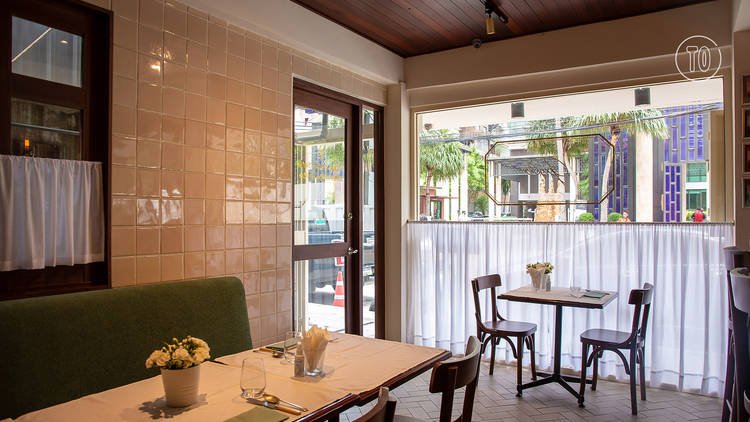
A Piazza, a Palazzo, and the Pace of Lucchese Dining
Lucca does not rush. The city operates behind medieval walls that seem to slow everything down — the cyclists on the ramparts, the passeggiata on Via Fillungo, and above all the ritual of sitting down to a long lunch or dinner at a proper table. The restaurants that thrive here tend to understand that rhythm. Giglio, positioned on Piazza del Giglio in an 18th-century palazzo, earns its place in that tradition not through spectacle but through an alignment between setting, cooking, and the particular tempo of this city.
Approaching the restaurant, the piazza itself does much of the work. The outdoor terrace, set against the pale stone facade of the palazzo, occupies the kind of civic space that most Italian cities still preserve for exactly this purpose: sitting, eating, watching. Indoors, the architecture carries the formality that the address implies — high ceilings, proportions that predate the modern obsession with intimacy, a room that asks you to settle in rather than eat quickly and leave.
The shortlist, unlocked.
Hard-to-book tables, cellar releases, and concierge-planned trips.
Get Exclusive Access →How the Meal Actually Unfolds
The dining ritual at Giglio follows the structure that serious Italian restaurants have maintained for generations: a menu organized around the logical progression of antipasto, primo, secondo, and dolce, with the kitchen's authority expressed through the quality of individual courses rather than the orchestration of a tasting sequence. This is not an omakase format or a parade of small plates. The meal has a beginning, a middle, and an end, and the pacing between courses is unhurried enough that conversation fills the space naturally.
The cooking style sits within the category Michelin classifies as Classic Cuisine, which in this context means a foundation in traditional Italian recipes with selective modern technique applied to particular dishes. The Michelin Plate recognition , awarded in both 2024 and 2025 , signals cooking that meets a consistent standard of quality without the editorial intervention that a star implies. In Lucca's restaurant market, where a handful of addresses occupy the upper price tier, Giglio sits at the €€€ level alongside L'Imbuto, while All'Olivo and Nida operate at a lower price point and Il Mecenate at the accessible end of the spectrum.
The Kitchen's Interpretive Range
Italian classic cooking at this level tends to divide between restaurants that treat tradition as a constraint and those that treat it as a platform. Giglio sits in the second group. The documented dish that leading illustrates the kitchen's approach is a siphoned potato served with bottarga, squid sauce, chanterelle mushrooms, and spicy parsley cream: a dish assembled from well-established Italian ingredients and flavor affinities, but processed and plated in a way that removes the rusticity without removing the identity. The siphoning technique produces a texture that the ingredients in their unaltered form would never achieve, while the combination of cured fish roe, cephalopod, and forest mushroom remains legibly Italian.
The bread program is noted separately in the Michelin assessment, which reflects a standard of care that distinguishes the kitchen's commitment to the whole table rather than only the headline courses. In the broader Italian dining context, bread quality functions as an early signal: a kitchen that bakes well is a kitchen that respects the fundamentals. Among Tuscan restaurants in Lucca, this kind of attention to supporting elements is less universal than the region's reputation might suggest.
The menu draws from both meat and fish preparations, following traditional Italian practice of offering the diner a choice between land and sea rather than committing the kitchen to a single direction. This flexibility reflects the local geography: Lucca sits close enough to the Ligurian coast that seafood sourcing is plausible, while the inland Garfagnana provides the charcuterie and game traditions that run through Tuscan cooking. Restaurants working at this intersection of influences occupy a different position from purely coastal or purely agrarian Tuscan addresses.
Giglio Within the Italian Classic Tradition
Classic Cuisine restaurants in Italy occupy an interesting middle position in the current moment. The category sits above direct trattoria cooking but does not compete directly with the conceptual ambition of addresses like Osteria Francescana in Modena or Le Calandre in Rubano. It also differs from the heritage-focused luxury of Dal Pescatore in Runate or the urban fine dining of Enoteca Pinchiorri in Florence and Enrico Bartolini in Milan. The Michelin Plate tier, which Giglio holds consistently, identifies kitchens that are cooking well within their category without pressing toward the star conversation. That is not a criticism; it is a useful orientation. Across Europe, this category of technically confident, tradition-rooted cooking produces some of the most satisfying meals , comparable in their register to addresses like Maison Rostang in Paris or KOMU in Munich, which hold their own positions within the classic tradition in their respective cities.
Within Lucca specifically, the restaurant's location and format place it in a different conversation from Buca di Sant'Antonio, which is the city's most widely cited address for anchored Lucchese tradition, and from L'Imbuto's creative tasting menu format. Giglio occupies the space between those poles: more formally composed than a traditional trattoria, less experimentally driven than the city's most contemporary kitchen.
Planning Your Visit
The restaurant sits at Piazza del Giglio 2, a short walk from most of Lucca's walled centro storico. The piazza location means the outdoor terrace is a genuine option rather than a pavement afterthought, and lunch in particular makes use of the setting. Reservations at the €€€ level in Lucca's high season , April through October, with August at peak pressure , benefit from advance booking; the combination of a small city and a limited number of quality tables means that walk-in availability on weekend evenings is not reliable. The Google rating of 4.4 across 850 reviews suggests a consistency that holds across a substantial sample of diners, which is a more informative signal than a smaller review pool. For a broader map of where Giglio sits in the city's dining options, our full Lucca restaurants guide covers the range across price points and styles. If you are also planning accommodation or other activities, our Lucca hotels guide, bars guide, wineries guide, and experiences guide provide coverage across the city's full offer. For ambitious day-trip cooking from the Tuscan region, Atelier Moessmer Norbert Niederkofler in Brunico represents a different register of Italian regional fine dining worth knowing about.
What to Order at Giglio
What should I eat at Giglio?
The kitchen's documented strength is in dishes that apply modern technique to traditional Italian ingredients, with the siphoned potato served with bottarga, squid sauce, chanterelle mushrooms, and spicy parsley cream being the clearest illustration of that approach. The menu spans both meat and fish preparations, consistent with the Michelin Plate classification for Classic Cuisine. Bread is specifically noted in the Michelin assessment as a highlight, which means it is worth attention at the start of the meal rather than treated as background. The €€€ price tier implies a multi-course structure; working through the full progression from antipasto to secondo reflects both how the kitchen has designed the meal and how the setting rewards taking time at the table.
Cuisine and Credentials
A quick peer reference to anchor this venue in its category.
Need a table?
Our members enjoy priority alerts and concierge-led booking support for the world's most difficult tables.
Get Exclusive AccessThe shortlist, unlocked.
Hard-to-book tables, cellar releases, and concierge-planned trips.
Get Exclusive Access →