Forage
Forage on Rowena Avenue sits in Silver Lake, one of Los Angeles's most food-serious neighbourhoods, where the local-first sourcing ethic that reshaped American dining over two decades has found a particularly committed expression. The restaurant's name signals its editorial position clearly: ingredient provenance is the organizing principle, not culinary theatrics. It occupies a mid-tier price point in a city where the distance between a neighbourhood staple and a Michelin-starred counter can be measured in blocks.
Pearl is the En Primeur Club membership app — saves, bookings, and concierge access live there. Same editors, same standards.
- Address
- 2764 Rowena Ave, Los Angeles, CA 90039
- Phone
- +1 323 407 6377
- Website
- foragela.com
- Directions
- Get directions
 Saves & bookings on Pearl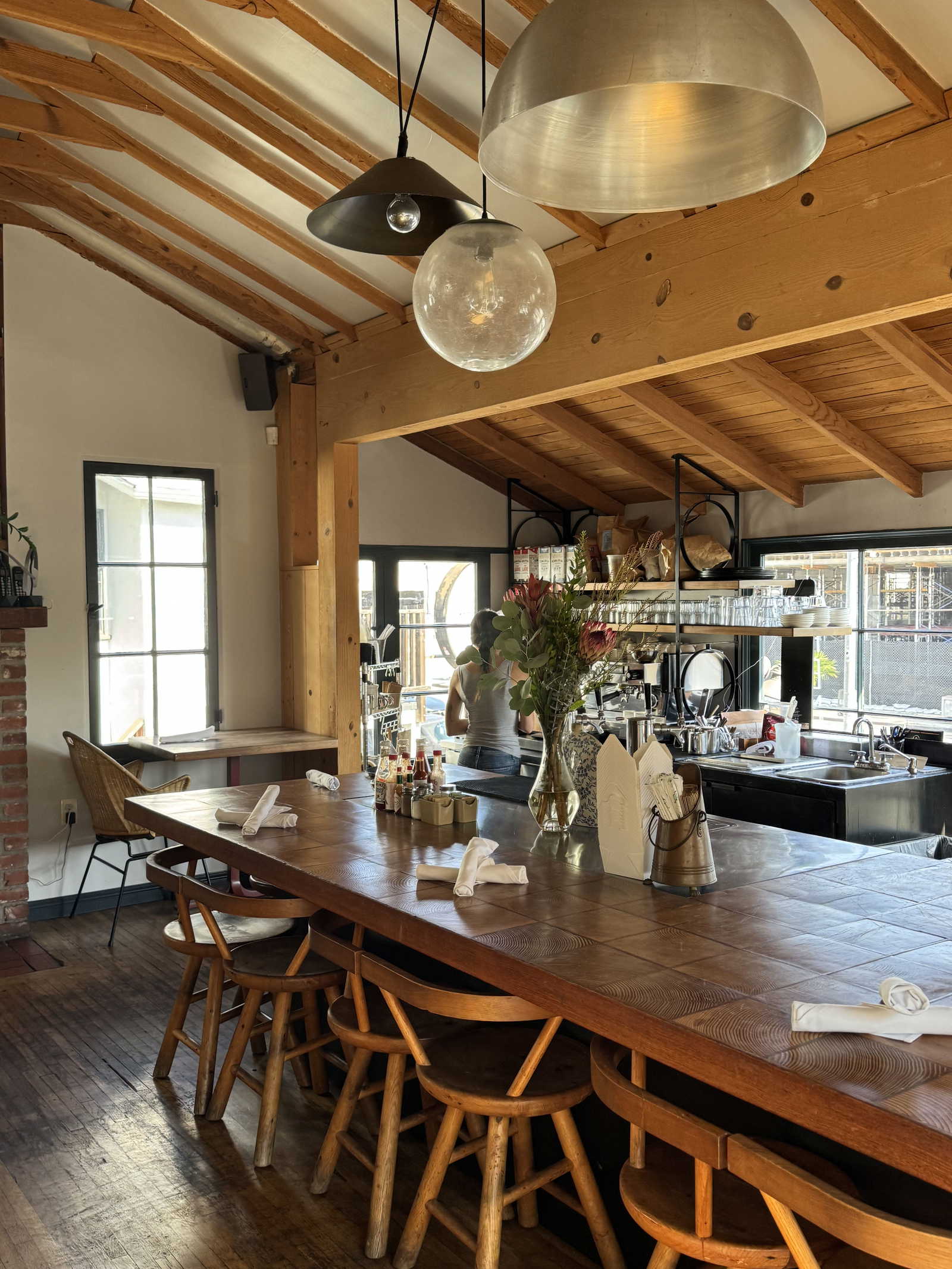
Silver Lake and the Sourcing-First Tradition
Rowena Avenue in Silver Lake is the kind of street that rewards paying attention. The neighbourhood sits east of Hollywood and north of Echo Park, and over the past fifteen years it has developed one of Los Angeles's more coherent food identities: independent, ingredient-driven, and resistant to the format inflation that pushes so many ambitious kitchens toward tasting-menu formalism. Forage, at 2764 Rowena, belongs to that tradition. The name is not incidental. It positions the restaurant inside a lineage of American kitchens that treat sourcing as the primary creative act rather than a backstory detail appended to a press release.
This sourcing-first philosophy has deep roots in California cooking. The state's proximity to year-round agricultural production, its network of small farms, and the cultural permission structure established by the Berkeley and Chez Panisse generation in the 1970s created the conditions for a style of cooking where the market, not the menu, sets the agenda. That tradition has since spread nationally, appearing in forms as varied as Blue Hill at Stone Barns in Tarrytown, Single Thread Farm in Healdsburg, and Smyth in Chicago. What distinguishes the Silver Lake expression of it is scale and accessibility. These are not destination restaurants built around elaborate production. They are neighbourhood anchors where the local-sourcing commitment operates at an everyday price point.
Los Angeles as a Foraging City
Los Angeles has a complicated relationship with its own food ambition. The city produces some of the country's most technically serious cooking at venues like Providence, where contemporary seafood reaches the level of precision associated with places like Le Bernardin in New York City, and at counters like Hayato, where Japanese kaiseki discipline is applied with unusual rigour for a non-Japanese city. At the more experimental end, Somni represents the molecular and progressive strand. Kato has redefined what New Taiwanese cooking can look like in an American context. Osteria Mozza anchors the Italian tradition with a seriousness that makes it a reference point rather than just a neighbourhood Italian.
But alongside that high-end tier, Los Angeles has always maintained a parallel track of restaurants where the cooking is serious without being elaborate, and where the connection to California's agricultural abundance is felt most directly. Forage sits on that track. In a city where ingredient quality is both genuinely available and culturally valued, a restaurant organised around sourcing is not making a contrarian statement. It is participating in something close to a civic norm.
The Cultural Logic of the Name
The word foraging carries specific cultural weight in American food circles. It connects to a broader movement in contemporary cooking that prizes what grows wild, what grows locally, and what is gathered rather than manufactured. That movement has produced particularly discussed restaurants in the country over the past two decades. The French Laundry in Napa established the California fine-dining grammar that later kitchens either refined or reacted against. Lazy Bear in San Francisco took the communal-table format and applied it to technically ambitious cooking. Frasca Food and Wine in Boulder showed how regional specificity could anchor a restaurant identity in a non-coastal market. At Forage, the sourcing emphasis is more vernacular than any of these references, but it draws from the same underlying current in American cooking.
That current runs through the broader farm-to-table movement that reshaped how Americans talk about and think about restaurant food from roughly the 1990s onward. It has produced genuine change in supply chains, in menu language, and in what diners expect to be told about their food. It has also produced significant amounts of marketing noise, where provenance claims outpace actual sourcing practice. One credible participants in this tradition are the ones where the sourcing commitment is structural rather than decorative, where it shows up in what is actually on the plate rather than only in the language used to describe it.
Neighbourhood Placement and Practical Considerations
Silver Lake's food scene rewards exploration on foot. The Rowena corridor in particular has developed enough density to justify treating a meal at Forage as one stop in a longer evening. The neighbourhood is accessible from central Los Angeles via the 2 freeway and has reasonable street parking by city standards, though timing matters. Weekend evenings in Silver Lake compress parking availability noticeably. The neighbourhood also sits close enough to Los Feliz and Atwater Village that restaurant-hopping between these adjoining areas is a reasonable approach for visitors spending more than one evening on the east side.
Comparable commitments to ingredient sourcing at higher price points appear in places like Addison in San Diego, The Inn at Little Washington, and internationally at Atelier Moessmer Norbert Niederkofler in Brunico, where the relationship between kitchen and local landscape is the organising principle of the entire enterprise. Forage operates at a different scale and price register, but the underlying logic is recognisably related. The difference is one of ambition and format, not of cultural orientation.
For diners coming from outside Los Angeles, the comparison that might be most useful is to think of Forage alongside places like Emeril's in New Orleans or Atomix in New York City in terms of their neighbourhood-anchoring function, even if the cooking styles differ considerably. Every serious food city has restaurants that do the work of establishing local food culture at the ground level, and Forage performs that function for Silver Lake.
Planning Your Visit
Forage is located at 2764 Rowena Ave, Los Angeles, CA 90039, in the Silver Lake neighbourhood. Given the restaurant's neighbourhood following and the general compression of demand in Silver Lake's dining scene on Thursday through Saturday evenings, contacting the restaurant directly to confirm availability before arriving is advisable. The Rowena corridor is approached with flexibility: parking conditions and wait times vary week to week, and building time into the arrival for the neighbourhood itself is worthwhile.
Nearby-ish Comparables
Comparable venues nearby, for context on price, style, and recognition.
| Venue | Cuisine | Price | Notes |
|---|---|---|---|
| ForageThis venue — the venue you are viewing | Farm-to-Table Vegetarian Bowls & Sandwiches | $$ | Not listed |
| Cafe Gratitude | Organic Vegan | $$ | Venice |
| Backyard Bowls | Acai Bowls & Superfood Porridges | $ | Beverly Grove |
| Plant Food + Wine | Modern Plant-Based Vegan | $$ | Beverly Grove |
| Momed | Modern Mediterranean | $$ | Glassell Park |
| All Time | Modern American Comfort | $$ | Los Feliz |
Continue exploring
More in Los Angeles
Restaurants in Los Angeles
Browse all →
Bars in Los Angeles
Browse all →

Hotels in Los Angeles
Browse all →
Wineries in Los Angeles
Browse all →
At a Glance
- Trendy
- Casual
- Bohemian
- Casual Hangout
- Solo
- Family
- Group Dining
- Open Kitchen
- Standalone
- Farm To Table
- Local Sourcing
- Organic
Current opening hours
- Monday
- Closed
- Tuesday
- 9 AM–9 PM
- Wednesday
- 9 AM–9 PM
- Thursday
- 9 AM–9 PM
- Friday
- 9 AM–10 PM
- Saturday
- 9 AM–10 PM
- Sunday
- 9 AM–9 PM
Hours can change for holidays and private events. Last verified .