Our verdict
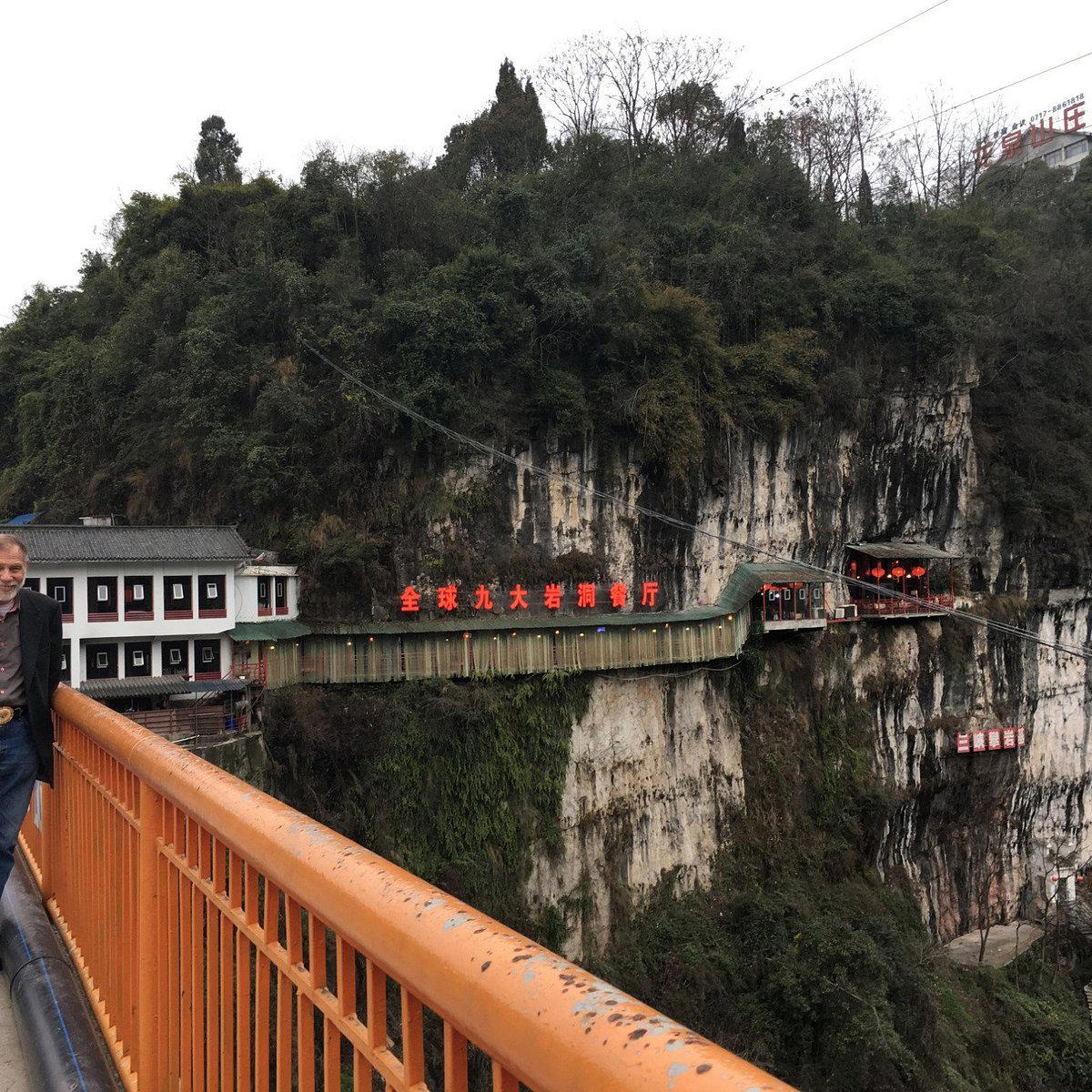
Fangweng (放翁酒家) sits at the head of the Sanyou Cave bridge in Xiaoxita, where the Yangtze gorge landscape has shaped local food traditions for centuries. The address alone, at the base of one of Hubei's most historically layered sites, signals a kitchen anchored in place rather than trend. For travellers moving through Yichang toward the Three Gorges, it is a useful reference point for the region's river-sourced cooking.

Pearl is the En Primeur Club membership app, where members save venues, book tables and use the concierge.
The menu
What to order
- Chinese sturgeon fish
Where the Yangtze Sets the Table
The approach to Sanyou Cave, along the limestone-flanked western edge of Yichang, establishes context before you eat anything. The road follows the river past layered cliffs that have defined this stretch of the Yangtze for millennia, and the bridge at Nanjinguan marks the point where the water begins to narrow toward the first gorge. Fangweng (放翁酒家) sits at that bridgehead, an address that is less a piece of real estate than a statement about provenance. In a region where the river has always determined what arrives on the table, location and ingredient sourcing are the same argument.
This part of Hubei is rarely on the itinerary of travellers visiting China for its restaurant culture, which largely orbits Chengdu, Shanghai, and Beijing. That gap is partly a function of infrastructure and partly a function of how regional Chinese cooking gets categorised internationally. Hubei cuisine occupies a middle position in the broader Yangtze basin tradition: heavier on freshwater fish and river vegetables than the Sichuan canon, less architecturally refined than the Jiangnan school that produced places like Ru Yuan in Hangzhou or Pingjiangsong in Suzhou. What it offers instead is a directness shaped by geography: you eat what the Yangtze and its tributaries supply, prepared in ways that have changed less than the surrounding tourism economy.
Ingredient Logic Along the Gorge
The sourcing premise of any serious kitchen in this corridor starts with water. The Yangtze above Yichang, before it descends into the plains, runs cold and fast. Fish from this section, historically including species specific to the upper gorge system, have a texture and flavour profile that differs from the farmed freshwater fish dominating lower-basin markets. River crabs, wild greens harvested from the cliff margins, and preserved vegetables prepared using methods that predate refrigeration all belong to the ingredient vocabulary of kitchens operating in this stretch.
The name Fangweng (放翁) itself is a literary reference, invoking the Song dynasty poet Lu You, who travelled through the Three Gorges and wrote about its landscape with the kind of specificity that doubles as a food diary. That referential frame positions the restaurant within a longer tradition of understanding this geography through what it produces, not just what it looks like. Kitchens that claim deep local roots in regions like this are always worth interrogating: the question is whether the sourcing reflects genuine engagement with the river system or merely local branding. The Nanjinguan address, at the entrance to the gorge zone rather than in the tourist centre of Yichang city, suggests the former orientation.
For comparative context, Chinese regional restaurants that anchor their identity to place-based sourcing occupy a different competitive tier than urban prestige addresses. Fu He Hui in Shanghai operates as a ¥¥¥¥ vegetarian concept built around philosophical sourcing; Xin Rong Ji in Chengdu represents Taizhou cuisine transplanted and refined for a metropolitan audience. Fangweng, by contrast, operates in its source region, which typically means different price positioning and a more direct relationship between season and menu.
The Sanyou Cave Setting
The physical context matters more here than at most restaurants in comparable Chinese cities. Sanyou Cave (三游洞) is a documented historical site, referenced in Tang and Song dynasty texts and associated with the poets Bai Juyi, Bai Xingjian, and Yuan Zhen, who gave the cave its name after visiting together. The surrounding park area has been developed for tourism, but the bridgehead location where Fangweng sits retains an orientation toward the gorge rather than toward the visitor infrastructure. Eating here is inseparable from that landscape, in the way that riverside restaurants along the Loire or the Douro derive meaning from their specific geography even when the menu itself doesn't explicitly reference it.
That kind of contextual eating is increasingly what draws informed travellers to secondary Chinese cities. The concentration of critical attention and Michelin activity around Shanghai, Beijing, Guangzhou, and Macau, venues like Imperial Treasure Fine Chinese Cuisine in Guangzhou or Chef Tam's Seasons in Macau, means that genuinely regional cooking in smaller cities operates almost entirely outside that recognition framework. That is not a flaw in the restaurant; it is a structural feature of how Chinese fine dining gets evaluated. Dai Yuet Heen in Nanjing and Fleurs Et Festin in Xiamen represent the more documented end of regional Chinese dining; Fangweng operates further from that axis, which makes independent assessment harder but doesn't diminish the underlying food tradition it represents.
Planning a Visit
Yichang is accessible by high-speed rail from Wuhan (roughly two hours) and functions as the primary embarkation point for Three Gorges cruises. The Xiaoxita district sits on the western edge of the city, and the Nanjinguan area where Fangweng is addressed is further west still, closer to the gorge entrance than to the urban centre. Visitors arriving by rail would typically need a taxi or rideshare to reach the site, as it sits outside the main urban transit pattern. The Sanyou Cave scenic area is most visited in spring and autumn, when river levels and temperatures make the gorge accessible and comfortable; summer brings heat and higher tourist volume, while winter offers solitude and potentially better conditions for the kind of preserved and cured ingredients central to Hubei's cold-season cooking. For broader dining context across the region, see our full Xiaoxita restaurants guide.
Travellers with an appetite for China's less-mapped regional kitchens, who have already worked through the reference addresses in Beijing, Yangzhou, or Fuzhou, will find the Yichang corridor genuinely underexplored. The Three Gorges region has a food culture anchored in its river system in ways that the more accessible regional restaurants in cities like Changsha, Xi'an, or Quanzhou don't replicate. Fangweng, positioned at the literal entrance to the gorge, is as close as a restaurant can get to eating inside that tradition rather than referencing it from a distance.
Frequently asked questions
Is Fangweng (放翁酒家) child-friendly?
The location at Sanyou Cave bridge on the Yangtze's western bank draws families visiting the historical site, so the setting is accustomed to mixed-age groups. The gorge-side environment and open approach suit relaxed meals rather than formal dining occasions.
What kind of setting is Fangweng (放翁酒家)?
Fangweng sits at the bridge approach to Sanyou Cave (三游洞), a documented historical site on the limestone-flanked western edge of Yichang in Hubei province. The address, 南津关三游洞桥头, places it at the gorge mouth where the Yangtze begins its descent into the plains. Expect a riverside setting tied to the cultural weight of the cave rather than an urban dining room.
Why do visitors to the Three Gorges stop at Fangweng (放翁酒家) specifically?
Fangweng's address at 南津关三游洞桥头 places it at one of the Yangtze's most historically documented stops: Sanyou Cave has drawn travellers since the Tang dynasty, and the restaurant's name directly references Lu You's Song-era writings about this location. For travellers embarking on Three Gorges cruises from Yichang, the primary departure city, it offers a meal grounded in the gorge's own literary and geographical identity before the river journey begins. That combination of site specificity and cultural anchoring is what separates it from generic riverside options in the city centre.
Where is Fangweng (放翁酒家) located?
Fangweng (放翁酒家) is located at 南津关三游洞桥头, 宜昌, 湖北, Xiaoxita.
Do I need a reservation for Fangweng (放翁酒家)?
The restaurant's position at the Sanyou Cave trailhead means foot traffic peaks when tourist groups move through the site, particularly during Three Gorges cruise season. Arriving outside peak tour hours, early lunch or late afternoon, reduces the chance of a wait.
In Context: Similar Options
| Venue | Cuisine | Price | Awards | Notes |
|---|---|---|---|---|
| Fangweng (放翁酒家)This venue (the venue you are viewing) | Hubei Chinese Cave Restaurant | $10–20 | Not listed | Not listed |
| Fu He Hui | Modern Seasonal Vegetarian Fine Dining | $200–300 | 2 Michelin Stars · World's 50 Best #11 | Vegetarian |
| Lai Heen | Michelin-Starred Cantonese | $50–100 | 1 Michelin Star · Forbes 5-Star | Cantonese |
| Xin Rong Ji | Taizhou Cuisine | $50–100 | 1 Michelin Star · La Liste Top Restaurants | Taizhou |
| Five Foot Road | Modern Sichuan Fine Dining | Not listed | 1 Michelin Star · La Liste Top Restaurants | Sichuan |
| Aji | Asian Bistronomy (Nikkei Fusion) | $50–100 | 1 Michelin Star · Wine Spectator Best of Award of Excellence | Nikkei, Innovative |
Details
- Scenic
- Well Known
- Rustic
- Casual Hangout
- Family
- Group Dining
- Waterfront
- Panoramic View
- Historic Building
- Standalone
- Local Sourcing
- Waterfront
- Mountain
- A La Carte
- Vegetarian Friendly
Dramatic cave-and-cliff setting with winding paths, historic atmosphere, and expansive gorge and river views.