Our verdict
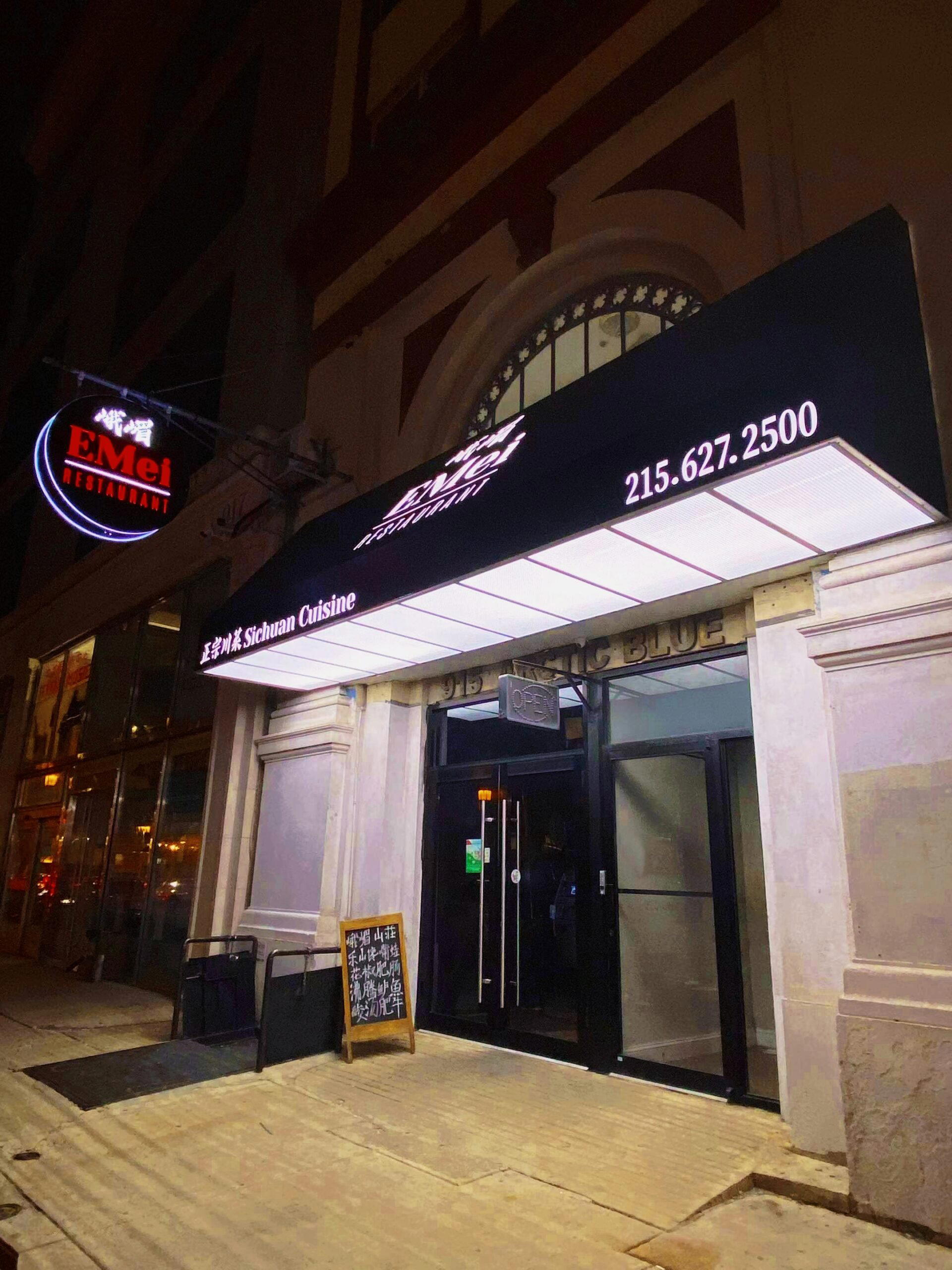
EMei sits on Arch Street in Philadelphia's Chinatown, a block where ingredient sourcing and regional Chinese cooking traditions carry more weight than décor or showmanship. The address places it inside one of the Northeast's most concentrated pockets of Chinese culinary practice, where what arrives on the table is shaped as much by supply chains and regional loyalty as by any single kitchen's ambitions.

Pearl is the En Primeur Club membership app — saves, bookings, and concierge access live there. Same editors, same standards.
- Address
- 915 Arch St, Philadelphia, PA 19107
- Phone
- (215) 627-2500
- Hours
- Mon–Thu 11 AM–9 PMFri–Sat 11 AM–10 PMSun 11 AM–9 PM
- Website
- emeiphilly.com
- Directions
- Get directions
- Booking
- Book on OpenTable
The menu
What to order
- Scallion Pancake
- Dumplings in Hot Chili Oil
- Dan Dan Noodle
- Singapore Rice Noodles with Chicken
Arch Street, Chinatown, and the Logic of Proximity
Philadelphia's Chinatown occupies a compact grid between Market and Vine, Eighth and Eleventh, and within that grid the density of Chinese restaurants is high enough that sourcing habits and regional specialisation become the primary differentiators. Arch Street in particular functions as a corridor where ingredient access — proximity to Chinatown's wholesale suppliers, butchers, and produce importers — shapes what kitchens can credibly put on the table. EMei sits at 915 Arch St, inside that corridor, and the address is itself an editorial fact: this is not a Chinese restaurant positioned at a comfortable remove from its supply chain, placed in a neighbourhood where Chinese ingredients are a special-order affair. The raw materials are at hand.
That matters because Chinese regional cooking, particularly the Sichuan and broader southwestern traditions the EMei name references, is among the most ingredient-sensitive in any major culinary canon. The namesake reference, Mount Emei in Sichuan Province, one of China's four sacred Buddhist mountains and a region with a distinct culinary identity tied to its geography and agriculture, signals a kitchen that frames itself within a specific provincial lineage rather than a generalised pan-Chinese menu. Sichuan cooking at its most serious is not primarily about heat; it is about the layered use of ingredients like Sichuan peppercorn (the source of the cuisine's characteristic numbing quality, known as má), fermented black bean pastes, and dried chilies sourced and aged with the same care that serious European kitchens give to cured meats or aged vinegars.
What the Sourcing Argument Actually Means Here
American cities with large, active Chinatown districts have a structural advantage when it comes to Chinese regional cooking: access to imported dry goods, fermented condiments, and fresh produce that simply does not move through conventional wholesale networks. Philadelphia's Chinatown, which has been a functioning commercial and residential district since the 1870s, has built supply relationships over more than a century. Kitchens embedded in that network can source Sichuan peppercorns, dried facing-heaven chilies, and fermented doubanjiang from Pixian at a quality level that restaurants outside the district typically cannot match without importing directly.
This is the ingredient argument for a Chinatown address, and it carries weight across the broader Northeast Chinese dining scene. In New York, the sourcing infrastructure around Flushing and Manhattan's Chinatown supports a tier of regional Chinese restaurants that compete credibly with high-end Chinese cooking in other global cities. Philadelphia's Chinatown operates at a smaller scale but with similar logic: proximity to supply is a form of culinary credibility, and EMei's Arch Street location places it inside that system rather than outside it.
For context on how ingredient sourcing functions as a competitive signal more broadly, consider how American restaurants with farm-direct sourcing programs, from Blue Hill at Stone Barns in Tarrytown to Single Thread Farm in Healdsburg, have made supply chain transparency a central editorial and commercial argument. The same logic applies to ingredient-intensive regional Chinese cooking, even if the language used to describe it rarely gets as formal.
Philadelphia's Chinese Dining Tier and Where EMei Fits
Philadelphia's restaurant scene has developed a recognisable upper tier in the past decade, with New American kitchens like Fork and Friday Saturday Sunday drawing national attention, and more recent openings in Cambodian and Pan-Asian cooking, such as Mawn, adding range to the city's Asian dining options. French-influenced rooms like My Loup have reinforced the city's reputation for technically serious cooking outside the tasting-menu format. Within that broader picture, Chinatown remains its own operating system: different booking conventions, different price structures, different ways of communicating quality.
Regional Chinese restaurants in Chinatown districts across the US tend to price against their immediate neighbours rather than against the city's wider fine dining market. That means value relative to technical complexity is often higher than at a comparable level of cooking in a non-Chinatown address. It also means that the signals of quality are different: a long-standing local reputation, a loyal regular clientele, and the ability to source ingredients that cannot be faked are more meaningful indicators than awards cycles or press coverage.
EMei's position on Arch Street places it in a competitive set defined by those Chinatown-specific signals rather than by the broader Philadelphia restaurant awards circuit. That is not a limitation; it is a different competitive logic, and one that rewards repeat visits and accumulated knowledge over single-occasion exploration.
The Broader Sichuan Moment in American Cities
Sichuan cooking has moved from novelty to establishment in American dining over the past fifteen years. Cities like Chicago, Los Angeles, and New York now have multiple Sichuan restaurants operating at a level of technical seriousness that would have been unusual before 2010. The conversation has shifted from whether American diners can handle the heat to whether American kitchens can source and prepare the foundational ingredients with enough fidelity to the regional tradition. That is a more interesting question, and it is the one that places like EMei are positioned to answer.
Among the restaurants drawing serious attention for their approach to ingredient sourcing and regional fidelity nationally, kitchens as different as Providence in Los Angeles and Atomix in New York City have made the argument that ingredient provenance and cultural specificity are not decorative claims but structural ones. The same argument runs through the better end of American regional Chinese cooking, even if it is made in less explicitly branded terms.
For travellers already planning a Philadelphia itinerary that includes the city's other high-engagement dining options, the sourcing-forward Mexican cooking at South Philly Barbacoa, for instance, which has built a national reputation around a specific regional tradition, the logic of adding a Chinatown stop is similar. Different supply chain, different regional grammar, but the same underlying commitment to ingredient specificity over generalist approachability.
Planning Your Visit
EMei is located at 915 Arch St, Philadelphia, PA 19107, in the heart of Chinatown. Contact and booking details are not currently listed; walk-in availability is typical for Chinatown district restaurants at this address, though peak weekend evenings and lunch service on weekends tend to be the highest-demand windows across the neighbourhood. For current hours and any updated booking options, checking directly with the restaurant is the most reliable approach.
How EMei Compares in the Philadelphia Dining Context
| Venue | Cuisine | Format | Neighbourhood |
|---|---|---|---|
| EMei | Chinese (Sichuan-referenced) | Chinatown dining room | Chinatown / Arch St |
| Fork | New American | Full-service restaurant | Old City |
| Friday Saturday Sunday | New American | Full-service restaurant | Rittenhouse |
| Mawn | Cambodian / Pan-Asian | Full-service restaurant | Philadelphia |
| South Philly Barbacoa | Mexican | Counter service | South Philadelphia |
For a broader map of where EMei sits within Philadelphia's dining options, see our full Philadelphia restaurants guide.
Frequently asked questions
What do people recommend at EMei?
Can I walk in to EMei?
What is EMei known for?
Can EMei adjust for dietary needs?
Is EMei in Philadelphia's Chinatown a good option for a solo diner?
Where the Accolades Land
| Venue | Cuisine | Price | Awards |
|---|---|---|---|
| EMeiThis venue — the venue you are viewing | Authentic Sichuan Chinese | $30–50 | Not listed |
| Friday Saturday Sunday | Modern American Tasting Menu | $100–150 | 1 Michelin Star · World's 50 Best #40 |
| Fork | Seasonal New American | Not listed | James Beard Award Outstanding Restaurateur #1 · Wine Spectator Award of Excellence |
| South Philly Barbacoa | Authentic Mexican Barbacoa Taqueria | $10–20 | James Beard Award Best Chef: Mid Atlantic · Chef's Table Featured on Chef's Table |
| Jean-Georges Philadelphia | Modern French Fine Dining | $200–300 | La Liste Top Restaurants · Wine Spectator Best of Award of Excellence |
| Helm | Seasonal New American Small Plates | $50–100 | Not listed |
Continue exploring
More in Philadelphia
Restaurants in Philadelphia
Browse all →
Bars in Philadelphia
Browse all →
Details
- Classic
- Well Known
- Energetic
- Group Dining
- Casual Hangout
- Family
- Private Dining
- Open Kitchen
- Local Sourcing
- Family Style
- A La Carte
- Vegetarian Friendly
- Vegan Options
- Gluten Free Options
Current opening hours
- Monday
- 11 AM–9 PM
- Tuesday
- 11 AM–9 PM
- Wednesday
- 11 AM–9 PM
- Thursday
- 11 AM–9 PM
- Friday
- 11 AM–10 PM
- Saturday
- 11 AM–10 PM
- Sunday
- 11 AM–9 PM
Hours can change for holidays and private events. Last verified .
Lively and energetic dining atmosphere in an intimate Chinatown setting, celebrating authentic Western Chinese culinary traditions.