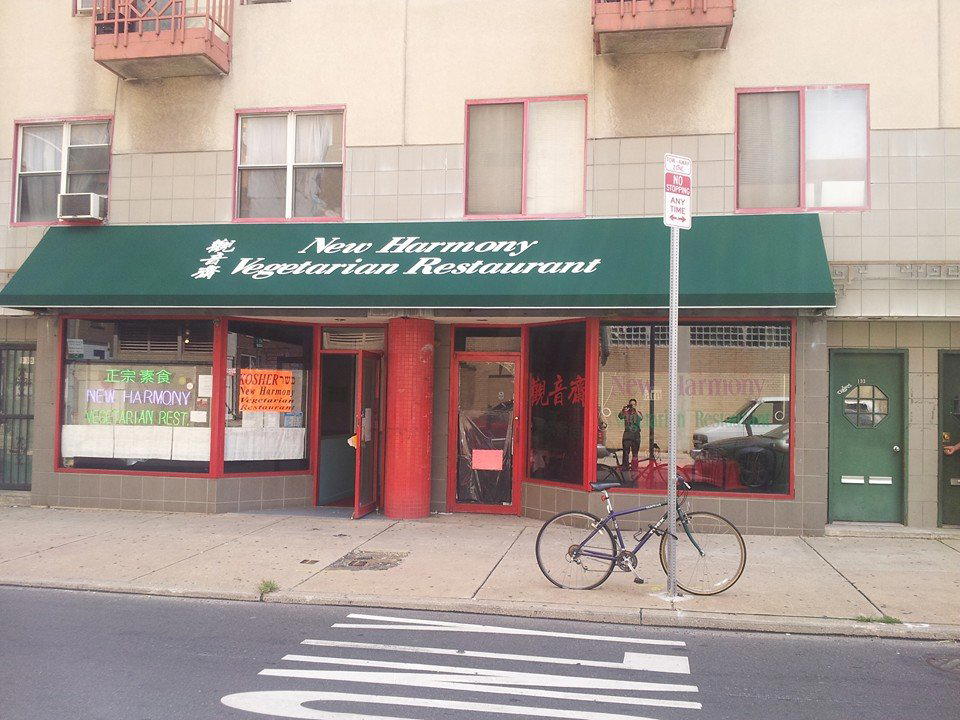
New Harmony Vegetarian Restaurant
Our verdict
On a block where Chinatown meets the broader cultural corridor of North 9th Street, New Harmony Vegetarian Restaurant occupies a position that Philadelphia's plant-based dining scene has quietly depended on for years. The kitchen draws from Chinese vegetarian traditions rather than the contemporary meat-substitute playbook, placing it in a different category than the city's newer vegan concepts. For those working through a full spread rather than a single dish, the format rewards patience and order selection.
- Address
- 135 N 9th St, Philadelphia, PA 19107
- Phone
- (215) 627-4520
- Website
- newharmonyphilly.com
- Directions
- Get directions
The menu
What to order
- General Tso's chicken
- Walnut shrimp
- Vegetable pancakes
- Sesame peanut noodles
Where Chinatown's Vegetarian Tradition Holds Ground
Philadelphia's Chinatown is a compact, working neighbourhood — not a tourist corridor dressed up for visitors, but a dense grid of storefronts where the cooking is aimed at people who live nearby, eat there regularly, and have opinions. North 9th Street, where New Harmony Vegetarian Restaurant sits at number 135, runs through this district as a practical artery rather than a dining destination in the curated sense. That positioning matters. Restaurants on this block compete on value, familiarity, and consistency rather than on concept or occasion, and New Harmony has found its footing within those terms.
Chinese Buddhist vegetarian cooking is the tradition New Harmony draws from — a cuisine with centuries of technique behind it that bears almost no resemblance to the plant-forward menus appearing at Philadelphia's newer fine-dining addresses. Where restaurants like Friday Saturday Sunday or Fork treat vegetable-forward dishes as a contemporary editorial position, Buddhist-influenced vegetarian cooking in the Chinese tradition treats it as a starting premise with its own deep grammar, mock meats made from wheat gluten and tofu, braised preparations that prioritise texture contrast over reduction, and seasoning built around fermented soy rather than acid and fat.
The Shape of a Meal Here
The way a meal progresses at a Chinese vegetarian restaurant like New Harmony is governed by different logic than a tasting menu or a New American prix fixe. There is no chef-driven arc from light to rich, no pacing enforced by servers bringing courses. Instead, the table fills incrementally as dishes arrive from the kitchen, and the sequencing becomes the diner's own responsibility, which is, in this tradition, entirely by design.
The opening phase of a meal tends to be defined by cold preparations and lighter starters: pickled vegetables, chilled tofu dishes, items that function as palate-setters rather than showpieces. These are the dishes that reward early attention before the more substantial plates arrive and the table gets crowded. In Chinese vegetarian cooking, this early register is where the kitchen's commitment to technique is most legible, a well-made cold tofu dish requires the same discipline as a good ceviche, and a poorly made one is immediately obvious.
Middle of the meal is where the mock-meat preparations appear, and this is often where newcomers to this cuisine form their clearest impressions. Wheat gluten preparations, sometimes labelled as mock duck, mock pork, or mock abalone, have a texture that genuinely does not exist in Western vegetarian cooking. It is not a simulation so much as a distinct ingredient category, and it responds to braising, stir-frying, and saucing in ways that tofu alone does not. For diners arriving from the New American vegetable-forward tradition, this is the educational centre of the meal.
Towards the end of a table spread, the rice or noodle dish arrives, in Chinese dining custom, a signal that the savoury courses are complete and the meal is drawing toward its close. This is not a side dish or an afterthought; in the structure of a Chinese meal, the starch course is the anchor, and everything preceding it is, technically, accompaniment. Understanding this sequencing changes how the meal reads. Diners who pace themselves across the earlier dishes arrive at this point still in possession of appetite.
Philadelphia's Vegetarian Tier and Where This Fits
Philadelphia's dining scene has grown considerably in range and ambition over the past decade. The arrival of serious tasting-menu programmes, strong representation from Cambodian and Pan-Asian kitchens, and neighbourhood restaurants like My Loup have given the city a more complex identity than its decades-old reputation as a secondary market suggested. Nationally, plant-forward fine dining has claimed serious territory, Blue Hill at Stone Barns in Tarrytown and Single Thread Farm in Healdsburg have each shown what happens when vegetable-centric cooking receives the same investment as conventional tasting menus. In that national frame, New Harmony belongs to a different category entirely: a neighbourhood institution rather than a destination, and a practitioner of a specific cultural tradition rather than a conceptual proposition.
That distinction is not a downgrade. Within the Chinese vegetarian category in the northeastern United States, restaurants operating in this tradition are genuinely few. The cuisine requires specific ingredient knowledge, sourcing relationships for wheat gluten and specialised tofu products, and a kitchen fluent in a technique set that overlaps minimally with mainstream American cooking. New Harmony's longevity on North 9th Street speaks to consistency within those terms.
For comparison: the ambition of a reservation at Le Bernardin in New York or The French Laundry in Napa sits in an entirely different register from what New Harmony offers, and treating them as comparable would misunderstand both. But within its own category, New Harmony functions as a reference point, the kind of restaurant that defines what the cuisine means in its city rather than the kind that experiments with what it could mean. Programmes like Smyth in Chicago or Atomix in New York represent the ambition end of the serious dining spectrum; New Harmony represents the durability end of a specific cultural tradition.
Planning a Visit
New Harmony sits in the heart of Chinatown, walking distance from City Hall and accessible from multiple transit lines, which makes it convenient for visitors staying in Center City. The neighbourhood itself warrants exploration before or after the meal: this is one of the few remaining compact urban Chinatowns in the northeastern corridor with active grocery and herbal suppliers alongside restaurants. Ordering at New Harmony rewards a group of three or four who can cover more of the menu and share across the table, the format scales poorly as a solo experience and opens up considerably when multiple dishes are ordered in parallel. There is no publicly listed booking system in EP Club's data so visiting in person or arriving at off-peak hours (early lunch, mid-afternoon) is the most reliable approach for securing a table without a wait.
For context on Philadelphia's broader dining range, from South Philly Barbacoa's Mexican regional cooking to the city's New American tier, EP Club's full Philadelphia restaurants guide covers the scene in detail.
Frequently asked questions
What is the atmosphere like at New Harmony Vegetarian Restaurant?
New Harmony sits on N 9th Street in the middle of Philadelphia's working Chinatown, which sets the tone: functional, no-frills, and oriented toward the meal rather than the room. The dining room draws a mix of neighbourhood regulars, Buddhist practitioners, and visitors who have done their research. Expect a casual, communal energy without any of the theatrics of a tasting-menu operation.
What's New Harmony Vegetarian Restaurant's location?
New Harmony Vegetarian Restaurant is located at 135 N 9th St, Philadelphia, PA 19107, Philadelphia.
Is New Harmony Vegetarian Restaurant suitable for people who are not vegetarian?
Chinese vegetarian cooking in the style practised at restaurants like New Harmony on N 9th Street in Philadelphia is built around techniques and flavour profiles that translate well for omnivores, particularly through mock-meat preparations that use gluten and tofu to replicate familiar textures. The kitchen's approach is rooted in a culinary tradition, not a dietary ideology, which makes the menu accessible to diners who simply want to eat Chinese food without meat rather than those looking for a lifestyle statement.
What should I order at New Harmony Vegetarian Restaurant?
New Harmony follows the logic of Chinese vegetarian cooking, where the kitchen works with tofu, gluten, and vegetables prepared across a range of techniques rather than defaulting to a single signature dish. The format rewards ordering several plates to share, as the menu covers both lighter preparations and more substantial mock-meat dishes rooted in Chinese Buddhist culinary tradition. Coming with at least two people gives you a fuller read of what the kitchen does.
Can I walk in to New Harmony Vegetarian Restaurant?
Walk-ins are generally feasible given the restaurant's neighbourhood positioning on N 9th Street in Philadelphia's Chinatown, though weekend lunch hours draw steady traffic from the surrounding area. Arriving early or timing around peak meal periods is a practical approach if you want a seat without a wait. Calling ahead when possible is a reasonable step, as the venue's phone details are not currently listed publicly.
What makes New Harmony Vegetarian Restaurant worth seeking out?
Within Philadelphia's Chinatown, New Harmony represents a specific culinary category that has few direct counterparts in the city: Chinese vegetarian cooking operating within a recognizable Buddhist-influenced tradition rather than as a lifestyle-brand concept. That distinction matters in a market where plant-based dining has largely moved toward New American frameworks. The address at 135 N 9th St places it at the centre of a neighbourhood with genuine culinary continuity, not a restaurant row curated for foot traffic.
The Quick Read
| Venue | Cuisine | Price | Awards | Notes |
|---|---|---|---|---|
| New Harmony Vegetarian RestaurantThis venue — the venue you are viewing | Vegan Chinese | Not listed | Not listed | Not listed |
| Friday Saturday Sunday | Modern American Tasting Menu | $100–150 | 1 Michelin Star · World's 50 Best #40 | New American |
| Fork | Seasonal New American | Not listed | James Beard Award Outstanding Restaurateur #1 · Wine Spectator Award of Excellence | New American |
| South Philly Barbacoa | Authentic Mexican Barbacoa Taqueria | $10–20 | James Beard Award Best Chef: Mid Atlantic · Chef's Table Featured on Chef's Table | Mexican |
| Jean-Georges Philadelphia | Modern French Fine Dining | $200–300 | La Liste Top Restaurants · Wine Spectator Best of Award of Excellence | French |
| Helm | Seasonal New American Small Plates | $50–100 | Not listed | Filipino |