Dorfstube

Michelin Plate
Our verdict
A Michelin Plate recipient in consecutive years (2024 and 2025), Dorfstube delivers grounded Swabian cooking in the village heart of Sonnenbühl. The kitchen works within a regional tradition that prizes seasonal produce and local craft, placing it squarely in the mid-range tier where honest ingredients and careful technique matter more than fine-dining spectacle.

Pearl is the En Primeur Club membership app, where members save venues, book tables and use the concierge.
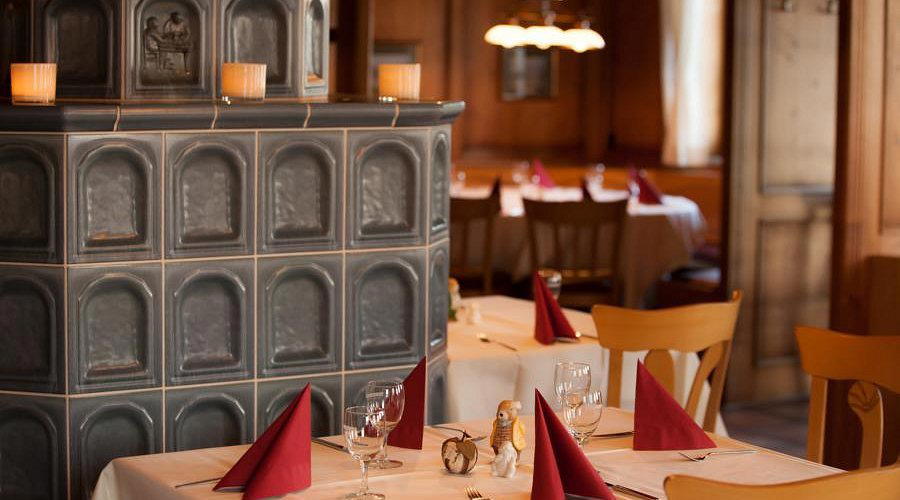
A Village Table in Swabia's Alb
There is a particular kind of German restaurant that the Michelin Guide has quietly tracked for decades without pushing it toward tasting-menu territory: the regional Gasthaus that treats local ingredients seriously, keeps the format approachable, and holds its ground against both the tourist-trap trap and the pressure to modernise for its own sake. Dorfstube, in the small hilltop settlement of Sonnenbühl on the Swabian Alb, fits that category. Sitting on Im Dorf 12 in the village core, the address itself signals what to expect. This is not a destination annexed to a spa hotel or a dining room operating on the coat-tails of a famous winemaker. It is a place the village built around, which is a harder thing to sustain than it sounds.
The Swabian Alb stretches across Baden-Württemberg as a limestone plateau defined by meadow farming, woodland, and a kitchen culture that has never needed external validation to know what it is. Lentils grown in the region carry protected-origin status. Spätzle is an art form with a generations-long argument about the correct scraping technique. The local Maultaschen tradition has EU protection. This is a food culture with documented identity, and Dorfstube operates within it rather than around it.
What the Michelin Plate Actually Signals Here
Receiving the Michelin Plate in both 2024 and 2025 tells a specific story at this price point. The Plate recognises kitchens that prepare food to a good standard without the additional layering of stars, which, in the €€ mid-range bracket, means the inspectors found technique and ingredient quality above what the price level strictly requires. At the three-star end of the German spectrum, restaurants like Aqua in Wolfsburg and Schwarzwaldstube in Baiersbronn operate in an entirely different economic register, with menus priced at multiples of what a Swabian village kitchen would charge. What the Plate does for a room like Dorfstube is confirm that the gap between those tiers is not a gap in seriousness, it is a gap in format and ambition. Two consecutive years of recognition suggests the kitchen is not riding a single good season but is consistently executing at a level that earns repeat inspection attention.
For context, the broader German fine-dining conversation tends to concentrate in Hamburg (Restaurant Haerlin), the Moselle Valley (Schanz in Piesport), and destination-resort towns. A Michelin-recognised address in Sonnenbühl, a municipality with a population measured in the low thousands, is less common than that concentration suggests it should be.
The Sourcing Logic Behind Swabian Cooking
The ingredient sourcing angle matters here more than it would at a metropolitan fine-dining address. Swabian cooking at its most grounded is a cuisine of short supply chains: the plateau produces its own lamb, dairy, grain, and pulses, and the kitchen tradition evolved to use them without the imported luxury additions that define haute cuisine elsewhere. That constraint produced a cuisine of genuine distinctiveness. Alb lentils, which were nearly extinct as a commercial crop before a revival effort in the 1990s, now anchor regional dishes across the area. The beef and lamb that come off the Alb carry flavour profiles tied to limestone-pasture grazing, which is categorically different from intensively farmed equivalents.
For a kitchen operating at Dorfstube's price tier, sourcing locally is not a marketing position, it is the economically rational approach to delivering quality at €€ pricing. The proximity of producers reduces cost while maintaining ingredient quality, which is exactly how regional cuisine sustains itself in a competitive hospitality market. The alternative, importing ingredients from outside the region to match menu trends, tends to either raise prices past the mid-range bracket or compress margins to the point where quality suffers. Kitchens that hold the Michelin Plate over consecutive years in this format have generally figured out that the regional supply chain is the answer, not the constraint.
Arriving in Sonnenbühl
Sonnenbühl sits on the Swabian Alb roughly between Reutlingen and the Zollernalb, accessible by car from Stuttgart in under an hour on a clear day. The village geography places Dorfstube in the kind of setting where the dining room is embedded in the residential fabric rather than positioned as a standalone attraction, which affects everything from parking to the pace of a meal. Guests coming from Stuttgart or Tübingen should treat this as a deliberate destination rather than a drop-in, which the €€ price range and mid-range format support; a dinner here does not require the kind of advance financial planning that a starred tasting menu does, but the drive warrants booking ahead rather than arriving on chance. For those planning broader time in the area, the full Sonnenbühl restaurants guide maps the full dining picture, and the Sonnenbühl hotels guide covers accommodation options for those making a night of it.
That will likely change as Michelin Plate recognition compounds. The window where a table is direct to secure may be narrower than it currently appears.
Where Dorfstube Sits in the Broader German Picture
The German restaurant scene has increasingly split between high-concept urban destinations, CODA Dessert Dining in Berlin, JAN in Munich, Vendôme in Bergisch Gladbach, ES:SENZ in Grassau, Victor's Fine Dining in Perl, Waldhotel Sonnora in Dreis, and the regional kitchens that hold tradition without chasing recognition. Dorfstube belongs to the second group, in the same way that certain Burgundian village restaurants sit well below the grands crus properties in price and visibility while drawing from the same terroir logic. The comparison to somewhere like Le Bernardin in New York or Atomix is not one of aspiration but of taxonomy: these are different models of what a serious kitchen can be.
For readers exploring the Swabian Alb beyond the table, the Sonnenbühl bars guide, wineries guide, and experiences guide cover the surrounding offer. The Alb is underrepresented in English-language travel writing relative to what it actually delivers, and Dorfstube is evidence of that gap.
Frequently asked questions
Is Dorfstube award-winning?
Dorfstube has received recognition including: Michelin Plate (2025); Michelin Plate (2024).
What dish is Dorfstube famous for?
The menu centres on traditional Swabian cooking, the regional canon of which runs through dishes such as Maultaschen, Linsen mit Spätzle, and slow-braised meats tied to local sourcing. The Michelin Plate recognition in both 2024 and 2025 points to consistent kitchen execution within that tradition rather than any single signature showpiece.
What does dinner at Dorfstube typically cost?
Pricing at Dorfstube is listed as €€.
Where do I go for Dorfstube?
Dorfstube is located at Im Dorf 12, 72820 Sonnenbühl, Germany, Sonnenbühl.
How hard is it to get a table at Dorfstube?
Dorfstube operates at a €€ price point in Sonnenbühl, a small village on the Swabian Alb rather than a city-centre address. That combination of Michelin Plate recognition and limited rural seating means weekend tables book up, and contacting the restaurant directly in advance is advisable.
What is Dorfstube known for?
Dorfstube is known for grounded Swabian regional cooking at a village address in Sonnenbühl, recognised by the Michelin Guide with a Plate award in both 2024 and 2025. It represents a category of German restaurant the Michelin Guide consistently tracks: locally rooted, ingredient-led, and priced accessibly at €€ without repositioning toward tasting-menu formats.
Comparison Snapshot
| Venue | Cuisine | Price | Awards | Notes |
|---|---|---|---|---|
| DorfstubeThis venue (the venue you are viewing) | Traditional Swabian Regional Cuisine | $30–50 | Michelin Plate | Not listed |
| Schwarzwaldstube | Modern French Fine Dining | $150–200 | 3 Michelin Stars · World's 50 Best #47 | French, Classic French |
| Aqua | Contemporary German, Italian/Japanese, Creative | Not listed | Michelin 3 Star | Not listed |
| CODA Dessert Dining | Dessert-Inspired Fine Dining | $200–300 | 2 Michelin Stars · World's 50 Best #82 | Creative |
| Tantris | Modern French, French Contemporary | Not listed | Michelin 2 Star | Not listed |
| Vendôme | Modern German Haute Cuisine | $200–300 | 2 Michelin Stars · World's 50 Best #47 | Modern European, Creative |
Recognition history
Dated appearances from independent guides and award organizations, with the underlying list record or original source where available.
Michelin Plate
Michelin · 2026 Michelin Plate
Full recognition history (3 entries)
Michelin Plate
Michelin
Michelin Plate
Michelin
Continue exploring
More in Sonnenbühl
Restaurants in Sonnenbühl
All restaurants in Sonnenbühl →
Bars in Sonnenbühl
Browse all →
Hotels in Sonnenbühl
Browse all →

Details
- Cozy
- Rustic
- Classic
- Family
- Casual Hangout
- Historic Building
- Hotel Restaurant
- Extensive Wine List
- Local Sourcing
- A La Carte
- Vegetarian Friendly
Current opening hours
- Monday
- Closed
- Tuesday
- 6–8:30 PM
- Wednesday
- 12–1:30 PM, 6–8:30 PM
- Thursday
- Closed
- Friday
- Closed
- Saturday
- Closed
- Sunday
- Closed
Hours can change for holidays and private events. Hours as of .
Cosy old dining space completely paneled in wood with a gemütlich, welcoming atmosphere.