Doggi's Arepa Bar

Our verdict
Doggi's Arepa Bar on Biscayne Boulevard has held a spot on the Opinionated About Dining Cheap Eats list for three consecutive years, placing Venezuelan street food in serious critical company. Under chef Carlos Estevez, the kitchen focuses on the kind of arepa-centered cooking that Miami's Venezuelan diaspora built its food culture around, direct, affordable, and traceable to a specific culinary tradition.

Pearl is the En Primeur Club membership app, where members save venues, book tables and use the concierge.
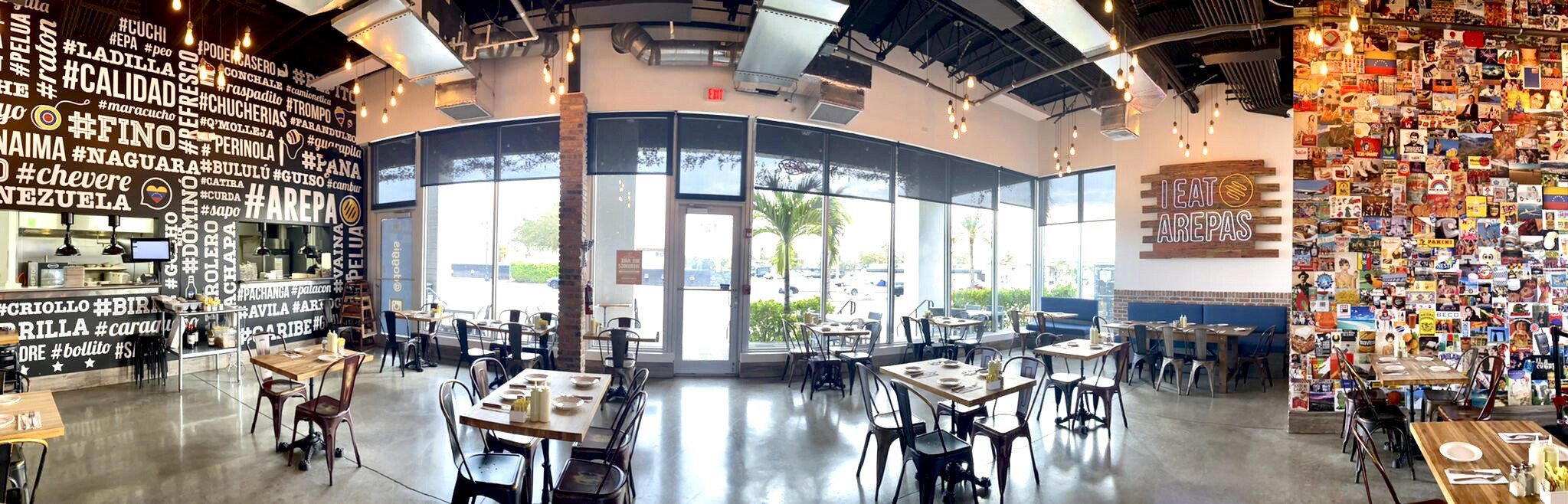
Biscayne Boulevard and the Venezuelan Counter-Narrative
Miami's dining conversation tends to orbit a familiar axis: the Michelin-starred rooms of Brickell and the Design District, the tasting-counter ambitions of places like Boia De or Ariete, the imported French authority of L'Atelier de Joël Robuchon Miami. What that narrative tends to flatten is the parallel food city running along Biscayne Boulevard through the MiMo district and into the upper reaches of Miami's east side, a corridor where Venezuelan, Haitian, Caribbean, and Central American kitchens have been feeding working and middle-class Miami for decades without the benefit of a PR agency or a sommelier.
Doggi's Arepa Bar at 7281 Biscayne Blvd sits in that corridor. The address is neither fashionable nor particularly photogenic, a storefront on a stretch of the boulevard that rewards knowing where to stop rather than wandering until something catches your eye. The experience of approaching it is less about atmosphere in the design-hotel sense and more about the specificity of place: the smell of masa on the griddle, the visual shorthand of a counter-service operation that has been doing the same thing long enough to stop explaining itself.
Three Years in the OAD Rankings: What That Actually Means
Opinionated About Dining is a useful calibration tool precisely because it does not traffic in the same institutional logic as the Michelin Guide. Its cheap eats lists are crowd-sourced from a community of serious diners, people who cross-reference a Venezuelan arepa kitchen in Miami with noodle counters in Singapore and taco stands in Oaxaca. The methodology favors frequency of return over occasion dining, and it surfaces places that feed a neighbourhood rather than perform for it.
Doggi's has appeared on the OAD Cheap Eats in North America list three consecutive times: recommended in 2023, ranked 275th in 2024, and holding that same position in 2025. Consistency at that level, in a list that refreshes annually based on diner submissions, is a more reliable signal than a single-year placement. It suggests a kitchen that has not drifted, no pivot to fusion, no menu inflation to chase a different demographic, no quiet erosion of quality under the pressure of a growing following. The comparison set at that ranking tier includes Venezuelan kitchens, taqueries, ramen shops, and regional American diners: category-agnostic, price-conscious, and judged entirely on whether the food is worth going out of your way for.
Within Miami's critical ecosystem, this positions Doggi's in an interesting middle space. It is not competing with Cote Miami or the tasting menus. But it is operating in a tier above the undifferentiated fast-casual corridor, recognized by the same critical community that debates Atomix in New York and Lazy Bear in San Francisco. That cross-category recognition matters in a city where Venezuelan food has historically been treated as neighborhood infrastructure rather than critical subject matter.
The Arepa as a Fixed Point
Venezuelan cuisine in the United States is still in the process of being narrated for a general dining public. Unlike Peruvian cooking, which has found critical anchors in ambitious formats like ITAMAE in Miami, Venezuelan food has largely circulated through diaspora channels: family operations, lunch counters, small strip-mall spots serving communities that already know what they want. The arepa is both the simplest and the most specific expression of that tradition: a round of ground corn masa, griddled or baked, split and filled. The variations are regional and fiercely argued, but the format itself is fixed.
What distinguishes a serious arepa kitchen from an average one is not innovation but calibration: the ratio of masa to filling, the crust development on the griddle, the temperature and texture at the moment of service. These are not variables that improve with fusion thinking. They improve with repetition and attention. Chef Carlos Estevez runs a kitchen oriented around that discipline, and the OAD record suggests it has been consistent enough, over three years of critical scrutiny, to hold its position against a North American field that includes well-resourced competition in New York, Los Angeles, Houston, and Chicago.
For context on the depth of the Venezuelan tradition in the American Northeast, Valencia Luncheria in Norwalk represents one of the longer-running Venezuelan operations in New England, a useful reference point for understanding how the cuisine has developed across different American markets, with Miami's large South American diaspora giving it particular density here.
Evolution and Staying Power on the Boulevard
The editorial angle on Doggi's is not the founding story, it is the question of what it takes to hold a position. Miami's food scene has a well-documented churn problem: concepts that open with significant momentum, generate a year or two of critical attention, and then dissolve under the pressure of real estate costs, staffing instability, or audience fatigue. The corridors where that churn is most visible are the ones where rents are highest and the dining public is most novelty-driven.
Biscayne Boulevard's upper stretch operates under different logic. The customer base here is less trend-sensitive and more return-driven. A kitchen that earns those regulars does so by not changing the things that brought them in. Doggi's evolution, such as it is, reads as a process of refinement within a fixed format rather than reinvention in response to external pressure. Three years of OAD placement is the measurable outcome of that approach.
Planning a Visit
Doggi's Arepa Bar is a counter-service operation on Biscayne Boulevard, accessible from central Miami by heading north on the boulevard through the MiMo district. Phone and booking details are not published, which is consistent with the format, this is not a reservation-driven room. Timing your visit to avoid lunch and early dinner peaks, particularly on weekends, is advisable. The price point sits in the cheap eats tier, which at Miami standards means the kind of meal that costs considerably less than the Michelin-starred options and, on its own terms, competes with them on satisfaction.
For anyone building a broader Miami itinerary, EP Club's full Miami restaurants guide covers the range from Biscayne Boulevard counters to tasting-menu rooms. Separate guides cover hotels, bars, wineries, and experiences across the city.
Frequently asked questions
What's the address for Doggi's Arepa Bar?
Doggi's Arepa Bar is located at 7281 Biscayne Blvd, Miami, FL 33138, Miami.
Should I book Doggi's Arepa Bar in advance?
Doggi's operates as a counter-service spot at 7281 Biscayne Blvd, a format that typically runs on a walk-in basis rather than reservations. That said, a three-year presence on the OAD Cheap Eats rankings draws a loyal crowd, so arriving during off-peak hours is the practical way to avoid a wait.
Comparable Spots, Quickly
| Venue | Cuisine | Price | Awards | Notes |
|---|---|---|---|---|
| Doggi's Arepa BarThis venue (the venue you are viewing) | Authentic Venezuelan Arepas | $20–30 | Not listed | Not listed |
| Ariete | Modern Cuban-American Fine Dining | $150–200 | 1 Michelin Star · Star Wine List | Modern American, Contemporary |
| Boia De | Modern Italian-Inspired | $50–100 | 1 Michelin Star · Star Wine List | Italian, Contemporary |
| Cote Miami | Modern Korean Steakhouse with Table-Side BBQ | $150–200 | 1 Michelin Star · La Liste Top Restaurants | Korean Steakhouse, Korean |
| Stubborn Seed | Modern American Fine Dining | $200–300 | 1 Michelin Star | Progressive American, Contemporary |
| Los Fuegos by Francis Mallmann | Argentinian Open-Fire Asado Steakhouse | $200–300 | Michelin Plate · Forbes 4-Star | Argentinian |
Recognition history
Dated appearances from independent guides and award organizations, with the underlying list record or original source where available.
Opinionated About Dining Cheap Eats in North America Ranked #275
Opinionated About Dining
Full recognition history (3 entries)
Opinionated About Dining Cheap Eats in North America Ranked #275
Opinionated About Dining
Opinionated About Dining Cheap Eats in North America in Recommended
Opinionated About Dining
Continue exploring
More in Miami
More from Chef Carlos Estevez
Browse all →
Restaurants in Miami
All restaurants in Miami →
Bars in Miami
All bars in Miami →


Details
- Cozy
- Lively
- Trendy
- Family
- Casual Hangout
- Group Dining
- A La Carte
- Vegetarian Friendly
Current opening hours
- Monday
- 9 AM–10 PM
- Tuesday
- 9 AM–10 PM
- Wednesday
- 9 AM–10 PM
- Thursday
- 9 AM–11 PM
- Friday
- 9 AM–11 PM
- Saturday
- 9 AM–11 PM
- Sunday
- 9 AM–10 PM
Hours can change for holidays and private events. Hours as of .
Warm and lively atmosphere with a cozy, intimate setting and just the right amount of energy.