

Michelin-starred Divinum on Carrer de l'Albereda holds a 4.7 Google rating across 1,104 reviews and earned its first Michelin star in 2024. The kitchen works a modern-Catalan register, drawing on deep regional larder — Maresme peas, seasonal escalivada, a 20-variety cheese trolley — with two tasting menus and a flexible à la carte that includes half-portions. Closed Monday and Sunday; open for lunch and dinner Tuesday through Saturday.
 Discover on Pearl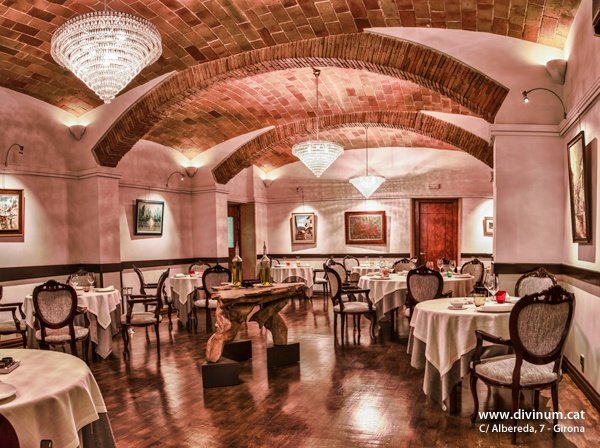
Where Modern Catalonia Meets the Girona Table
The medieval core of Girona is not short of serious cooking. The city hosts one of Spain's most scrutinised restaurant clusters, anchored by El Celler de Can Roca at the summit and sustained by a tier of independently run restaurants that draw on the same Catalan larder with less ceremony and, typically, more flexibility. Divinum, on Carrer de l'Albereda, sits squarely in that second tier: a one-Michelin-star address (awarded 2024) that treats the regional pantry with evident seriousness, delivering a menu that is modern in technique but rooted in recognisable Catalan reference points.
The street itself runs through the older part of the city, close enough to the Onyar riverbank that the surrounding neighbourhood carries the low-key confidence of a place that doesn't need to announce itself. Approaching the dining room, the register is contemporary rather than theatrical — the kind of room where the cooking is intended to do most of the talking. That restraint is consistent with a broader pattern in Girona's mid-to-upper dining tier, where the more durable addresses tend to rely on ingredient quality and service discipline rather than concept spectacle.
The shortlist, unlocked.
Hard-to-book tables, cellar releases, and concierge-planned trips.
Get Exclusive Access →The Catalan Larder as Both Subject and Method
Catalan cuisine's strength has always rested on geographic specificity. The Costa Brava coast, the volcanic soils of the Garrotxa, the alluvial plains of the Maresme: each sub-region produces ingredients with enough character to carry a dish on their own terms. Divinum's kitchen takes that specificity seriously. The Maresme peas — among the most prized seasonal ingredients in Catalan cooking, available for a short window in spring , appear here in a preparation that combines them with pil-pil broth, cod tripe, and truffle shavings. The combination is technically modern but the cultural logic is classically Catalan: surf-and-mountain pairing, slow-cooked fat emulsification from the Basque-influenced pil-pil technique, and a seasonal product treated as the main event rather than a garnish.
The kitchen's version of escalivada is equally telling. Escalivada is one of those Catalan dishes so deeply embedded in domestic and restaurant cooking that it rarely gets re-examined , charred aubergine and peppers, dressed simply, served at room temperature. Divinum deconstructs and reconstructs the dish, introducing what reviewers have described as an original sweet element. The approach reflects a wider movement across Catalan fine dining: not abandoning tradition but pressuring it, asking what the dish means when its components are disaggregated and reassembled with different proportions and temperatures. This is the territory that Disfrutar in Barcelona works at the avant-garde extreme; Divinum operates in a less disruptive register, which makes it accessible to a broader range of diners without sacrificing intellectual intent.
The cheese trolley , over 20 varieties according to reviewers , is a signal worth reading carefully. In an era when many modern restaurants have reduced or eliminated the cheese course in favour of a streamlined dessert sequence, maintaining a substantial wheeled selection indicates a deliberate commitment to a more classical service rhythm. It also signals confidence in the sourcing network: a 20-variety selection, maintained consistently, requires reliable relationships with affineurs and producers. Spain's cheese geography is under-documented relative to its breadth, and a curated trolley of this scale in a Catalan context likely draws on both local and broader Iberian production.
Format and Flexibility
Divinum's menu structure is worth examining as an editorial point about how Catalan mid-tier restaurants have been adapting to a post-pandemic dining public that is more varied in appetite and commitment level. The restaurant offers two tasting menus , Petit and Essencia , alongside an à la carte that includes the option of half-portions. That combination of formats is less common than it sounds. Most one-star addresses settle on either a single tasting menu or a conventional à la carte; offering both, plus a smaller menu tier, requires a kitchen and front-of-house team comfortable managing simultaneous service rhythms.
The half-portion option on à la carte dishes is particularly intelligent from a guest-experience standpoint: it allows diners to cover more ground in a single sitting without the fixed architecture of a tasting menu. It also makes the restaurant genuinely viable for solo diners or pairs with unequal appetite, a demographic consideration that many formal restaurants still handle awkwardly. Compared with Massana, which operates in the same price neighbourhood in Girona, Divinum's structural flexibility represents a distinct point of difference.
The plant-based capability is documented rather than inferred. A published reviewer noted that, after flagging the preference at reservation, the kitchen delivered a fully plant-based menu that drew attention from other diners in the room. That kind of responsiveness is not standard across the €€€ tier in Spain, and it places Divinum in a small peer group of Michelin-level kitchens that treat dietary alternatives as a serious creative challenge rather than a concession. We're Smart, the vegetable-focused restaurant guide, has recognised the quality of the kitchen's plant-forward output, an endorsement that operates in a different register to Michelin but signals genuine engagement with ingredient-led cooking beyond protein-focused menus.
Girona in the Broader Spanish Fine Dining Map
Girona's restaurant reputation is disproportionate to its size. A city of around 100,000 people supports multiple Michelin-starred addresses alongside a wider tier of serious independent restaurants. The concentration is partly explained by the city's position within a region that has historically treated cooking as a form of cultural expression , a tradition that runs through the Ferran Adrià generation and their successors. The major reference points in Spanish haute cuisine , Arzak in San Sebastián, Aponiente in El Puerto de Santa María, Quique Dacosta in Dénia, Azurmendi in Larrabetzu, DiverXO in Madrid , are geographically distributed, but Catalonia and the Basque Country have historically generated the densest clusters of technical ambition.
Within that context, Girona's second-tier restaurants occupy a useful position: they benefit from proximity to serious culinary culture without being priced or formatted for destination-dining tourists alone. Divinum's €€€ positioning (compared to the €€€€ tier occupied by Massana and El Celler de Can Roca) makes it the kind of address that rewards diners who want one-star cooking at accessible price points, without travelling to a major capital. For reference points at a similar creative register in different geographies, Frantzén in Stockholm and FZN by Björn Frantzén in Dubai show how a similar modern-with-classical-roots approach translates across different culinary cultures.
For diners building a broader Girona itinerary, the city's restaurant tier extends well beyond the starred addresses. Cipresaia and Normal represent the traditional end of the local spectrum, while Nexe occupies the contemporary tier at a similar price point to Divinum. The full picture is covered in our full Girona restaurants guide, with supplementary coverage in our Girona hotels guide, bars guide, wineries guide, and experiences guide.
Planning a Visit
Divinum operates Tuesday through Saturday, with lunch service from 1:30 PM to 3:00 PM and dinner from 8:30 PM to 10:30 PM; the restaurant is closed Monday and Sunday. The Google score of 4.7 across 1,104 reviews is a reliable signal of consistency rather than occasional brilliance , a meaningful distinction at the one-star tier, where scores can be distorted by irregular visits. The price range at €€€ positions it below Girona's two-star tier and roughly level with Nexe in the contemporary bracket. Given the 2024 Michelin recognition and the documented reputation for attentive owner-led service, reservations should be made well in advance, particularly for dinner on Friday and Saturday.
What to Order at Divinum
The documented standout dishes draw on Catalonia's seasonal ingredient calendar and classical technique vocabulary. The Maresme peas, available in season, represent the kitchen's approach at its most direct: a premium regional product prepared with technical precision (pil-pil emulsification, cod tripe, truffle) in a way that amplifies rather than replaces the ingredient's character. The deconstructed escalivada demonstrates the kitchen's willingness to re-examine familiar Catalan reference points rather than reproduce them unchanged. Both dishes illustrate the broader editorial point about Divinum's register: modern in method, Catalan in cultural logic.
For the cheese course, the trolley of 20-plus varieties is the kind of selection that justifies arriving hungry enough to eat through multiple courses. At the format level, diners who want to cover the most ground efficiently should consider the half-portion à la carte option; those who prefer a structured progression will find two tasting menu lengths , Petit and Essencia , that accommodate different time commitments and appetite levels. The kitchen's documented ability to deliver a serious plant-based menu on request makes it worth flagging dietary preferences at the time of reservation rather than on arrival.
A Pricing-First Comparison
A quick peer reference to anchor this venue in its category.
| Venue | Price | Awards | Notes |
|---|---|---|---|
| Divinum | €€€ | Michelin 1 Star | This venue |
| El Celler de Can Roca | €€€€ | Michelin 3 Star | Progressive Spanish, Creative, €€€€ |
| Massana | €€€€ | Michelin 1 Star | Modern Spanish, Modern Cuisine, €€€€ |
| Rocambolesc | Gelato | ||
| Normal | €€ | Traditional Cuisine, €€ | |
| Nexe | €€€ | Contemporary, €€€ |
Need a table?
Our members enjoy priority alerts and concierge-led booking support for the world's most difficult tables.
Get Exclusive AccessThe shortlist, unlocked.
Hard-to-book tables, cellar releases, and concierge-planned trips.
Get Exclusive Access →