
A compact Nakatsu biryani specialist where Osaka’s casual dining economy meets a narrower, spice-driven format. DIAMOND BIRYANI sits in the JPY 1,000–1,999 bracket, has 12 seats, and carries Tabelog 100 Asian cuisine / Ethnic cuisine WEST selections for 2022, 2023, and 2024, making it a useful marker for value-led ethnic cooking in the city.
Pearl is the En Primeur Club membership app — saves, bookings, and concierge access live there. Same editors, same standards.
- Address
- 3 Chome-17-2 Nakatsu, Kita Ward, Osaka, 531-0071, Japan
- Phone
- +81 6-6225-7181
- Website
- ja-jp.facebook.com
 Saves & bookings on Pearl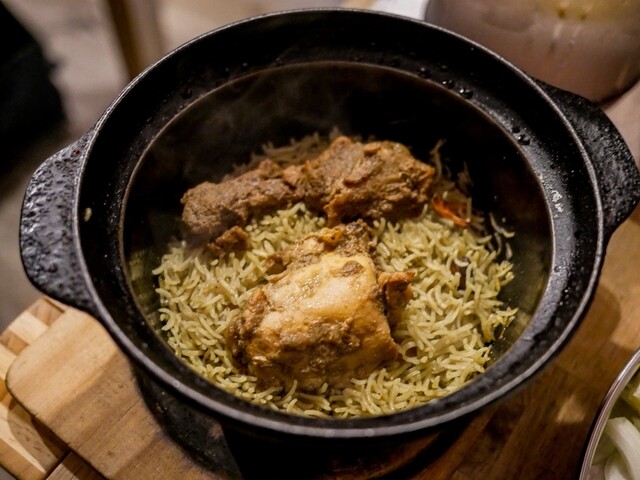
Approaching Nakatsu from the Umeda side, the dining register changes quickly: department-store polish gives way to small counters, apartment blocks, local cafés, and restaurants built for regular use rather than ceremony. That setting matters. Osaka’s value dining is often discussed through takoyaki, kushikatsu, or standing bars, but the stronger story is broader: this is a city where tightly focused restaurants can hold serious attention without moving into luxury pricing.
DIAMOND BIRYANI belongs to that category. The room is small, the format is narrow, and the proposition is unusually clear for Osaka: biryani as the centre of gravity rather than a supporting item on a general Indian menu. In a city where curry culture ranges from Japanese roux counters to South Asian specialist kitchens, a dedicated biryani address signals a different kind of confidence. The value is not about abundance for its own sake; it is about paying modestly for a dish that depends on timing, rice handling, spice structure, and heat control.
Why a biryani specialist changes the Osaka value equation
Biryani does not behave like a casual curry-rice plate. At its origin points across South Asia, especially in Hyderabad, the dish is tied to layered rice, aromatic spicing, and a cooking method that rewards patience. In Japan, where speed and consistency often define mid-priced dining, biryani specialists occupy an interesting middle ground: more process-driven than a quick lunch counter, less formal than tasting-menu dining, and usually judged by whether the kitchen can make rice, spice, and protein read as a single structure.
That is where the price bracket becomes meaningful. The restaurant’s listed lunch and dinner range sits at JPY 1,000–1,999, the same broad value band as SOMA among the comparison venues, and well below Tonkatsu Noguchi’s higher katsu pricing. Think Shokudo and Japoni move into higher dinner brackets, which makes DIAMOND BIRYANI a sharper case study in Osaka’s sub-2,000-yen dining tier: specialist cooking without the financial grammar of a destination counter.
The recognition adds weight. Selection for Tabelog 100 Asian cuisine / Ethnic cuisine WEST in 2022, 2023, and 2024 places the restaurant within a regional list that tracks depth beyond the city’s obvious Japanese categories. Tabelog’s 3.69 score is another useful signal in Japan’s rating culture, where incremental differences can matter and casual formats can be scrutinised heavily by repeat diners. This is not fine dining disguised as comfort food. It is a compact, single-minded restaurant competing on execution and repeat value.
Nakatsu gives the format room to stay focused
Nakatsu is close enough to Umeda to be convenient, but it does not have to perform like a station-front spectacle. That helps explain why small-format restaurants work here. The neighbourhood supports places that do one thing with discipline, draw regulars, and avoid the rent-driven pressure to become all things to all diners. Counter seating and a 12-seat capacity reinforce that rhythm: this is a scale suited to a kitchen that needs control more than theatre.
The setting also clarifies how to read the meal. Osaka visitors often build itineraries around Dotonbori, Shinsekai, and Umeda’s retail towers, but Nakatsu rewards a different pace, especially for diners looking beyond the city’s standard hit list. Pairing a compact lunch or early dinner here with broader Osaka planning makes sense: use Our full Osaka restaurants guide for the city’s wider dining map, then keep Our full Osaka hotels guide, Our full Osaka bars guide, Our full Osaka wineries guide, and Our full Osaka experiences guide for the rest of the trip architecture.
Within Osaka, the comparison is instructive rather than competitive..cafe and 52CHO-ME BAKERY speak to the city’s lighter daytime habits. 551 Horai (551蓬莱) is a reminder that mass affection and casual pricing can coexist in Osaka. 99 Pizza Napoletana Gourmet and a canto (Italian) show how non-Japanese formats are judged here when technique is visible. The biryani specialist sits inside that same broader pattern: imported culinary grammar, Osaka price sensitivity, and a diner base that rewards focus.
Who should choose this over a longer, pricier meal
The strongest reason to choose DIAMOND BIRYANI is the ratio between specificity and spend. A diner is not paying for linen, a long progression, or a room designed around occasion dining. The appeal is narrower: a biryani-led meal at a price that leaves room for another stop later in the evening. For travellers, that matters in Osaka, where eating well often means sequencing several small experiences rather than committing the whole night to one table.
The practical reading is simple: this is better suited to solo diners, pairs, and small groups comfortable with a compact room than to anyone planning a leisurely private-room meal. Reservations are available, payment is cash-led, and the no-smoking policy fits the current direction of Osaka’s better casual restaurants. Parking is not part of the appeal; the neighbourhood is better approached as an urban dining stop connected to the rail network.
For readers building a wider Japan food itinerary, the value comparison travels. Curry and rice specialists such as [Curry Senmon Ten] Maruyama Kyoju. in Sapporo, Vietnamese cooking at (Shoku) Vietnam in Kawasaki, sake-bar dining at Jōdo Saké Bar in Los Angeles, and rice-led casual formats like Onigiri Time in Pasadena each frame affordability differently. More formal or region-specific addresses, including -Grilled beef Sukiyaki- KAMAKURA TANUKIAN 鎌倉 たぬき庵 in Kamakura. 鮪と炭火焼き うお炭 秋葉原店 in Tokyo.know in Kumamoto, and [ki:] in Kyoto, underline the same point from different angles: price only tells part of the story. Format, focus, and repeatability decide whether the spend makes sense.
On that measure, the restaurant is an efficient Osaka choice. It gives a specific reading of the city’s Asian and ethnic dining tier, backed by repeated Tabelog 100 WEST selection, without asking the diner to turn the meal into a production. In a city that understands value better than almost anywhere in Japan, that restraint is part of the argument.
Recognition Snapshot
Comparable venues for orientation by cuisine and category.
| Venue | Cuisine | Price | Notes |
|---|---|---|---|
| DIAMOND BIRYANIThis venue — the venue you are viewing | Hyderabadi biryani specialist | $ | Not listed |
| Spice Curry Babiru no To | Spice curry & Indian-style curry | $ | Chūō |
| Spice Curry Harmonia | Osaka-style spice curry & Indian-inspired curry | $ | Kita |
| Curry & Spice Warung | Osaka Spice Curry & Indian Curry | $$ | Nishi |
| ASIAN KITCHEN ChaiChai | Indian Curry House | $ | Nishi |
| ERICK SOUTH Nishitenma | South Indian Dosa & Biryani House | $$ | Kita |
Recognition history
Dated appearances from independent guides and award organizations, with the underlying list record or original source where available.
Tabelog 100 #53 · No. 53
Tabelog · Tabelog 100 - Asian cuisine / Ethnic cuisine - WEST - 2024
Continue exploring
More in Osaka
Restaurants in Osaka
Browse all →




Bars in Osaka
Browse all →




Hotels in Osaka
Browse all →



Wineries in Osaka
Browse all →
At a Glance
- Cozy
- Solo
- Casual Hangout
- Family
- Group Dining
- Late Night
- Standalone
Current opening hours
- Monday
- 11 AM–3 PM, 5–10:30 PM
- Tuesday
- 11 AM–3 PM, 5–10:30 PM
- Wednesday
- 11 AM–3 PM, 5–10:30 PM
- Thursday
- 11 AM–3 PM, 5–10:30 PM
- Friday
- 11 AM–3 PM, 5–10:30 PM
- Saturday
- 11 AM–3 PM, 5–10:30 PM
- Sunday
- 11 AM–3 PM, 5–10:30 PM
Hours can change for holidays and private events. Last verified .
A small, simple neighborhood spot in a Nakatsu alley with just a dozen seats, casual service, and the warm, aromatic atmosphere of biryani pots cooking in an open kitchen.