

Michelin Plate
Our verdict
On Eppendorfer Landstraße, Cornelia Poletto holds a Michelin Plate and an Opinionated About Dining ranking for its Mediterranean-Italian cooking served across structured lunch and evening formats. The terrace opens in summer, and the adjacent Paola's bar-deli extends the ritual before or after the meal. A composed, unhurried alternative to Hamburg's more maximalist fine-dining rooms.

Pearl is the En Primeur Club membership app, where members save venues, book tables and use the concierge.
Eppendorf's Italian Cadence
Hamburg's fine-dining scene is concentrated largely around the Alster and HafenCity, where theatrical formats and waterfront settings compete for the same audience. Eppendorf operates on a different frequency. The residential neighbourhood north of the city centre has long supported a more considered dining culture, one where the pacing of the meal matters as much as its technical ambition. Cornelia Poletto, at Eppendorfer Landstraße 80, sits squarely in that tradition: a restaurant whose Italian-Mediterranean program is built around the cadence of the meal rather than spectacle.
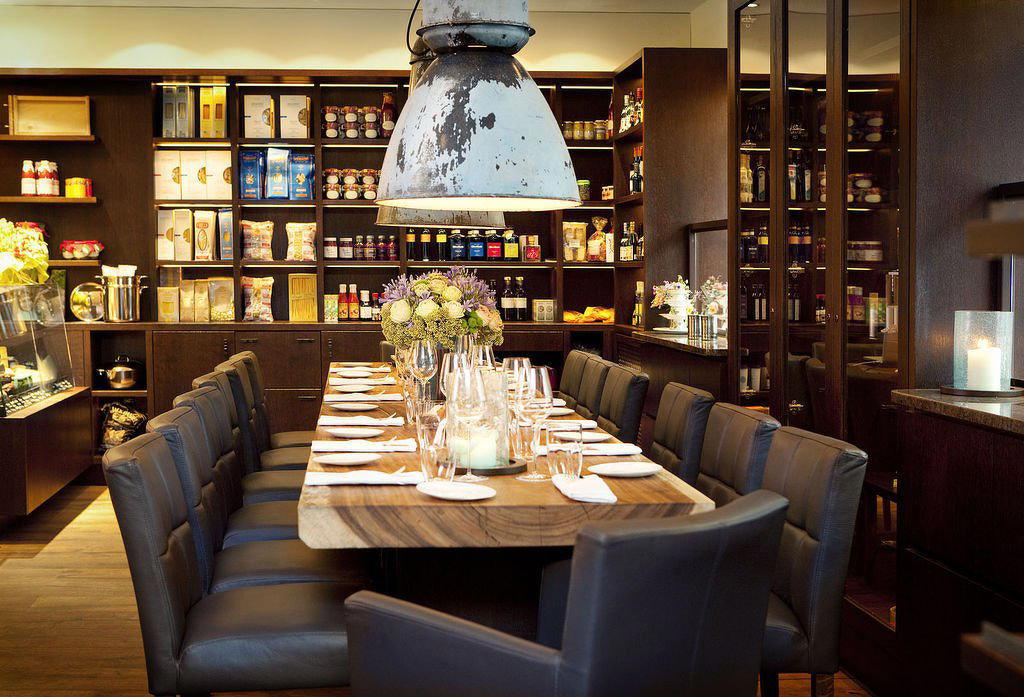
Approaching from the street, the building presents as an address rather than a statement. In summer, a handful of pavement tables sit in front of the building, an arrangement that places the restaurant in conversation with the neighbourhood rather than apart from it. Inside, the interior is upscale and modern without tipping into the kind of austere minimalism that can make a dining room feel like an examination. The setting supports the ritual rather than competing with it.
Lunch and Evening: Two Distinct Formats
The meal structure at Cornelia Poletto divides cleanly between formats, which is itself an editorial point about how Italian dining rhythm has been interpreted in the German context. At midday, a three-course set menu carries the kitchen's Mediterranean proposition in a compressed, accessible form. This is not a concession to a business-lunch crowd but a deliberate compression of the Italian dining ritual: the arc from antipasto through a main course to a close, executed within working-hours constraints.
In the evening, the format expands. A larger set menu is offered alongside à la carte options, giving the meal room to breathe across more courses. The Michelin recommendation is pointed on one detail: the antipasti. In Italian tradition, the antipasto course is where a kitchen signals its actual priorities, before the architecture of a tasting menu imposes its own logic. Here, that course carries enough weight that Michelin singled it out as the entry point most worth attention.
The broader Italian fine-dining conversation in Europe has been shaped by a tension between regional specificity and international legibility. Places like 8½ Otto e Mezzo Bombana in Hong Kong and cenci in Kyoto show how Italian culinary grammar travels when its structural logic is preserved rather than diluted. Cornelia Poletto addresses the same question on its home territory: how to maintain the integrity of Mediterranean-Italian cooking in a northern European city where the dominant fine-dining vocabulary is French-influenced or German-rooted.
Where It Sits in Hamburg's Fine-Dining Tier
Hamburg's recognised fine-dining range runs from three-Michelin-star creative cooking at The Table Kevin Fehling through to two-star Mediterranean work at bianc and two-star lakeside German cuisine at Lakeside. At the one-star and Plate tier, the question is less about absolute technical peak and more about consistency, value signal, and the specific experience a restaurant is designed to deliver.
Cornelia Poletto holds a Michelin Plate in 2025, a recognition that Michelin reserves for restaurants it considers worth a visit within their category. That double positioning, Plate recognition alongside an OAD classical ranking, suggests a kitchen that has committed to a specific register and executes within it reliably.
At the €€€ price range, it sits a tier below the €€€€ restaurants in Hamburg's star-holder group. That positioning reflects the format: a restaurant serving a structured Italian menu with professional service, in a comfortable room, without the per-head cost of a multi-course creative tasting menu. For comparison across German fine-dining at a similar register, the classical French-influenced programs at Vendôme in Bergisch Gladbach or the precision cooking at Aqua in Wolfsburg operate in comparable territory, though with different culinary lineages.
The Ritual Extended: Paola's Bar-Deli
Between the restaurant and the cookery school on the same address sits Paola's, described explicitly as a bar-deli suited to an aperitif or cocktails. In Italian dining culture, the aperitivo moment has a structural function: it marks the transition into the meal's time, slowing the pace before the table is taken. Paola's provides that function in physical form, giving guests the option to extend the ritual before or after the dining room itself.
This kind of layered format, where a restaurant anchors a small ecosystem of related spaces, is more common in larger food-and-hospitality operations, but the scale here is deliberately contained. The cookery school component also places Cornelia Poletto in a category of chef-restaurateurs who treat the dining room as one output of a broader culinary platform, which is a pattern visible across Germany's more established restaurant figures. JAN in Munich and Schwarzwaldstube in Baiersbronn represent different points on that same spectrum of chef-led institutions.
Seasonal and Practical Considerations
The most material seasonal shift is the addition of pavement tables in summer. This is worth accounting for when booking: the terrace changes the character of the meal, placing it in the neighbourhood's ambient life rather than in the contained world of the interior. For those who prefer the focused environment of the dining room, a summer booking inside may require a specific request.
The restaurant sits on Eppendorfer Landstraße in Hamburg's Eppendorf district, accessible from the city centre by U-Bahn. The €€€ price range aligns with the structured set-menu format, the three-course lunch represents the lower-commitment entry point, while the evening à la carte and larger set menu require more time and a higher outlay. Service is described as friendly and professional, a combination that suggests attentive execution without the formality that can make a fine-dining dinner feel procedural.
Hamburg's Italian offering at this price tier is not crowded. The city's most-decorated rooms trend toward creative European or regional German cooking. Restaurants at the Italian-Mediterranean end, operating with classical discipline and a structured meal format, occupy a smaller niche. Within that niche, Cornelia Poletto's combination of Michelin recognition, OAD classical ranking, and the extended ecosystem of Paola's and the cookery school gives it a particular gravity in the neighbourhood.
For broader Hamburg dining context, see our full Hamburg restaurants guide. Additional city coverage across hotels, bars, wineries, and experiences is available through our Hamburg hotels guide, our Hamburg bars guide, our Hamburg wineries guide, and our Hamburg experiences guide. For creative French fine dining in Hamburg, Restaurant Haerlin and 100/200 Kitchen represent different points on the city's upper tier. For dessert-focused innovation at the other end of Germany's dining spectrum, CODA Dessert Dining in Berlin and ES:SENZ in Grassau illustrate how far the country's creative restaurant culture has extended beyond its classical anchors.
What Should I Eat at Cornelia Poletto?
The Michelin Plate recognition and the OAD Classical in Europe ranking together point toward a kitchen with a coherent identity in Mediterranean-Italian cooking. Michelin's own note singles out the antipasti as the course most worth attention, a reasonable entry point given that the antipasto selection in Italian tradition reflects the kitchen's actual range and priorities before the set-menu architecture takes over. The three-course lunch set menu is the lower-commitment way to assess the kitchen's register; the evening format, with its larger set menu and à la carte options, gives more room to explore the full Italian-Mediterranean program. The Paola's bar-deli, positioned between the restaurant and the cookery school, is the natural aperitivo stop before a dinner booking.
Frequently asked questions
What price level is Cornelia Poletto?
Pricing at Cornelia Poletto is listed as €€€.
Where is Cornelia Poletto located?
Cornelia Poletto is located at Eppendorfer Landstraße 80, 20249 Hamburg, Germany, Hamburg.
Comparable Spots
A quick peer check to anchor this venue’s price and recognition.
| Venue | Cuisine | Price | Awards | Notes |
|---|---|---|---|---|
| Cornelia PolettoThis venue (the venue you are viewing) | Modern Italian-Mediterranean Fine Dining | $50–100 | Michelin Plate | Not listed |
| The Table Kevin Fehling | Avant-Garde Fusion Fine Dining | $200–300 | 3 Michelin Stars · La Liste Top Restaurants | Creative |
| bianc | Modern Mediterranean Fine Dining | $200–300 | 2 Michelin Stars · La Liste Top Restaurants | Modern Mediterranean, Mediterranean Cuisine |
| Lakeside | Modern European Fine Dining | $200–300 | 2 Michelin Stars · La Liste Top Restaurants | German Lakeside |
| Landhaus Scherrer | Michelin-Starred North German Fine Dining | $150–200 | 1 Michelin Star · Star Wine List | Modern European, Classic Cuisine |
| Heimatjuwel | Modern Regional German Vegetarian Fine Dining | Not listed | 1 Michelin Star · We're Smart World 3 Radishes | German, Creative |
Recognition history
Dated appearances from independent guides and award organizations, with the underlying list record or original source where available.
Michelin Plate
Michelin · 2026 Michelin Plate
Opinionated About Dining Classical in Europe Ranked #482
Opinionated About Dining
Full recognition history (4 entries)
Michelin Plate
Michelin
Michelin Plate
Michelin
Continue exploring
More in Hamburg
Restaurants in Hamburg
All restaurants in Hamburg →
Bars in Hamburg
All bars in Hamburg →
Hotels in Hamburg
All hotels in Hamburg →
Wineries in Hamburg
Browse all →
Cornelia Poletto
The wine
- Wine program
- Deep wine list
- Extensive wine list
Details
- Elegant
- Cozy
- Sophisticated
- Intimate
- Trendy
- Date Night
- Special Occasion
- Business Dinner
- Open Kitchen
- Extensive Wine List
- A La Carte
- Prix Fixe
- Wine
- Vegetarian Friendly
- Gluten Free Options
Current opening hours
- Monday
- Closed
- Tuesday
- 12–3 PM, 6–11 PM
- Wednesday
- 12–3 PM, 6–11 PM
- Thursday
- 12–3 PM, 6–11 PM
- Friday
- 12–3 PM, 6–11 PM
- Saturday
- 12–3 PM, 6–11 PM
- Sunday
- Closed
Hours can change for holidays and private events. Hours as of .
Cozy yet elegant with upscale modern interior, warm lighting, and a sophisticated yet approachable atmosphere praised for intimacy and refinement.