
Tabelog 100 #51
Our verdict
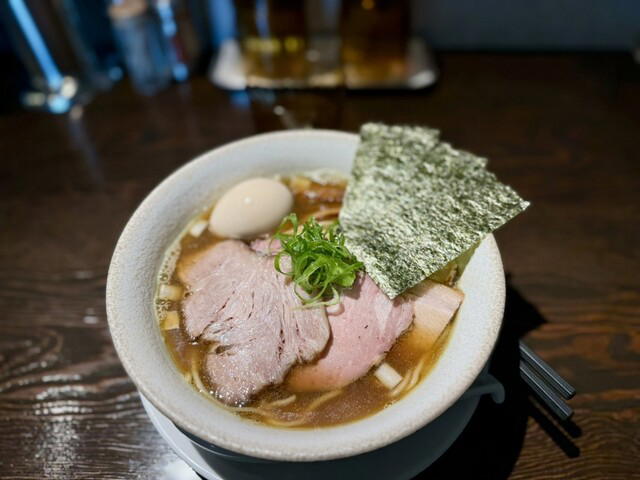
Chuka Soba Yanagi places Matsudo’s suburban ramen culture in a sharper light: small-format, low-priced, and serious enough to earn selection in Tabelog’s Ramen EAST “Tabelog 100” in 2024 and 2025. The room is compact, the format is casual, and the appeal sits in the Japanese chuka soba tradition rather than luxury dining theatrics.

Pearl is the En Primeur Club membership app, where members save venues, book tables and use the concierge.
The menu
What to order
- Special Salt Ramen (Tokusei Shio)
- Special Soy Sauce Ramen (Tokusei Shoyu)
- Hand-kneaded noodle versions of shio and shoyu
Approaching a ramen shop in suburban Chiba is unlike entering a Ginza counter or hotel dining room. The cues are practical: compact storefront, short service window, turnover-focused room, and diners who treat noodles as daily culture rather than occasion dining. In Matsudo, that context matters. Chuka Soba Yanagi sits in the small-shop ramen tier, where reputation is earned bowl by bowl and a place can become a destination without fine-dining language or pricing.
Japanese ramen has long balanced everyday access with obsessive specialization. Chuka soba points to the older Chinese-influenced noodle tradition Japan absorbed, localized, and refined into regional and shop-by-shop identities. The category rewards clarity: stock, tare, noodles, aroma oil, and timing must align in a format with little room to hide. That is why Tabelog’s Ramen EAST “Tabelog 100” selections matter here. The list does not make a ramen shop a luxury restaurant; it signals that a modest format has entered a more scrutinized competitive circle.
Small-room ramen in Matsudo, judged by a larger eastern Japan field
Matsudo’s dining map is not single-theme. It runs from bakery culture at Backstube Zopf to old-school local dining at Ajitokoro Musashino, curry at Curry House MUMBAI Matsudo ten, yoshoku-leaning casual cooking at baga tokidoki youshokutei, and ramen at Chuka Soba Maruki. That range frames Chuka Soba Yanagi not as an isolated pilgrimage stop, but as part of a city where specialist shops coexist with neighbourhood staples.
The restaurant’s scale is central: eleven seats, split between seven counter seats and one four-seat table, place it in the intimate format common across Japan’s serious noodle culture. This is neither a long-menu izakaya nor the tasting-menu version of ramen sometimes found in central Tokyo. It is a focused, high-throughput room where the counter carries much of the experience. In that setting, recognition in both the 2024 and 2025 Tabelog Ramen EAST “Tabelog 100” selections gives the shop a credential beyond local familiarity.
Price keeps the experience grounded. The listed spend is JPY 1,000 to JPY 1,999, the everyday bracket of several casual Matsudo peers rather than a premium omakase-adjacent tier. That matters culturally. Ramen’s democratic power in Japan comes from this equation: a meal can be inexpensive, technically exacting, and critically followed at once. Chuka Soba Yanagi fits that pattern more convincingly than venues that dress ramen in luxury signals.
Why chuka soba still anchors the serious ramen conversation
The phrase chuka soba carries restraint. It usually implies a lineage older than modern maximalist ramen: a bowl shaped by balance rather than excess, even when shops push intensity in their own way. Without naming unlisted dishes or invented signatures, the relevant point is the format itself. Chuka soba asks diners to read small decisions: noodle texture, broth concentration, seasoning depth, and the finish of fat or aroma. In a small room, those decisions become the meal.
That is why suburban ramen can compete with central-city dining without mimicking it. The eastern Japan ramen field stretches across Tokyo and surrounding prefectures, and the Tabelog Ramen EAST selection places shops from that broader region in one conversation. Matsudo benefits from the commuter-belt dynamic: close enough to Tokyo to share its exacting noodle culture, far enough from central rents to preserve compact, personal-scale operations. A short lunch can carry the seriousness of a destination meal.
The Matsudo comparison is instructive. Backstube Zopf works in a similarly accessible price band, but its culture is bakery-led and morning-to-daytime in rhythm. Ramen shops operate on another clock: service windows, queues, counter turnover, and the narrow choreography of hot noodles. Chuka Soba Yanagi’s reservations-unavailable format reinforces that older ramen logic. Diners do not buy certainty through advance planning; they work with the shop’s hours and capacity.
Planning the meal without mistaking it for fine dining
The practical read is simple: treat the shop as a small, cash-only ramen counter with limited seats and defined service periods. Credit cards, electronic money, and QR code payments are not accepted. The address is 82 Tonohiraga in Matsudo, with Kita-Kogane Station the nearest rail reference; the shop is listed as a three-minute walk from the north exit on the JR Joban Line. Parking exists, but only in a small number of spaces, so rail is cleaner for visitors moving through greater Tokyo or Chiba.
Families are not excluded. Children and strollers are welcome, and the single four-seat table helps groups that would find a pure counter shop awkward. Still, the room is compact. A family meal works better when everyone is ready for ramen-shop rhythm: order, eat while the noodles are at their intended texture, and leave the seat for the next party.
For travellers building a broader Matsudo day, the restaurant works well as a focused food stop rather than a long lunch anchor. Pairing it with other local addresses gives a clearer view of the city’s casual dining range; start with our full Matsudo restaurants guide, then widen planning through our full Matsudo hotels guide, our full Matsudo bars guide, our full Matsudo wineries guide, and our full Matsudo experiences guide. For a wider Japan and international dining lens, contrast the everyday-specialist model with -Grilled beef Sukiyaki- KAMAKURA TANUKIAN 鎌倉 たぬき庵 in Kamakura. 鮪と炭火焼き うお炭 秋葉原店 in Tokyo.cafe in Osaka.know in Kumamoto, (Shoku) Vietnam in Kawasaki, [Curry Senmon Ten] Maruyama Kyoju. in Sapporo, Jōdo Saké Bar in Los Angeles, and Onigiri Time in Pasadena.
The editorial value of Chuka Soba Yanagi is not that it turns ramen into ceremony. It does the opposite: shows how a low-price, small-seat, suburban chuka soba shop can join a serious regional conversation while remaining legible as an everyday Japanese meal. That combination is the reason to pay attention.
Frequently asked questions
Is Chuka Soba Yanagi a family-friendly restaurant?
Yes. the public record lists it as family friendly, with children welcome and strollers welcome. It also has 11 seats, including 7 at the counter and 1 table for 4, in Matsudo. Check the venue's official channels for the latest details.
What's the overall feel of Chuka Soba Yanagi?
It reads as a compact ramen shop rather than a long-form dining room: 11 seats, reservations unavailable, and a lunch price range of JPY 1,000–JPY 1,999. The Tabelog 100 Ramen East 2025 selection gives it clear regional credibility in Matsudo.
What's the price range at Chuka Soba Yanagi?
Pricing at Chuka Soba Yanagi is listed as JPY 1,000 - JPY 1,999 JPY 1,000 - JPY 1,999.
When can I go to Chuka Soba Yanagi?
Hours at Chuka Soba Yanagi: Mon: 11:30 AM–2:30 PM, 6–8:30 PM; Tue: 11:30 AM–2:30 PM, 6–8:30 PM; Wed: Closed; Thu: Closed; Fri: 11:30 AM–2:30 PM, 6–8:30 PM; Sat: 11:30 AM–2:30 PM, 6–8:30 PM; Sun: 11:30 AM–2:30 PM.
Price Lens
Comparable venues by cuisine and price in the same metro.
| Venue | Cuisine | Price | Awards | Notes |
|---|---|---|---|---|
| Chuka Soba YanagiThis venue (the venue you are viewing) | Ramen / Chuka Soba | $10–20 | Tabelog 100 #51 | Not listed |
| Tonikaku Matsudo honten | Ramen, tsukemen & abura soba | $10–20 | Tabelog 100 #42 | Matsudo, Ramen, tsukemen & abura soba |
| Tomita Ramen | Award-Winning Tsukemen Ramen | $20–30 | Tabelog 100 #94 | Matsudo, Award-Winning Tsukemen Ramen |
| Matsudo Chuka Soba Tomita Shokudo | Ramen & tsukemen shop | $10–20 | Tabelog 100 #3 | Matsudo, Ramen & tsukemen shop |
| Ramen Tomita | Award-Winning Tsukemen Ramen | $20–30 | Tabelog 100 #94 | Matsudo, Traditional Japanese Tsukemen |
| Trattoria Il Regalo | Seasonal Italian Trattoria & Neapolitan Pizza | $30–50 | Tabelog 100 #90 | Matsudo, Seasonal Italian Trattoria & Neapolitan Pizza |
Recognition history
Dated appearances from independent guides and award organizations, with the underlying list record or original source where available.
Tabelog 100 #51 · No. 51
Tabelog · Tabelog 100 - Ramen - EAST - 2025
Continue exploring
More in Matsudo
Restaurants in Matsudo
All restaurants in Matsudo →

Bars in Matsudo
Browse all →

Details
- Cozy
- Lively
- Solo
- Casual Hangout
- After Work
- Family
- Chefs Counter
- Standalone
- A La Carte
- Counter Dining
Current opening hours
- Monday
- 11:30 AM–2:30 PM, 6–8:30 PM
- Tuesday
- 11:30 AM–2:30 PM, 6–8:30 PM
- Wednesday
- Closed
- Thursday
- Closed
- Friday
- 11:30 AM–2:30 PM, 6–8:30 PM
- Saturday
- 11:30 AM–2:30 PM, 6–8:30 PM
- Sunday
- 11:30 AM–2:30 PM
Hours can change for holidays and private events. Hours as of .
Casual, compact neighborhood ramen shop with counter-focused seating, constant turnover, and an energetic but relaxed atmosphere typical of popular local chuka soba spots.