Chez Jay
A weathered Ocean Avenue institution that has anchored Santa Monica's dining scene for decades, Chez Jay reads as a direct counterpoint to the city's proliferating polished-casual concepts. The interior is intentionally unchanged: dim lighting, wood paneling, and a bar that has outlasted several generations of California dining trends. It sits at 1657 Ocean Ave, one block from the beach.
Pearl is the En Primeur Club membership app — saves, bookings, and concierge access live there. Same editors, same standards.
- Address
- 1657 Ocean Ave, Santa Monica, CA 90401
- Phone
- +13103951741
- Website
- chezjays.com
- Directions
- Get directions
 Saves & bookings on Pearl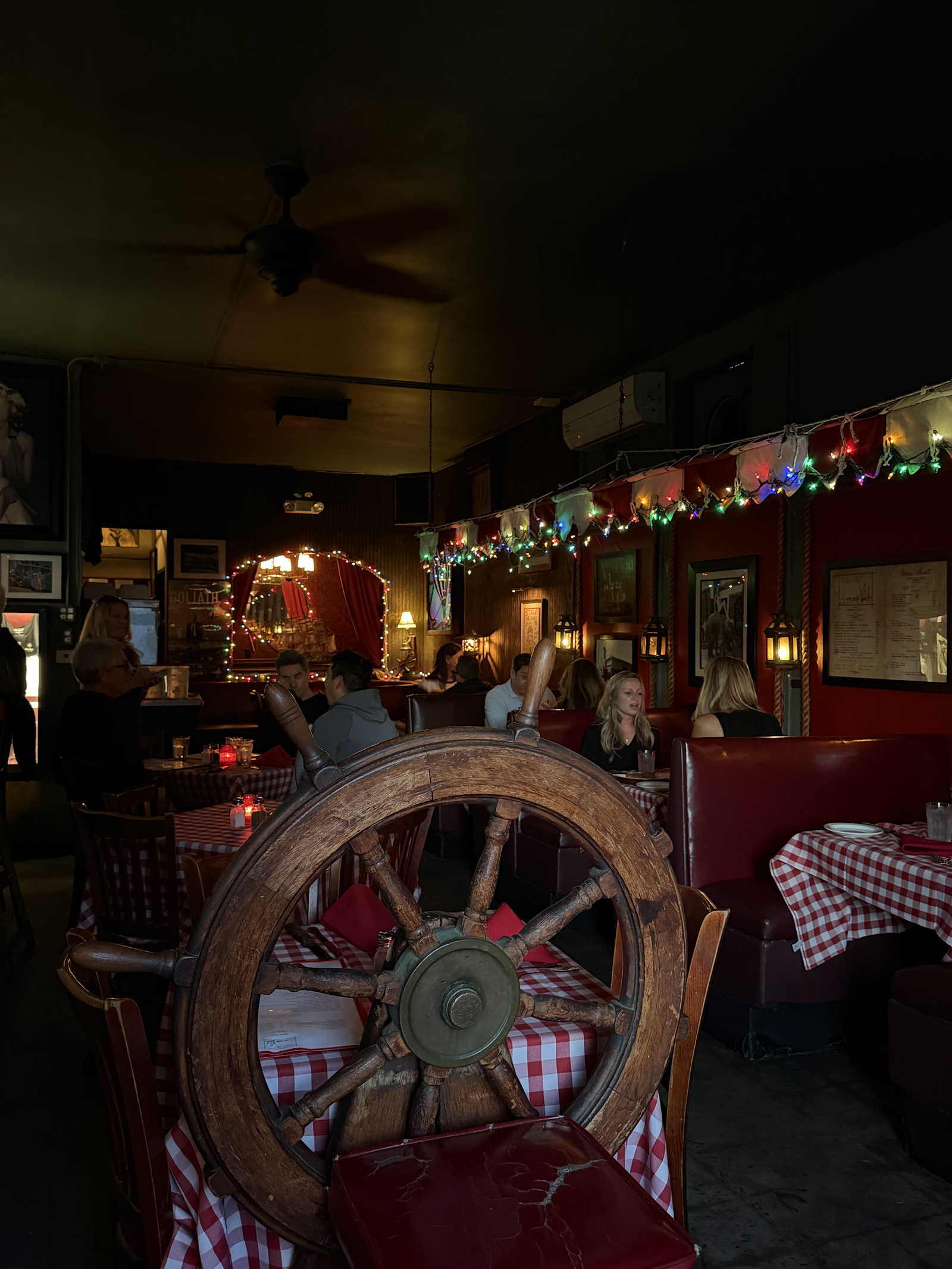
The Room Before the Food
There is a category of American dining room that resists renovation on principle. Walk into Chez Jay at 1657 Ocean Ave and you encounter that category in near-textbook form. The bar runs along one side, the booths are close, the lighting is low enough to require a moment of adjustment coming in from the Santa Monica sun. Wood paneling that looks decades old probably is. The physical container here is the argument: this is what a beach-adjacent American saloon looked like before Ocean Avenue became a strip of glass-fronted hotel restaurants and chef-driven concepts competing for the same Yelp-savvy clientele.
That physical character is not incidental. Across American cities, a small number of older dining rooms have survived long enough to become the thing newer restaurants try to approximate through designed authenticity. The exposed wood, the worn bar rail, the deliberate dimness, these are now aesthetic choices that cost money to manufacture. At Chez Jay, they are simply what happened when nobody changed anything. The result is a room that communicates a different set of priorities than its neighbours.
Where Chez Jay Sits in Santa Monica's Current Scene
Santa Monica's restaurant corridor has stratified considerably over the past decade. On one end, you have fast-casual concepts like 800 Degrees Woodfired Kitchen optimising for throughput and accessibility. On the other, you have hotel dining and chef-driven rooms reaching toward the kind of credentials associated with places like Providence in Los Angeles or, further afield, The French Laundry in Napa and Le Bernardin in New York City. The restaurant occupies neither position. It predates the stratification and has never repositioned to fit it.
That makes comparison to contemporaries like Amici Brentwood or Azure somewhat beside the point. Those venues arrived into an already-articulated market. The restaurant was here before the market looked like this, which is itself a form of positioning. Its comparable set is not defined by cuisine type or price tier but by longevity and the particular social function that long-running neighbourhood bars and grills serve in coastal California cities.
The Physical Space as Historical Document
The interior design logic at the restaurant is best understood as the absence of a redesign. American bar-and-grill rooms of the mid-twentieth century were built around a set of conventions: proximity between tables, a bar that functions as a social anchor rather than a service station, lighting that prioritises atmosphere over visibility. These conventions have largely been replaced in newer venues by open kitchens, communal tables, and the kind of declarative design that signals intent before food arrives. The restaurant never made that transition, which means the room itself functions as a record of an earlier set of assumptions about what a restaurant should feel like.
For context on how other long-standing American rooms have managed legacy versus reinvention, the comparison with Emeril's in New Orleans is instructive, a venue that has navigated the tension between institutional identity and market evolution. The restaurant appears to have resolved that tension differently, by declining to treat it as a tension at all. The room is what it is. Whether that reads as stubbornness or confidence depends on what you are looking for when you walk in.
The Dining Tradition It Represents
The American beach-town saloon-grill is a specific and increasingly rare format. It is distinct from the upscale coastal seafood room (see Addison in San Diego for that tier) and equally distinct from the farm-to-table destination format represented by venues like Blue Hill at Stone Barns in Tarrytown or Single Thread Farm in Healdsburg. The saloon-grill tradition values comfort and consistency over novelty, and it tends to attract a mixed clientele that the destination-dining format explicitly does not aim for: locals on weeknights, tourists who wandered off the promenade, people who want a drink and something direct to eat without a reservation made three weeks in advance.
That tradition has thinned considerably in Santa Monica as real estate values have made the economics of low-turnover, moderate-check dining increasingly difficult. Venues operating in the casual-to-moderate register, like Augie's On Main, face constant pressure to either raise their price point or differentiate through concept. The restaurant's position on Ocean Avenue, and its apparent resistance to repositioning, is worth noting against that backdrop.
Context Within the Broader California Dining Conversation
California's dining identity has increasingly been told through its highest-expression venues. The tasting-menu format at Lazy Bear in San Francisco, the precision-driven work at Smyth in Chicago, or the ingredient-first philosophy visible at venues like Atelier Moessmer Norbert Niederkofler in Brunico represent one version of where serious dining has moved. At the other end of the seriousness spectrum, neighbourhood anchors that predate the fine-dining acceleration serve a different but not lesser function. They hold the social fabric of a dining district in ways that destination restaurants cannot, precisely because they are not destinations.
The comparison with Atomix in New York City or The Inn at Little Washington would be a category error. Those venues are answering different questions. The restaurant is answering the question of what it looks like when a room on the California coast just keeps doing what it has always done, decade after decade, while the city around it keeps reinventing itself.
Planning a Visit
The restaurant is located at 1657 Ocean Ave, Santa Monica, one block from the beach and within walking distance of the Third Street Promenade. The address places it in a corridor that attracts both foot traffic from the waterfront and regulars from surrounding neighbourhoods.
Cuisine-First Comparison
Comparable venues nearby, for context on price, style, and recognition.
| Venue | Cuisine | Price | Notes |
|---|---|---|---|
| Chez JayThis venue — the venue you are viewing | Classic American Steak & Seafood | $$ | Not listed |
| Shoop's Delicatessen | European Deli | $$ | Ocean Park Association |
| Big Sur Grill | California coastal wood-fired grill | $$$ | Wilshire Montana |
| The Hive Superfood Eats & Organic Cafe - Santa Monica | Superfood Cafe | $$ | Pico Neighborhood Association |
| Back on the Beach | Seasonal Californian Beach Cafe | $$ | Wilshire |
| Lazy Daisy Cafe | American Breakfast Cafe | $$ | Pico Neighborhood Association |
Continue exploring
More in Santa Monica
Restaurants in Santa Monica
Browse all →
Bars in Santa Monica
Browse all →
Hotels in Santa Monica
Browse all →

Wineries in Santa Monica
Browse all →
At a Glance
- Classic
- Cozy
- Well Known
- Historic
- Casual Hangout
- Late Night
- Celebration
- Historic Building
- Live Music
- Craft Cocktails
- Street Scene
Current opening hours
- Monday
- 5:30 PM–12 AM
- Tuesday
- 2 PM–12 AM
- Wednesday
- 2 PM–12 AM
- Thursday
- 2 PM–12 AM
- Friday
- 2 PM–12 AM
- Saturday
- 10 AM–1:30 AM
- Sunday
- 10 AM–1:30 AM
Hours can change for holidays and private events. Last verified .
Dimly lit with red booths, checkered tablecloths, taxidermied fish on walls, peanut shells on floor, kitschy maritime theme, and old-school nostalgic atmosphere.