Charkoal's Brazilian Steakhouse
Our verdict
The format centers on continuous tableside service of fire-roasted meats, a model rooted in southern Brazil's gaucho cattle culture.

Pearl is the En Primeur Club membership app — saves, bookings, and concierge access live there. Same editors, same standards.
- Address
- 220 N Gulph Rd, King of Prussia, PA 19406
- Phone
- (610) 946-6480
- Hours
- Mon–Thu 11:30 AM–10 PMFri–Sat 11:30 AM–10:30 PMSun 11:30 AM–9 PM
- Website
- charkoals.com
- Directions
- Get directions
- Booking
- Book on OpenTable
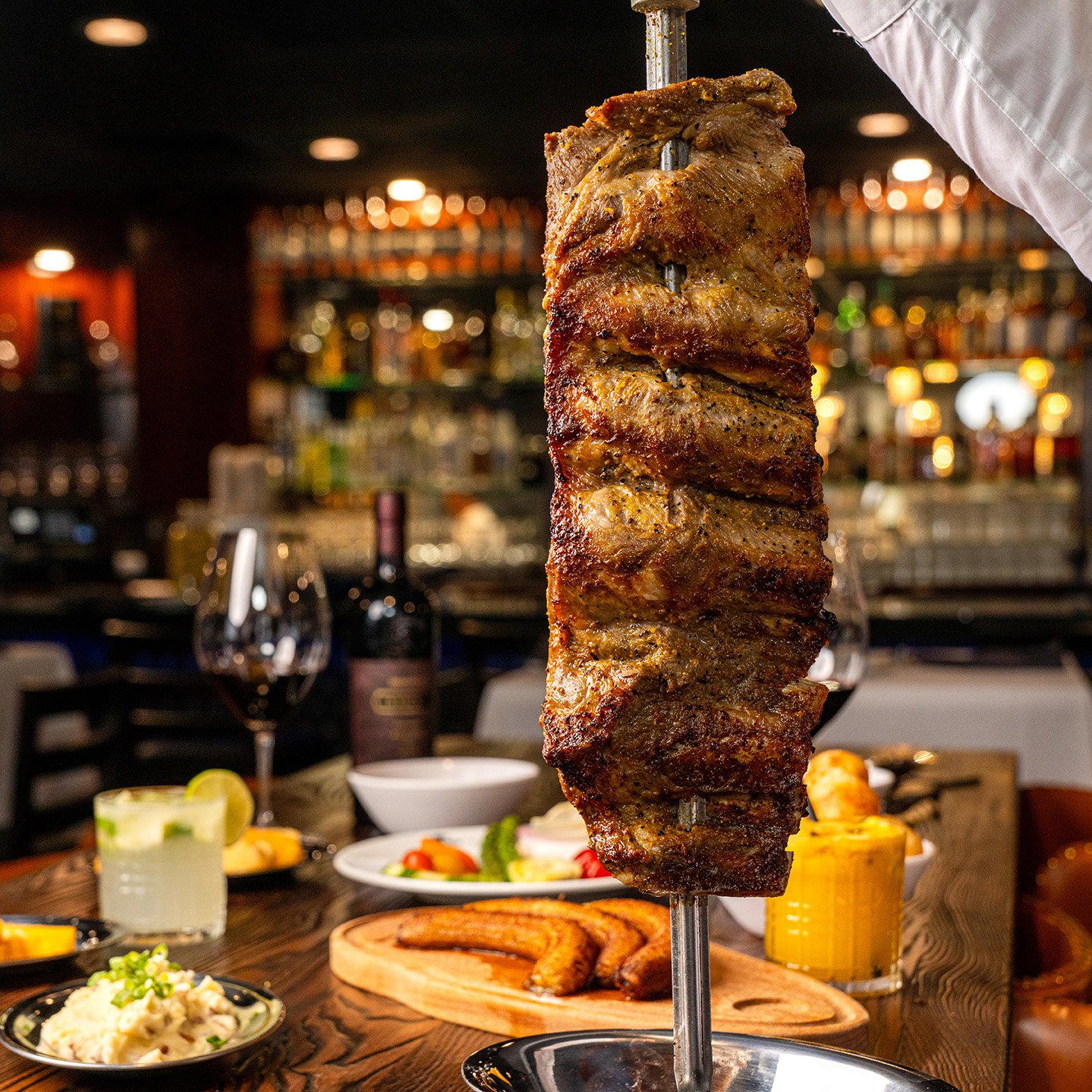
Where Gaucho Culture Meets the Pennsylvania Suburbs
The churrascaria model has a specific logic that takes a moment to register the first time you encounter it. There is no menu in the conventional sense. Servers move through the dining room carrying long skewers of fire-roasted meat, slicing portions tableside in a continuous rotation that only pauses when you flip a small disc from green to red. The rhythm of the meal is determined by the guest, not the kitchen's tasting arc. This format, which originated with the gaúcho cattle herders of Rio Grande do Sul in southern Brazil, traveled north through São Paulo and eventually into the United States as churrascaria chains expanded during the 1990s and 2000s.
The Gaucho Tradition and What It Actually Means at the Table
Brazilian churrasco is not simply grilled meat. The technique involves slow rotation over open flame or charcoal, with large cuts — picanha, fraldinha, costela — seasoned with coarse rock salt and cooked to different internal temperatures across a single service. The picanha, a cap of rump with a thick fat layer, is the defining cut: it arrives with the fat partially rendered, the interior pink, and the exterior carrying a char that the salt has pulled into a crust rather than a crust formed by dry rub. That specificity of cut and technique is what separates a serious churrascaria from a generic steakhouse that rotates skewers for theater.
The rodízio service model, where a fixed price covers unlimited tableside cuts, also structures the economics differently from a la carte steakhouses. Guests are expected to pace themselves, use the salad bar strategically as a counterweight to the protein parade, and treat the meal as a deliberate, extended occasion rather than a course-driven progression. The format rewards patience. For groups and celebratory tables, it has a social utility that individual plated entrées rarely match. The dining options skew toward reliable mid-range formats and Italian concepts. American steakhouse culture, from the classic New York chophouse to the contemporary tasting-menu format seen at venues like Smyth in Chicago or the farm-driven precision of Blue Hill at Stone Barns in Tarrytown, tends toward individual portion control and carefully staged progression. The churrascaria model inverts nearly every one of those conventions. There is abundance rather than restraint, communal rhythm rather than individual pacing, and a tableside theatrics that is functional rather than performative, the gaucho server is not presenting a dish, they are executing a butchering motion that affects the quality of the slice you receive. That contrast becomes useful context for understanding what kind of occasion Charkoal's is suited to. It is not the setting you choose when you want the quiet editorial control of a tasting menu at The French Laundry in Napa or Atomix in New York City. It is the setting you choose when the meal itself is meant to be a social event, when the group is large, and when the format's built-in generosity is part of the point. In a churrascaria, the strategic question is sequencing, not selection. The salad bar, typically covering cured meats, cheeses, grilled vegetables, farofa (toasted cassava flour), and vinaigrette-dressed sides, functions as a first course and a palate counterpoint, not a meal in itself. The mistake most first-timers make is filling up there before the skewers have made a full rotation. Among the meat cuts that define a serious churrascaria, picanha is the reference point: if the fat rendering and salt crust are well-executed, the kitchen understands the tradition. Lamb chops, when available, and chicken hearts, the latter a São Paulo street-food staple that migrated into the churrascaria format, are useful markers of how far the menu extends beyond the expected beef-heavy rotation. Pacing with the red-green disc is the single most useful piece of operational advice: flip to red early enough to rest between rounds, and return to green when you are ready to receive the cuts you actually want rather than accepting whatever the next server is carrying. The rodízio format makes it a natural choice for groups and celebrations, where the fixed-price structure simplifies the logistics of a shared bill. Because the venue data available does not include current pricing, hours, or booking method, confirming those details directly before visiting is the practical step. The format itself, however, has a known shape: expect the meal to run longer than a standard dinner out, build in time for the full rotation of cuts, and arrive with appetite rather than a light pre-dinner snack already consumed. For those interested in how the churrascaria format compares to other fire-driven or protein-focused dining traditions across the United States, the range runs from coastal fine-dining interpretations to suburban rodízio houses like this one. Venues such as Emeril's in New Orleans, Providence in Los Angeles, Lazy Bear in San Francisco, Le Bernardin in New York City, Single Thread Farm in Healdsburg, Addison in San Diego, The Inn at Little Washington, and Atelier Moessmer Norbert Niederkofler in Brunico each represent a different point on that wider spectrum of what fire and protein can mean in a formal dining context.How the Format Plays Against American Steakhouse Conventions
What to Order and How to Approach the Meal
Frequently asked questions
Is Charkoal's Brazilian Steakhouse child-friendly?
The rodízio format suits families with older children reasonably well — the tableside carving service removes the pressure of menu decisions, and the volume of food arriving continuously keeps the pace moving. Families with younger children should note that the King of Prussia commercial corridor draws a largely adult dining crowd, and churrascarias run at a social volume that may not suit quieter evenings with toddlers. The address at 220 N Gulph Rd places it within easy reach of the broader KOP area.
What should I expect atmosphere-wise at Charkoal's Brazilian Steakhouse?
Brazilian churrascarias in American suburban markets operate at a higher decibel level than a la carte steakhouses — the format is communal by design, and tableside carving from gauchos creates constant movement through the dining room. At 220 N Gulph Rd in King of Prussia, the surrounding commercial density means the clientele skews toward business gatherings and group celebrations rather than quiet couples' dinners. Plan for an animated room rather than a reserved one.
How does the rodízio format at Charkoal's Brazilian Steakhouse differ from a standard American steakhouse in King of Prussia?
At Charkoal's, located at 220 N Gulph Rd, King of Prussia, the rodízio model replaces the conventional à la carte ordering process entirely — there is no steak selected by cut and weight from a menu. Instead, gauchos rotate through the room carving directly from skewers until the guest signals to stop, which means the per-person experience is determined by pacing and protein preference rather than by individual selection. This positions Charkoal's in a distinct category from the standard American chophouse format that dominates the King of Prussia dining corridor.
What should I order at Charkoal's Brazilian Steakhouse?
In a rodízio format there is no ordering in the conventional sense, but sequencing matters. Prioritize picanha — the signature Brazilian rump cap cut — above other proteins when the gauchos come around, as it is the clearest benchmark for any churrascaria's execution. Hold off on filling up at the salad bar early; the cold station is better treated as a palate break between meat courses rather than a first course.
Booking and Cost Snapshot
Comparable venues nearby, for context on price, style, and recognition.
| Venue | Cuisine | Price | Awards | Notes |
|---|---|---|---|---|
| Charkoal's Brazilian SteakhouseThis venue — the venue you are viewing | Brazilian Rodízio Steakhouse | $30–50 | Not listed | Not listed |
| NM Cafe | Contemporary American Café | $30–50 | Not listed | King of Prussia, Contemporary American Café |
| Davio's Northern Italian Steakhouse | Northern Italian Steakhouse | $50–100 | Star Wine List · Wine Spectator Award of Excellence | King of Prussia, Northern Italian Steakhouse |
| La Pizza e La Pasta - King of Prussia | Neapolitan Pizza & Artisanal Pasta | $30–50 | Not listed | King of Prussia, Neapolitan Pizza & Artisanal Pasta |
| Kooma - King of Prussia | Asian Fusion Sushi Bar | $50–100 | Not listed | King of Prussia Town Center, Asian Fusion & Sushi |
| The Kibitz Room King of Prussia | Classic Jewish Deli | Not listed | Not listed | King of Prussia, Classic Jewish Deli |
Continue exploring
More in King of Prussia
Restaurants in King of Prussia
Browse all →
Bars in King of Prussia
Browse all →
Hotels in King of Prussia
Browse all →
Wineries in King of Prussia
Browse all →
Details
- Lively
- Energetic
- Group Dining
- Family
- Celebration
- Open Kitchen
- Prix Fixe
- Buffet
- Family Style
Current opening hours
- Monday
- 11:30 AM–10 PM
- Tuesday
- 11:30 AM–10 PM
- Wednesday
- 11:30 AM–10 PM
- Thursday
- 11:30 AM–10 PM
- Friday
- 11:30 AM–10:30 PM
- Saturday
- 11:30 AM–10:30 PM
- Sunday
- 11:30 AM–9 PM
Hours can change for holidays and private events. Last verified .
Lively atmosphere with attentive gaucho service circulating tableside grilled meats and a bustling salad bar.