
Cardón sits within a resort compound off the Pichilingue highway on the outskirts of La Paz, open to non-guests and positioned as one of the more serious dining addresses in Baja California Sur. The menu draws on the peninsula's distinctive ingredient pool, from Sea of Cortez seafood to regional produce, and pairs it with a wine selection that reflects the growing sophistication of Baja dining. It has been cited as one of the notable revelations of the region.
 Discover on Pearl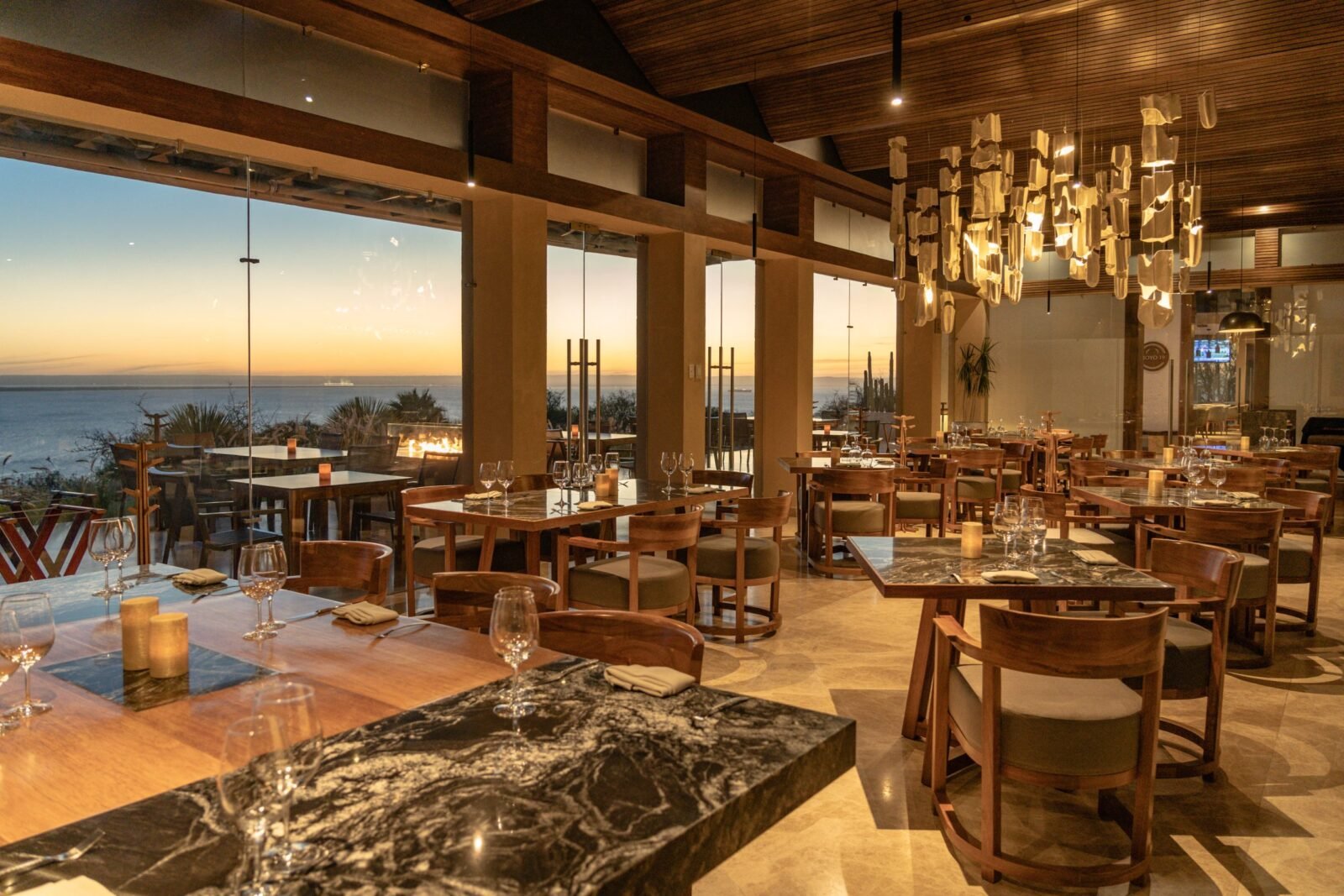
Where the Sea of Cortez Meets the Table
Driving north from La Paz along the Pichilingue road, the city's waterfront bustle gives way to quieter coastal scrubland, the kind of high-desert terrain that shapes Baja California Sur as much as its famous ocean does. At kilometre 7.5, the resort that houses Cardón marks a shift in register. The surroundings are calm by design, and that calm extends directly into the dining room. This is not a restaurant that competes with its environment for attention. It uses the environment as context.
That relationship between place and plate is central to understanding what Cardón is doing in the broader pattern of Baja dining. Across Mexico's peninsula, a generation of restaurants has moved away from generic coastal menus and toward something more grounded in the actual sourcing geography around them. The Sea of Cortez, one of the most biodiverse marine environments on the planet, sits minutes from this address. Local fishing communities have worked these waters for generations, and the leading Baja kitchens now treat that provenance as structural rather than decorative. Cardón belongs to that conversation.
The shortlist, unlocked.
Hard-to-book tables, cellar releases, and concierge-planned trips.
Get Exclusive Access →The Ingredient Logic of Baja California Sur
The editorial case for Baja as a serious food destination rests substantially on its ingredient conditions. The peninsula operates at a productive intersection: cold, nutrient-rich Pacific currents push through the Sea of Cortez, supporting fish and shellfish populations that most coastal regions would struggle to match. At the same time, the arid interior and the high-altitude farming pockets north toward Valle de Guadalupe produce herbs, chiles, and vegetables adapted to extreme conditions, with the concentrated flavour profiles that come from water-stressed growing. Restaurants that understand both zones, and can move between seafood-forward cooking and land-sourced complexity, have a structural advantage that coastal kitchens elsewhere simply do not.
Cardón's menu is described as varied and full of flavour, which in the context of Baja cooking typically signals a kitchen committed to working across this full ingredient range rather than narrowing into one register. The comparison set in La Paz is instructive. Jazamango has built its reputation on Mexican coastal cooking with strong regional sourcing credentials. Ancestral works further into pre-colonial ingredient traditions. Arami and Phayawi represent different points on the city's dining range. Gustu, with its South American framing, brings yet another sourcing philosophy to the city. Cardón occupies a position where resort setting and public access converge with genuine culinary ambition, a combination that is rarer than it sounds.
The Resort Context and What It Actually Means
Resort restaurants occupy a complicated position in any serious dining conversation. The assumption, often justified, is that captive audience dynamics soften the kitchen's edge: menus broaden to accommodate the risk-averse, sourcing becomes secondary to consistency, and wine lists fill with safe international selections. The more interesting counterexample, increasingly visible across Mexico, is the resort restaurant that treats its relative isolation as permission to do something specific rather than something generic.
Cardón has been recognised as one of the main revelations of Baja California Sur, which is a meaningful designation in a region now producing cooking that draws attention from critics watching the broader arc of Mexican gastronomy. For context, the conversations happening around Pujol in Mexico City or Animalón in Valle de Guadalupe have established a national framework within which regional restaurants are now evaluated. Baja kitchens are being held to a higher comparative standard than a decade ago, and recognition within that context carries weight.
The fact that Cardón is open to non-resort guests is worth noting practically. Many of La Paz's visitors arrive specifically to explore the region's marine environment, spending days on boats in the Sea of Cortez before returning to the city in search of a meal that matches the quality of what they have just experienced in the water. A restaurant at kilometre 7.5 on the Pichilingue road is well positioned for exactly that sequence, sitting between the city centre and the ferry terminal area where much of the marine activity originates.
Wine and the Baja Conversation
The wine selection at Cardón is specifically cited as a point of distinction, and this aligns with a broader shift in how Baja restaurants approach the beverage side of the menu. Valle de Guadalupe, roughly four hours north, has matured into one of Mexico's most serious wine-producing zones, and the better La Paz restaurants have responded by building lists that prioritise Baja producers rather than defaulting to Chilean or Spanish imports. That sourcing logic, applied to wine as well as food, creates a more coherent sense of place at the table. The pairing of Sea of Cortez seafood with Valle de Guadalupe white wine is not a regional novelty act; it is increasingly the baseline expectation at restaurants operating at this level.
For those building a wider picture of Mexico's current dining range, the comparison points extend well beyond the peninsula. HA' in Playa del Carmen, Le Chique in Puerto Morelos, KOLI Cocina de Origen in Monterrey, and Levadura de Olla in Oaxaca each represent a different regional interpretation of what serious Mexican cooking looks like in 2024 and beyond. Cardón belongs to that national map, at the Baja Sur coordinate, where the ingredient conditions are distinct enough to produce cooking that does not read like anywhere else in the country.
Planning Your Visit
Cardón sits at Carretera a Pichilingue km 7.5, in the Lomas de Palmira area outside La Paz, within a resort property that allows public dining access. The drive from the city centre takes roughly fifteen minutes and passes along the bay road, making it a reasonable dinner destination for visitors based in the city rather than the resort. For those building a broader La Paz itinerary, the full picture of what the city offers is covered in our full La Paz restaurants guide, alongside dedicated coverage of La Paz hotels, bars, wineries, and experiences. Phone and online booking details are not currently listed; approaching through the resort directly or arriving with flexibility on timing is the practical approach for now. Those accustomed to the reservation protocols at addresses like Le Bernardin in New York or Emeril's in New Orleans will find the booking process here considerably more relaxed, which, given the setting, is entirely appropriate.
Frequently Asked Questions
- Would Cardón be comfortable with kids?
- The resort setting and relaxed pace of the Pichilingue road make Cardón a reasonable choice for families dining in La Paz, more so than the city's tighter, more atmosphere-driven addresses.
- What is the atmosphere like at Cardón?
- The setting is a resort compound on the quiet northern approach to La Paz, which produces an atmosphere considerably calmer than the city's waterfront dining strip. Recognised as one of Baja California Sur's notable revelations, it positions itself above the typical resort-restaurant register without the formality that designation might imply in other cities.
- What do people recommend at Cardón?
- The menu's range and its engagement with regional flavour are the points most consistently noted by those familiar with the restaurant. Given the Baja context, Sea of Cortez seafood is the area of the menu most directly tied to the kitchen's sourcing advantage, and the wine list has been singled out as a specific strength.
- What's the leading way to book Cardón?
- Contact the resort directly, as no dedicated phone line or online booking system for the restaurant is currently listed publicly. Given Cardón's recognition within Baja California Sur's dining scene, reaching out in advance rather than walking in is the sensible approach, particularly during the high season between November and April when La Paz sees its highest visitor volume.
Fast Comparison
These are the closest comparables we have in our database for quick context.
Need a table?
Our members enjoy priority alerts and concierge-led booking support for the world's most difficult tables.
Get Exclusive AccessThe shortlist, unlocked.
Hard-to-book tables, cellar releases, and concierge-planned trips.
Get Exclusive Access →