Capital

Our verdict
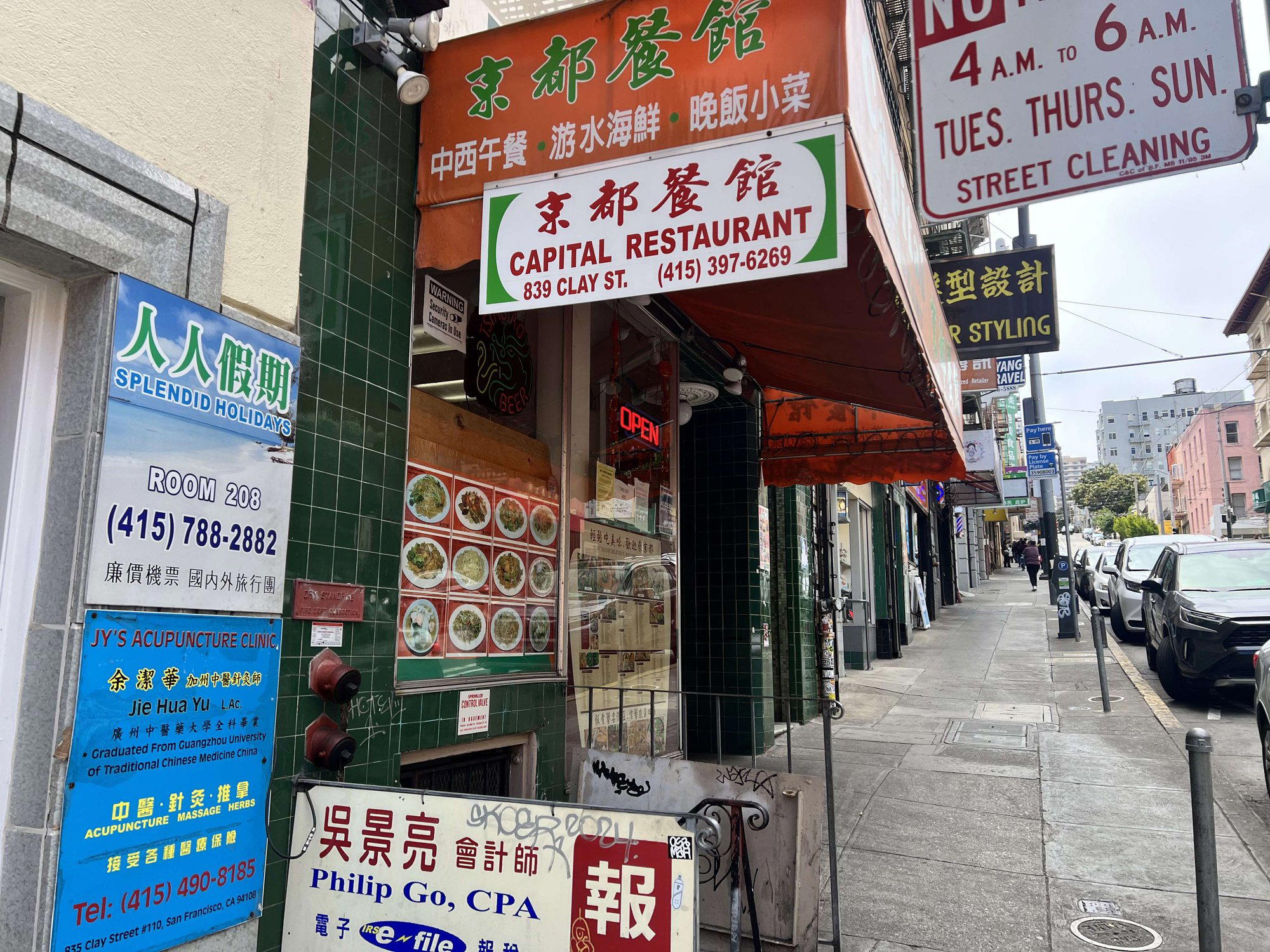
A Chinatown institution on Clay Street, Capital has operated since the 1980s and found renewed purpose under owner Samantha Lo, who took over in 2007 and sharpened a 100-item Cantonese menu around what has become one of San Francisco's most discussed fried dishes: salt-and-pepper wings with a shatter-crisp crust that carries across a room. Straightforward, unfussy, and consistent.

Pearl is the En Primeur Club membership app, where members save venues, book tables and use the concierge.
The menu
What to order
- Famous Chicken Wings
- Pot Stickers
Clay Street After Dark: Chinatown's Cantonese Standard-Bearer
San Francisco's Chinatown is the oldest in North America, and the restaurants along Clay, Sacramento, and Jackson streets have spent decades being filtered through two competing forces: the nostalgia of longtime residents who remember Hong Kong-style roast houses from the 1970s, and the appetite of a newer dining public that has little patience for frozen dim sum and fluorescent lighting. The restaurants that have survived that tension tend to share one quality, a willingness to commit to something specific rather than trying to please every table. Capital, at 839 Clay Street, has made that commitment through a particular piece of fried chicken.
The dining room itself reads like a working Cantonese restaurant that has no interest in performing its own history. The space is functional: round tables, the ambient noise of a full house, the kind of lighting that suggests the kitchen is the point. Entering on a weekday evening, the room tends to fill early and maintain pace through service, a pattern common among Chinatown restaurants that draw both neighbourhood regulars and visitors making the walk up from the Financial District.
One Hundred Items, One Signature
The menu at Capital runs to approximately 100 items, which places it in a category of Cantonese restaurants that function as full repertoire houses rather than edit-heavy modern operations. That breadth is its own editorial statement. In a city where the fine dining tier, represented by counters like Benu, with its French-Chinese synthesis, and destination restaurants like Atelier Crenn and Lazy Bear, tends toward tightly controlled, seasonal menus of 10 to 20 courses, a 100-item Cantonese menu represents a fundamentally different philosophy of hospitality. Choice, abundance, and table-style sharing are the organizing principles, not narrative tasting sequences.
Within that broad menu, the salt-and-pepper wings occupy a different tier of significance. That description is not embellishment. The crust on a properly executed salt-and-pepper preparation achieves a structural crispness that depends on dry-brined protein, a high-temperature fry, and immediate service, a chain of precision that can fail at any point. When it works, the sound is the evidence.
Sustainability and the Logic of the Full-Repertoire Kitchen
The editorial angle of environmental consciousness maps onto traditional Cantonese cooking in ways that are not always visible from the outside. Full-repertoire kitchens like Capital operate on a whole-utilization logic that predates the current sustainability vocabulary by several decades. In classic Cantonese practice, proteins are used completely, bones for stock, offal as featured dishes, fats rendered for cooking. A 100-item menu is not simply commercial ambition; it is the infrastructure required to use an ingredient at every stage of its useful life.
Salt-and-pepper preparations are a useful example. The technique, a dry seasoning applied to smaller cuts, fried at high heat, works well with wing sections that larger-format cooking deprioritizes. The dish is not a byproduct of waste reduction, but the cooking tradition it belongs to is one that has always found value in cuts and preparation methods that reduce what gets discarded. That tradition runs through Cantonese kitchens across San Francisco's Chinatown and connects Capital to a broader regional practice that the city's fine dining tier, for all its sourcing credentials, rarely matches in whole-animal efficiency.
For a point of comparison: restaurants operating at the other end of the price spectrum, Saison and Quince among them, have built significant reputations around ethical sourcing and seasonal discipline. Their sustainability credentials are public and well-documented. But the Cantonese full-menu model achieves utilization efficiency through cultural practice rather than programmatic commitment, and that distinction is worth noting when mapping the city's dining ecosystem.
Positioning in San Francisco's Chinese Restaurant Tier
San Francisco has a larger concentration of Cantonese restaurants than any American city outside New York, and within that concentration there is a clear differentiation between dim sum houses, roast-focused restaurants, banquet operations, and the kind of multi-purpose evening kitchen that Capital represents. The Clay Street location places it in the core of the tourist-adjacent Chinatown corridor, but the restaurant's tenure, operating since the 1980s, with Lo's ownership shift in 2007 representing a turning point rather than a founding moment, gives it a standing in the neighbourhood that newer openings in adjacent districts cannot replicate.
The salt-and-pepper wings now function as a reference point in conversations about Chinatown dining in the same way that specific dishes at Le Bernardin in New York or Alinea in Chicago define what those restaurants are known for at the city level. It is a different tier of recognition, neighbourhood and word-of-mouth rather than awards-body citation, but it reflects the same mechanism: a single dish that becomes shorthand for a kitchen's capability.
For visitors working through the city's full range, Capital sits in a different competitive set from the $$$$ tasting-menu operations. It competes instead with the strong Cantonese field in the Richmond District and the dim sum anchors of the Sunset. Within that set, its current reputation rests primarily on the wings and on the consistency that Lo's 17-year ownership has produced. See the full San Francisco restaurants guide for broader context across price tiers and neighbourhoods, and the San Francisco hotels guide for accommodation options within reach of Chinatown. The bars guide, wineries guide, and experiences guide round out the city picture.
For comparison outside California, Cantonese kitchens operating at similar whole-menu scope appear in the peer sets of Atomix in New York's broader Asian dining conversation and at the intersection of classical French and Chinese technique visible at Benu. The distance between Capital's format and those operations measures how much San Francisco's dining culture spans in a single square mile.
Planning a Visit
Capital is located at 839 Clay Street in San Francisco's Chinatown, accessible on foot from the Financial District in under 15 minutes or via the California Street cable car line. The menu's breadth means that larger tables of three or more can cover significant ground; the wings are the entry point, but a 100-item menu rewards the kind of ordered exploration that a table of four can accomplish in a single sitting. For travellers planning a broader circuit that includes Single Thread Farm in Healdsburg or The French Laundry in Napa, Capital operates at a complementary register, unpretentious, neighbourhood-scaled, and entirely distinct from the wine-country dining circuit that dominates Northern California's premium travel conversation.
Frequently asked questions
Is Capital award-winning?
Capital has received recognition including: Capital opened in Chinatown in the 1980s, but credit for its current relevance goes to owner Samantha Lo, who bought the Cantonese restaurant in 2007. Lo introduced to the 100-item menu what is now the restaurant’s signature: the unbelievab….
How do I find Capital?
Capital is located at 839 Clay St, San Francisco, CA 94108, San Francisco.
What should I order at Capital?
Start with the salt-and-pepper wings, the dish that defined the restaurant's identity after Samantha Lo took over in 2007. The preparation depends on precise fry temperature and immediate service, and the result is audibly crispy. Beyond that, the 100-item menu covers the full Cantonese repertoire, so the table is worth building around multiple dishes.
What's the best way to book Capital?
No reservation platform is listed for Capital at 839 Clay Street. Walk-in is the standard approach for restaurants at this tier in San Francisco's Chinatown, so arrive early, particularly on weekends when Clay Street sees heavier foot traffic from both locals and visitors.
What's Capital best at?
The salt-and-pepper wings are the documented signature, a preparation that requires consistent execution and has anchored the restaurant's reputation since Samantha Lo's 2007 acquisition. More broadly, Capital functions as a full-repertoire Cantonese house, a category that rewards return visits rather than a single-dish visit.
Accolades, Compared
A short peer table to compare basics side-by-side.
| Venue | Cuisine | Price | Awards | Notes |
|---|---|---|---|---|
| CapitalThis venue (the venue you are viewing) | Cantonese Chinese | $10–20 | Not listed | Not listed |
| Lazy Bear | Modern American Tasting Menu | Not listed | 2 Michelin Stars · World's 50 Best #25 | Progressive American, Contemporary |
| Atelier Crenn | Contemporary French Fine Dining | $300–500 | 3 Michelin Stars · World's 50 Best #44 | Modern French, Contemporary |
| Benu | Modern Asian Fusion Fine Dining | $150–200 | 3 Michelin Stars · World's 50 Best #33 | French - Chinese, Asian |
| Quince | Modern French Fine Dining | $300–500 | 3 Michelin Stars · World's 50 Best #48 | Italian, Contemporary |
| Saison | Modern French-Italian | Not listed | Michelin Plate | Progressive American, Californian |
Recognition history
Dated appearances from independent guides and award organizations, with the underlying list record or original source where available.
San Francisco Chronicle Top 100 Bay Area Restaurants #97
San Francisco Chronicle
Continue exploring
More in San Francisco
Restaurants in San Francisco
All restaurants in San Francisco →

Bars in San Francisco
All bars in San Francisco →



Details
- Lively
- Family
- Casual Hangout
- Standalone
- A La Carte
- Vegetarian Friendly
Current opening hours
- Monday
- Closed
- Tuesday
- 11 AM–8 PM
- Wednesday
- 11 AM–8 PM
- Thursday
- 11 AM–8 PM
- Friday
- 11 AM–8 PM
- Saturday
- 11 AM–8 PM
- Sunday
- 11 AM–8 PM
Hours can change for holidays and private events. Hours as of .
Lively and chaotic during dinner rush with a casual, no-frills Chinatown atmosphere.