Café Spice Namasté
.png)

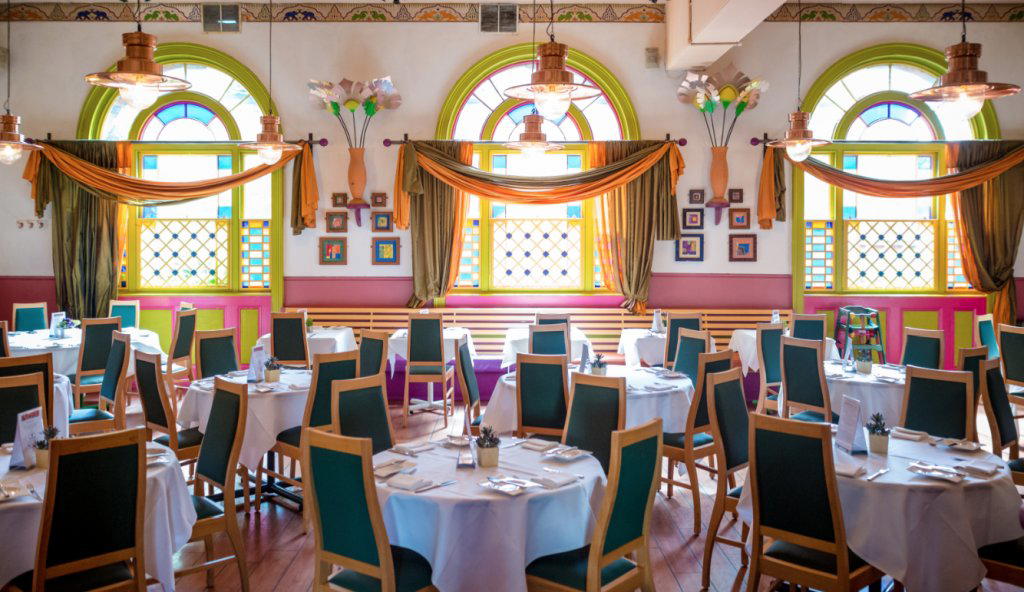
Café Spice Namasté occupies a colourfully decorated room on the ground floor of a Docklands apartment building overlooking the Royal Albert Wharf — a location that asks something of the visitor but pays back in kind. Chef-Owner Cyrus Todiwala draws from Goan and Bombay culinary roots, and the restaurant holds a Michelin Plate alongside consecutive Opinionated About Dining rankings in 2024 and 2025. The price point is accessible for the level of cooking on offer.

A Docklands Address That Demands the Trip
London's Indian restaurant scene has long clustered around zones that make geographical sense to visitors: Mayfair for high-ticket occasions, Soho and Fitzrovia for convenience, Tooting and Southall for depth of community cooking. The Docklands sits outside all of those patterns, which is precisely what makes Café Spice Namasté worth understanding on its own terms. The restaurant occupies the ground floor of a modern apartment building at 1-2 Lower Dock Walk, E16, with the Royal Albert Wharf visible through the windows. It is not a location that trading foot traffic built. It is a destination in the strict sense: you plan for it, you travel to it, and the commitment is part of the contract.
That geography has shaped the restaurant's character over time. Places that cannot rely on passing trade tend to develop a regulars culture with more depth than venues cushioned by tourist flow. The colourful interiors and the presence of Pervin Todiwala on the floor — described in Opinionated About Dining notes as a welcoming and delightful presence — speak to a room that has been running on loyalty and reputation rather than location advantage. The awards data confirms that the formula works: a Michelin Plate in both 2024 and 2025, and OAD Casual Europe rankings of #666 in 2024 climbing to #813 in 2025 across a much larger field.
The Goan-Bombay Axis and What It Actually Means on the Plate
Indian cooking in London has spent the last decade diversifying away from the generic north-Indian-curry-house template. The sharper end of the market now places restaurants by regional identity rather than by catch-all subcontinental positioning. Cyrus and Pervin Todiwala represent the Goa-Bombay corridor, a culinary pairing that draws on Catholic-influenced coastal cooking from one direction and the layered, cosmopolitan food culture of Maharashtra from the other.
Goan cooking carries Portuguese imprints that distinguish it from most of what London's Indian restaurants have historically served: vinegar-based marinades, pork as a centrepiece protein, coconut and tamarind as structural flavour elements rather than garnish. Bombay, now Mumbai, sits in a different register , street-food sophistication, Parsi influences, snack culture refined over generations of urban density. The Todiwalas draw from both sides, and the tension between those two traditions is what makes the food interesting rather than merely consistent.
Chicken cafrael is listed as a speciality: the dish originates in Goa with roots in the cafreal preparation brought by African soldiers in Portuguese colonial service, typically involving a green spice paste with coriander, ginger, garlic, and chillies applied to chicken before grilling or pan-frying. Cheese chilli toast signals the Bombay street-food lineage , a snack that belongs to the city's Irani café tradition. These are not fusion conceits; they are dishes with documented culinary geography, and presenting them as regional specialities rather than menu novelties marks a distinct editorial choice about what kind of Indian restaurant this is.
Where Café Spice Namasté Sits in London's Indian Restaurant Field
Positioning requires comparison. London's Indian restaurant tier with consistent awards recognition now spans several distinct registers. Amaya runs a live-fire grill format in Belgravia at the higher price bracket. Benares occupies a Mayfair address with corresponding price expectations and a Michelin star. Trishna in Marylebone focuses on coastal Indian cooking with a wine programme that draws serious attention. Ambassadors Clubhouse and Babur in Honor Oak Park offer further comparison points at the regional-speciality end of the market.
Café Spice Namasté at a single-pound price tier occupies a different value position from all of those. The combination of a Michelin Plate, consecutive OAD rankings, and a sub-premium price point is not common. For context, OAD's casual Europe list evaluates on value and cooking quality together, so a ranking in the 600-800 range places the restaurant in serious company for its tier. It is worth noting that the OAD ranking moved between the 2024 and 2025 lists , this is a function of the list's expanding field rather than a quality decline, but the continued inclusion in both years confirms consistent recognition.
For Indian cooking outside London, Opheem in Birmingham represents how the regional scene has developed beyond the capital. Internationally, Trèsind Studio in Dubai shows where modernist Indian cooking has pushed farthest in a fine-dining format. Café Spice Namasté is doing something different from both: it is a restaurant rooted in a specific family geography , two cities, two coastal traditions , operating without the apparatus of a tasting menu or a high-ticket price structure.
The Evolution: How the Restaurant Has Aged Into Its Reputation
Cyrus Todiwala has been part of London's food conversation long enough that the OAD notes describe him as approaching national treasure status. That phrase carries weight in a city where the Indian restaurant field has transformed repeatedly. When the restaurant opened in the East End, the Docklands was a development-in-progress rather than an established residential neighbourhood. The Royal Albert Wharf setting that now provides the view was itself part of that ongoing urban transformation. The restaurant did not benefit from arriving into a formed neighbourhood; it arrived early and waited for the area to catch up.
That patience is now visible in the quality of the regulars the restaurant has built. A room that makes sense geographically to a local residential community in E16 develops a different rhythm from venues in high-tourism zones. The fact that the awards recognition has continued and strengthened , two consecutive Michelin Plates, back-to-back OAD listings , suggests the cooking itself has held its line through what amounts to a long middle period between early reputation and settled institution. The colourful room and the presence of Pervin Todiwala in a front-of-house role that is clearly more than ceremonial are evidence of a family-run operation that has resisted the kind of format drift that afflicts restaurants when founding energy dissipates.
For visitors whose London dining usually runs through Mayfair, Marylebone, or Soho, travelling to E16 is a recalibration. It is also a reminder that the restaurants with the most settled sense of purpose are often the ones that geography forced into self-sufficiency earliest. See our full London restaurants guide for wider context across the city's dining range, or explore our London hotels guide, bars guide, experiences guide, and wineries guide to build a fuller itinerary.
For those building a wider programme around top-tier UK dining, the country's higher-end field includes The Fat Duck in Bray, L'Enclume in Cartmel, Moor Hall in Aughton, Gidleigh Park in Chagford, Hand and Flowers in Marlow, and hide and fox in Saltwood , a different register entirely, but useful context for where Café Spice Namasté sits within the broader awards ecosystem.
Frequently Asked Questions
What's the leading thing to order at Café Spice Namasté?
The dishes most directly tied to the restaurant's culinary identity are the Goan and Bombay specialities that reflect the Todiwalas' respective regional roots. Chicken cafrael , a Goan preparation with a green spice-paste marinade tracing back to the Portuguese colonial period in coastal India , is cited as a signature, as is cheese chilli toast, which belongs to the Irani café and street-food tradition of Mumbai. These are not menu-wide discoveries; they are the specific dishes that differentiate Café Spice Namasté from London's broader Indian restaurant field and carry the clearest connection to the regional cooking the Todiwalas have spent decades documenting and serving. The Michelin Plate recognition and consecutive OAD rankings both sit alongside the restaurant's consistent focus on these specialities, which is the strongest available signal about where the kitchen's confidence is concentrated.
Local Peer Set
A quick peer snapshot; use it as orientation, not a full ranking.
| Venue | Cuisine | Price | Notes |
|---|---|---|---|
| Café Spice Namasté | Indian | £ | This venue |
| The Ledbury | Modern European, Modern Cuisine | ££££ | Modern European, Modern Cuisine, ££££ |
| Sketch, The Lecture Room and Library | Modern French | ££££ | Modern French, ££££ |
| CORE by Clare Smyth | Modern British | ££££ | Modern British, ££££ |
| Restaurant Gordon Ramsay | Contemporary European, French | ££££ | Contemporary European, French, ££££ |
| Dinner by Heston Blumenthal | Modern British, Traditional British | ££££ | Modern British, Traditional British, ££££ |
Need a table?
Our members enjoy priority alerts and concierge-led booking support for the world's most difficult tables.
Access the Concierge