Bayrouti serves authentic Lebanese cooking at 13 Rue Thomassin in Lyon, with Fatteh aux pois chiches, Fattouch, and Batata Harra for lunch or dinner.
Pearl is the En Primeur Club membership app — saves, bookings, and concierge access live there. Same editors, same standards.
- Address
- 13 Rue Thomassin, 69002 Lyon, France
- Phone
- +33472312216
- Website
- restaurantbayrouti.fr
- Directions
- Get directions
 Saves & bookings on Pearl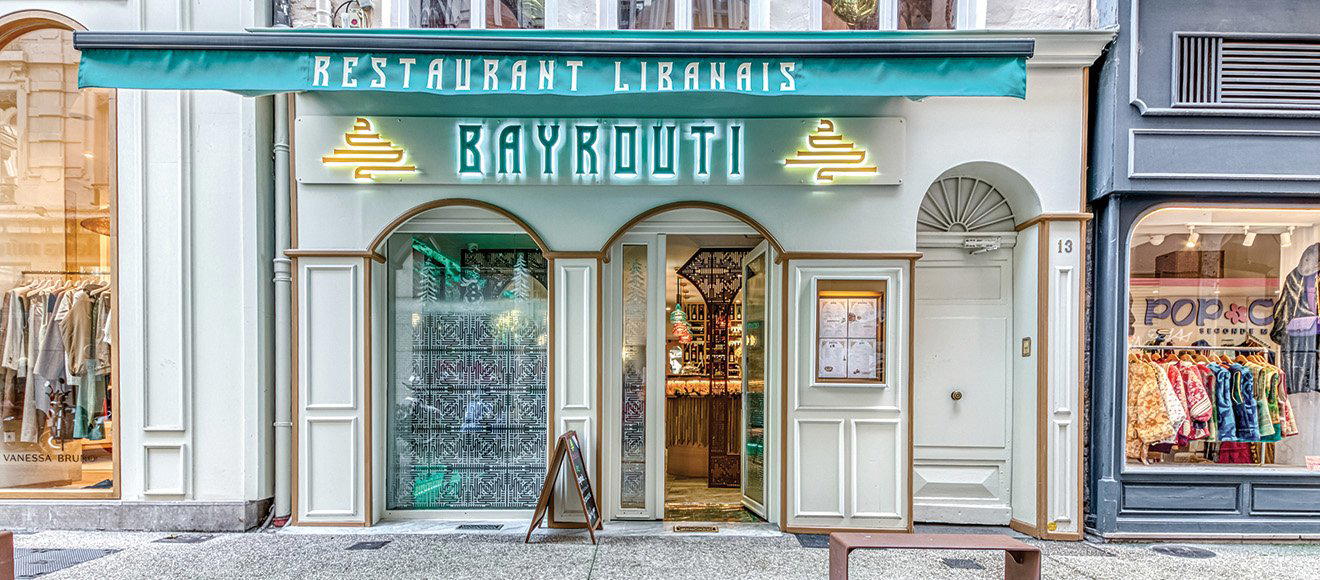
Lebanese Cooking in a French City That Takes Food Personally
Lyon operates on a particular kind of culinary pride. The city that produced Paul Bocuse and gave France its La Mère Brazier tradition does not absorb outside cuisines passively. When a restaurant from another culinary tradition takes root here, it faces an unusually demanding audience. Bayrouti, at 13 Rue Thomassin in the 2nd arrondissement, occupies that position: a Lebanese address in a city that measures restaurants against a long and serious benchmark.
Rue Thomassin sits in Presqu'île, the peninsula between the Rhône and the Saône that forms Lyon's commercial and gastronomic centre. The streets here carry the density of a city that has been feeding people seriously for centuries. Walking in from Place Bellecour, you pass bouchon signs and wine shop windows before arriving at an address that announces something different — a kitchen tradition rooted not in Burgundy or the Rhône Valley but in the eastern Mediterranean.
The Architecture of Lebanese Food
Lebanese cuisine is one of the most structurally sophisticated traditions in the Arab world, and understanding that structure matters when assessing a restaurant that represents it. The meze format — a progression of small dishes that builds a meal through accumulation rather than hierarchy, is not merely a service style. It reflects a culinary logic in which balance, proportion, and the relationship between cold and hot preparations carry as much weight as any single dish. Hummus, fattoush, kibbeh, and grilled meats are not interchangeable components; they occupy specific positions in a meal with internal architecture.
That architecture is what distinguishes serious Lebanese cooking from the simplified version that travels badly. The quality of the olive oil, the sourness level of the labneh, the char on the aubergine for moutabal, the freshness of the herbs in tabbouleh, these are the calibration points by which Lebanese diners, and increasingly informed Western ones, assess a kitchen. In Lyon, where the equivalent calibration points for a bouchon (the correct texture of quenelles, the depth of a tablier de sapeur) are points of civic conversation, Bayrouti enters a city that understands what precision in a culinary tradition actually means.
Presqu'île and the Geography of Lyon's Dining
The 2nd arrondissement is where Lyon concentrates much of its serious restaurant density. Le Neuvième Art and Takao Takano represent the contemporary French end of this concentration, while Au 14 Février and Burgundy by Matthieu occupy different points on the creative-to-classic spectrum. The neighbourhood rewards walking: restaurants arrive in clusters, and a single street can hold three or four rooms worth serious attention.
Within that geography, Bayrouti addresses a gap. Lyon's restaurant density skews heavily French, with meaningful representation from Italian and Japanese kitchens but fewer addresses that engage seriously with Middle Eastern culinary traditions. A Lebanese address in Presqu'île is, in that sense, filling a specific space in the city's dining map rather than competing directly with its French peers. The comparative frame shifts: the relevant question is not how Bayrouti compares with the bouchon tradition but how it holds up against the standard of Lebanese cooking in cities where that tradition has deeper roots.
What Lebanese Cuisine Demands of a Kitchen
The demands are significant. Unlike French cuisine, where the brigade system and formal training pathways are well-documented, Lebanese cooking transmits largely through family and regional networks. The vocabulary of a serious meze table, the right texture of makanek sausages, the correct method for kaak pastry, the sourness calibration of kishk, does not come from culinary school curricula. It comes from accumulated domestic knowledge, which means that kitchens representing this tradition at a serious level are doing something structurally different from their toque-wearing neighbours.
That difference matters editorially. When Lyon's dining establishment celebrates Paul Bocuse's Auberge du Pont de Collonges or the Troisgros family at Le Bois sans Feuilles, it is recognising codified mastery within a documented tradition. Bayrouti's kitchen draws on a different kind of institutional memory, one that is equally deep but less formally credentialled in the French system. This is not a disadvantage; it is simply a different relationship between a restaurant and the culinary tradition it represents.
Lyon in the Broader French Restaurant Context
Lyon's dining identity does not exist in isolation. The city's gravitational pull on serious eaters in France places it alongside addresses from Flocons de Sel in Megève and Bras in Laguiole in the mental map of French regional cooking. Further north, Auberge de l'Ill in Illhaeusern and Les Prés d'Eugénie in Eugénie-les-Bains anchor the Alsatian and southwestern ends of that same circuit. Internationally, the comparison set for high-level French dining extends to rooms like Mirazur in Menton, Alléno Paris au Pavillon Ledoyen, and La Table du Castellet. For readers moving between those circuits and Lyon's own scene, a full orientation is available in our full Lyon restaurants guide.
Bayrouti sits outside that French lineage entirely, which is precisely what gives it a specific function in Lyon's dining week. After a run of tasting menus and wine-paired progression dinners, a Lebanese meze table offers a structurally different evening, convivial, lateral, designed for sharing rather than sequential revelation. The rhythm of a meze meal, where the table fills quickly and eating is non-linear, provides a counterpoint to the paced formality that defines much of Lyon's serious dining.
Planning Your Visit
Bayrouti is at 13 Rue Thomassin, 69002 Lyon, in the Presqu'île district and accessible from Place Bellecour within a few minutes on foot. Given the limited publicly available information about booking method, hours, and pricing, contacting the restaurant directly before visiting is the practical approach. For readers exploring Lyon's wider dining options and wanting to plan across multiple meals, our full Lyon guide covers the full spectrum from bouchons to contemporary tasting-menu rooms. Those with interest in how other cities handle similarly cross-cultural dining in a formal French context may find comparison useful at rooms like Le Bernardin in New York or Lazy Bear in San Francisco, where the question of culinary tradition and its transmission takes different but parallel forms. For additional context on Georges Blanc's approach to regional French tradition as a point of reference, Georges Blanc in Vonnas offers the Bresse-anchored counterpoint.
Continue exploring
More in Lyon
Restaurants in Lyon
Browse all →
Bars in Lyon
Browse all →
Hotels in Lyon
Browse all →

At a Glance
- Elegant
- Cozy
- Modern
- Date Night
- Casual Hangout
- Terrace
Current opening hours
- Monday
- 12–2 PM, 7–10 PM
- Tuesday
- 12–2 PM, 7–10 PM
- Wednesday
- 12–2 PM, 7–10 PM
- Thursday
- 12–2 PM, 7–10 PM
- Friday
- 12–2 PM, 7–10:30 PM
- Saturday
- 12–2:30 PM, 7–10:30 PM
- Sunday
- 12–2:30 PM, 7–10 PM
Hours can change for holidays and private events. Last verified .
Refined and elegant with warm, exotic atmosphere.
Know Before You Go
- Getting there
- 13 Rue Thomassin, 69002 Lyon, France