Ann Chin Popiah operates from a stall on the second floor of Chinatown Complex Food Centre on Smith Street, where one of Singapore's most practised popiah traditions plays out daily. The format is assembly-line precise: fresh wheat skins wrapped around a braised turnip filling, dressed with sauces and garnishes in a specific order. For visitors tracking Singapore's hawker culture, this is a reliable reference point for the dish in its Hokkien form.
Pearl is the En Primeur Club membership app — saves, bookings, and concierge access live there. Same editors, same standards.
- Address
- 335 Smith St, #02-112, Singapore 050335
- Phone
- +6581894699
- Website
- annchinpopiah.com.sg
- Directions
- Get directions
 Saves & bookings on Pearl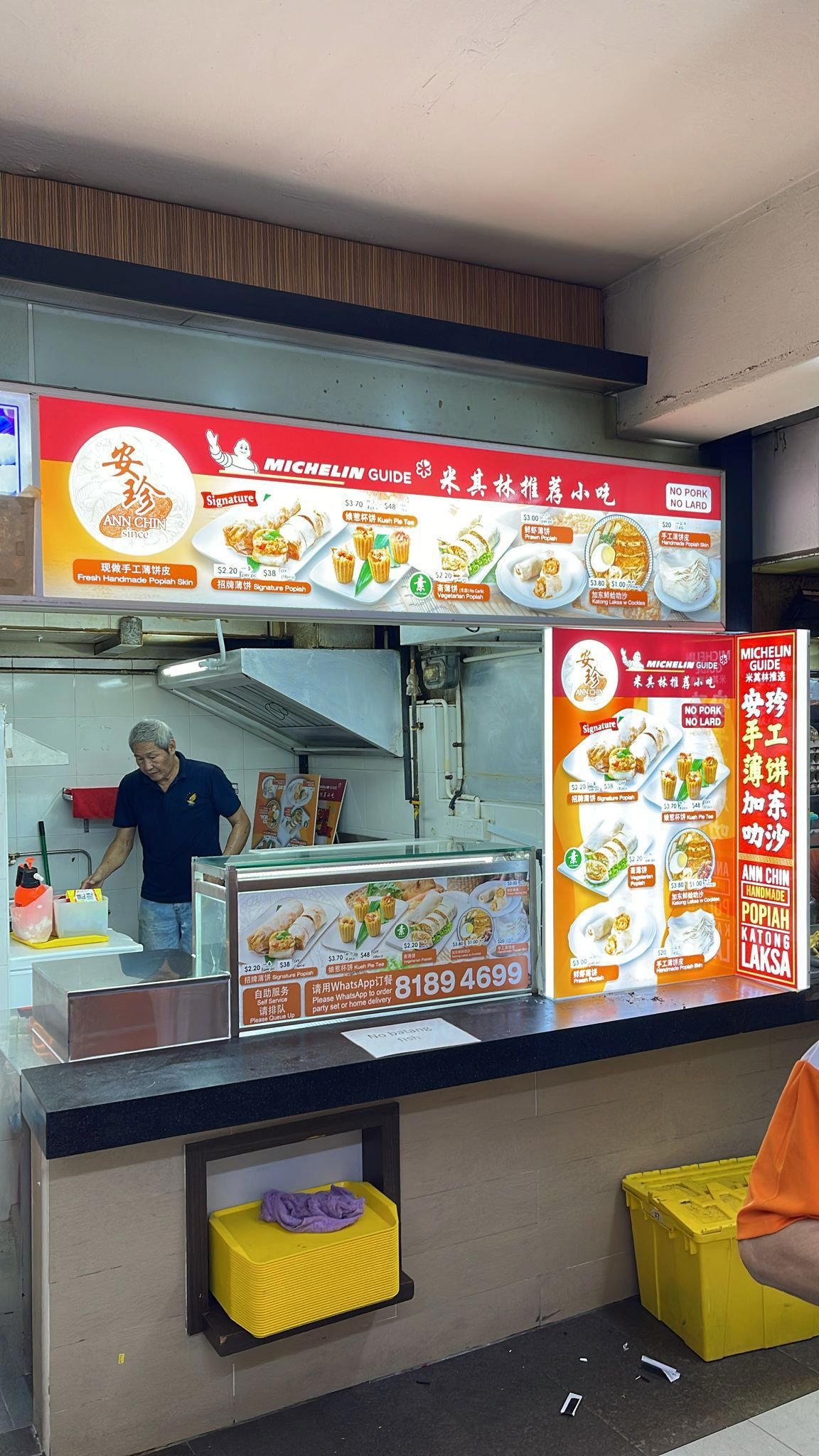
The Counter, the Queue, and the Protocol
Ann Chin Popiah is a hawker stall in Chinatown Complex Food Centre on Smith Street, Singapore, serving traditional handmade popiah at stall 02-112. The second floor hums with the compressed heat of dozens of stalls, ceiling fans doing modest work overhead, the air carrying layers of char, soy, and fresh dough. Ann Chin Popiah occupies a counter in that environment, and the experience of eating here is inseparable from it. This is hawker dining in its least mediated form: no reservation system, no printed menu handed to you at a table, no sommelier pass. You read the board, you join the queue, you watch the assembly, and you eat.
What that history produced is a dining format with its own etiquette, its own pacing, and its own kind of expertise distributed across both sides of the counter. The stall operator knows the order of construction. The regular customer knows when to arrive. The first-timer learns fast.
Popiah as a Ritual Form
Popiah is one of the more demanding dishes in the Hokkien-Peranakan canon precisely because it is assembled to order and relies on the interaction of multiple components rather than a single cooked element. The wheat skin wrapper, thin enough to be semi-translucent when fresh, provides structure without competing with the filling. The braised turnip, cooked down with carrots, sometimes egg and dried shrimp depending on the version, carries the body of the dish. What surrounds it, the layering of sweet sauce, chilli, crushed peanuts, garlic, lettuce, and bean sprouts, determines the character of each portion.
At a counter like Ann Chin Popiah, that assembly is not customisable in the way a modern restaurant might frame customisation. There is a correct order of operations, and the person behind the counter executes it according to the house method. The diner's role is to indicate preferences at most, not to direct the build. This is the ritual dimension of the dish: you are receiving a tradition, not composing a meal from scratch.
Across Singapore, popiah quality is measured by the freshness of the skin (made daily or delivered in tight windows), the moisture level of the turnip filling (neither too dry nor so wet it tears the wrapper), and the calibration of the sweet and chilli sauces. These are the same parameters that make Peranakan home-cooking versions and hawker versions comparable, even across different price points and settings. Ann Chin Popiah sits within that hawker tradition, at Chinatown Complex, which itself sits at the denser, more local end of Singapore's food infrastructure.
Chinatown Complex in Context
Chinatown Complex is the largest hawker centre in Singapore by stall count, with over 260 food and market stalls across its floors. It draws a mixed crowd: residents from the surrounding HDB blocks, office workers from the Outram and Tanjong Pagar belt, and visitors who treat it as an alternative to the food courts inside tourist-facing malls. The address on Smith Street places it a short walk from the MRT at Chinatown station, accessible enough that it functions as a practical lunch destination rather than a pilgrimage point.
For visitors already spending time in Outram, the food centre sits within a neighbourhood that covers significant culinary range. At the upper end of the register, Etna Restaurant and OSO Ristorante represent the Italian dining strand that has established a foothold in the district, while Guccio and Lime Restaurant extend that spectrum. The contrast with a hawker stall like Ann Chin Popiah is not incidental. It reflects how Outram functions as a district where Michelin-recognised hawker formats and sit-down restaurants coexist within walking distance of each other.
That Michelin context matters for understanding the restaurant's position in the broader scene. Liao Fan Hawker Chan, also operating within the Chinatown area, became one of the first hawker stalls globally to receive a Michelin star, which shifted how both local and international audiences think about hawker food as a category. That recognition did not make all neighbouring stalls equivalent, but it did establish that the format itself could carry serious culinary credentials. The restaurant operates in a food centre where that precedent is part of the ambient context.
Planning a Visit
The stall is on the second floor of Chinatown Complex Food Centre at 335 Smith Street, stall number 02-112. The restaurant is open daily from 8am to 8pm. The practical approach is to arrive before the peak lunch window, roughly 11:30am to 1pm on weekdays, when queues at popular stalls lengthen considerably. Payment at most Chinatown Complex stalls runs through cash or local digital payment systems; confirming the method at the counter takes seconds. Seating in hawker centres operates on a first-come basis, and it is standard practice to reserve a seat with a packet of tissues before joining a food queue.
For travellers building a broader Singapore itinerary around food, the restaurant fits naturally into a morning or lunchtime pass through Chinatown before moving on to the more formal dining options in the city. Those looking to benchmark Singapore's hawker culture against its fine dining scene might also consider the contrast with Les Amis in Singapore or Béni in Orchard. Across the island, parallel experiences in different formats can be found at 大巴窑93茶粿 in Kallang, Fu He Delights 福和 in Rochor, and KTMW chicken rice tea-cafe in Bedok, each representing a different hawker tradition in a different part of the city. Our full Outram restaurants guide maps the wider district for those spending more time in the area.
For context on how Singapore's hawker culture compares globally, the gap between a popiah counter in Chinatown Complex and a multi-course tasting menu at Le Bernardin in New York City or Atomix in New York City is not simply one of price. It is a difference in dining philosophy, format, and the relationship between diner and cook. Singapore's hawker tradition is one of the few in which that informality carries equivalent depth. Also worth exploring for broader comparisons: Imperial Treasure Fine Chinese Cuisine in Downtown Core, Asian Twist by 365 Food in Queenstown, Haidilao Hot Pot at Sun Plaza in Sembawang, Du Du Shou Shi in Jurong West, and Little Italy - Katong in Marine Parade.
Category Peers
Comparable venues nearby, for context on price, style, and recognition.
| Venue | Cuisine | Price | Notes |
|---|---|---|---|
| Ann Chin PopiahThis venue — the venue you are viewing | Traditional Handmade Popiah | $ | Not listed |
| Liao Fan Hawker Chan | Hong Kong Soya Sauce Chicken Rice & Noodle | $ | Chinatown |
| Side Door | Modern Cocktail Bar with Small Plates | $$ | Outram |
| The Store | Singaporean Char Kway Teow | $ | Outram |
| Guccio | Modern Italian Fine Dining | $$$$ | Outram |
| Shin Gi Tai | Japanese Bar with Cocktails | $$$ | Outram |

At a Glance
- Classic
- Casual Hangout
- Family
- Standalone
Current opening hours
- Monday
- 8 AM–8 PM
- Tuesday
- 8 AM–8 PM
- Wednesday
- 8 AM–8 PM
- Thursday
- 8 AM–8 PM
- Friday
- 8 AM–8 PM
- Saturday
- 8 AM–8 PM
- Sunday
- 8 AM–8 PM
Hours can change for holidays and private events. Last verified .
Bustling hawker centre atmosphere with fresh popiah rolled to order amid the lively energy of a traditional food market.