5.8 Undersea Restaurant
Our verdict
Five Metres Below the Surface There is a particular quality of light at reef depth that no architect can manufacture on land. It filters in layers — diffuse at the water's surface, then progressively cooler and more diffuse as the reef canopy takes over. At 5.8 Undersea Restaurant, set within Hurawalhi Island Resort in Lhaviyani Atoll, that light becomes the primary design element. The tunnel descent from the island above is short, but the shift in atmosphere is immediate: the ambient noise of the atoll disappears, replaced by the muffled pressure of open water and the slow movement of reef fish across curved acrylic panels. At 5.8 metres below the ocean surface, the restaurant sits within what is consistently cited as the largest all-glass underwater structure used for dining anywhere in operation. The geometry matters as much as the depth: the curved panels wrap the room on multiple sides, removing the framed-window effect common to most underwater viewing installations and replacing it with something closer to full immersion. The reef does not feel displayed. It feels present. What the Atoll Provides Lhaviyani Atoll sits roughly 140 kilometres north of Malé, separated from the more heavily trafficked central atolls by enough distance that its reef systems have retained measurable biodiversity. The atoll is known within Maldivian dive culture for consistent visibility and a resident population of larger pelagic species alongside the smaller reef community. That context is not incidental to the dining experience at 5.8 — it determines it. The species visible through the restaurant's panels on any given evening depend on the season, the tidal cycle, and the atoll's own biological patterns. In Maldivian resort dining more broadly, ingredient sourcing operates within a specific set of constraints. The islands are remote, freshwater is limited, and agricultural land is essentially non-existent. This means that the food arriving on any resort table in the atolls has traveled considerable distances, and the question of sourcing is less about local farms than about supply chain discipline and what the ocean itself provides. For an underwater restaurant positioned on an active reef, the surrounding marine environment functions as both the visual subject of the meal and, in any competently run kitchen, a direct reference point for what belongs on the plate. Reef-adjacent menus that draw on Indian Ocean fish species, caught through responsible supply lines rather than reef extraction, hold a coherence that menus assembled purely from imported product cannot replicate. This is a tension that the wider Maldives dining circuit has begun to address more directly. Properties like Aragu at Velaa Private Island and Le 1947 at Cheval Blanc Randheli have built menus that engage with provenance at the fine-dining level, while others operate more squarely in the international luxury hotel register. For our full overview of how different Maldives properties handle this, see our full Lhaviyani Atoll restaurants guide. The Underwater Dining Category in Context Underwater restaurants represent a small and specialist segment of destination dining globally. The format poses genuine operational challenges, pressurised access, structural maintenance of large acrylic panels, and kitchen logistics that have to function across a descent that most conventional hospitality builds never contend with. The few properties that have executed the format at scale tend to be in the Maldives, where resort infrastructure budgets and the physical environment align in ways that are difficult to replicate elsewhere. The closest comparator within the Maldives is Ithaa at Rangali Island, which opened in 2005 and is widely credited as the first all-glass undersea restaurant globally. Sea Underwater Restaurant at Kihavah Huravalhi represents another point on the same spectrum. 5.8 at Hurawalhi differentiates on panel scale and depth, positioning itself as a structural advancement on what the format had previously achieved. For travellers comparing these properties directly, the relevant variables are reef quality at each location, the menu approach, and the access format, factors that shift materially between atolls. For contrast from outside the underwater category, the Maldives' overwater and beach-facing fine dining options include Ozen Life Maadhoo, Terra Maldives at Ithaafushi, and Alba in Vommuli, each of which takes a different approach to how setting and cuisine interact. Outside the Maldives entirely, the closest reference points for destination dining where environment functions as an active element of the meal rather than backdrop are places like Le Bernardin in New York City, where the ocean as culinary subject is treated with similar seriousness, or Lazy Bear in San Francisco, where the setting's theatricality is structural to the format. Planning the Visit Hurawalhi Island Resort is accessible from Malé by seaplane, with the flight covering roughly 45 minutes across the northern atolls. Seaplane transfers in the Maldives operate within daylight hours, which makes arrival and departure timing a practical consideration for any multi-night stay. Reservations for 5.8 Undersea Restaurant are handled through the resort directly, and given the capacity constraints of an underground structure, demand from resort guests typically means advance booking is advisable. The restaurant operates as a destination experience within the broader resort, staying at Hurawalhi is the standard route to access. For travellers building a broader Maldives itinerary that includes dining at other properties, the comparison circuit also extends to Jing Restaurant at Constance Halaveli, Alizee Restaurant in Moofushi, and Li Long in the Maldives. The optimal time to visit Lhaviyani Atoll for reef visibility is broadly the dry season, running from November through April, when surface conditions are calmer and underwater light penetration is at its highest. What you see through the panels is, ultimately, determined by the atoll, not the kitchen. That dependence on natural systems is precisely what makes the format compelling and, occasionally, unpredictable. Frequently Asked Questions Can I bring kids to 5.8 Undersea Restaurant?At this price tier and location in Lhaviyani Atoll, 5.8 Undersea Restaurant is positioned as an adult-oriented destination dining experience; families with children should confirm the resort's age policy directly before booking.Is 5.8 Undersea Restaurant formal or casual?If you are arriving from a Maldives resort context, expect smart-resort dress rather than black-tie formality, the setting is theatrical by nature of its location, not by service register. That said, for a dedicated dinner reservation in an all-glass underwater structure in the Indian Ocean, resort-smart attire reads as appropriate; the ambience will outpace whatever you wear.What's the must-try dish at 5.8 Undersea Restaurant?Order whatever the kitchen is sourcing from Indian Ocean waters that evening.How does 5.8 compare to other underwater restaurants in the Maldives, specifically Ithaa at Rangali?Ithaa at Rangali, which opened in 2005, is the benchmark for the underwater dining format in the Maldives and is credited as the first all-glass undersea restaurant globally. 5.8 at Hurawalhi operates at a greater depth of 5.8 metres and within a larger acrylic structure, which changes both the light quality and the sense of reef immersion. The two properties sit in different atolls with distinct reef characters, so the choice between them is partly about the marine environment and partly about which resort's broader offering fits the itinerary, see also Sea Underwater Restaurant at Kihavah Huravalhi as a third point of comparison.

Pearl is the En Primeur Club membership app — saves, bookings, and concierge access live there. Same editors, same standards.
- Address
- Hurawalhi Island, Lhaviyani Atoll 20187 (underwater)
- Hours
- Daily 1:30–10 PM
- Directions
- Get directions
The menu
What to order
- Tuna Tartare
- Seared Scallop
- Poached Canadian Lobster
- Seared Wagyu Tenderloin
- Maldivian Reef Fish Carpaccio
- Alaskan King Crab
Five Metres Below the Surface
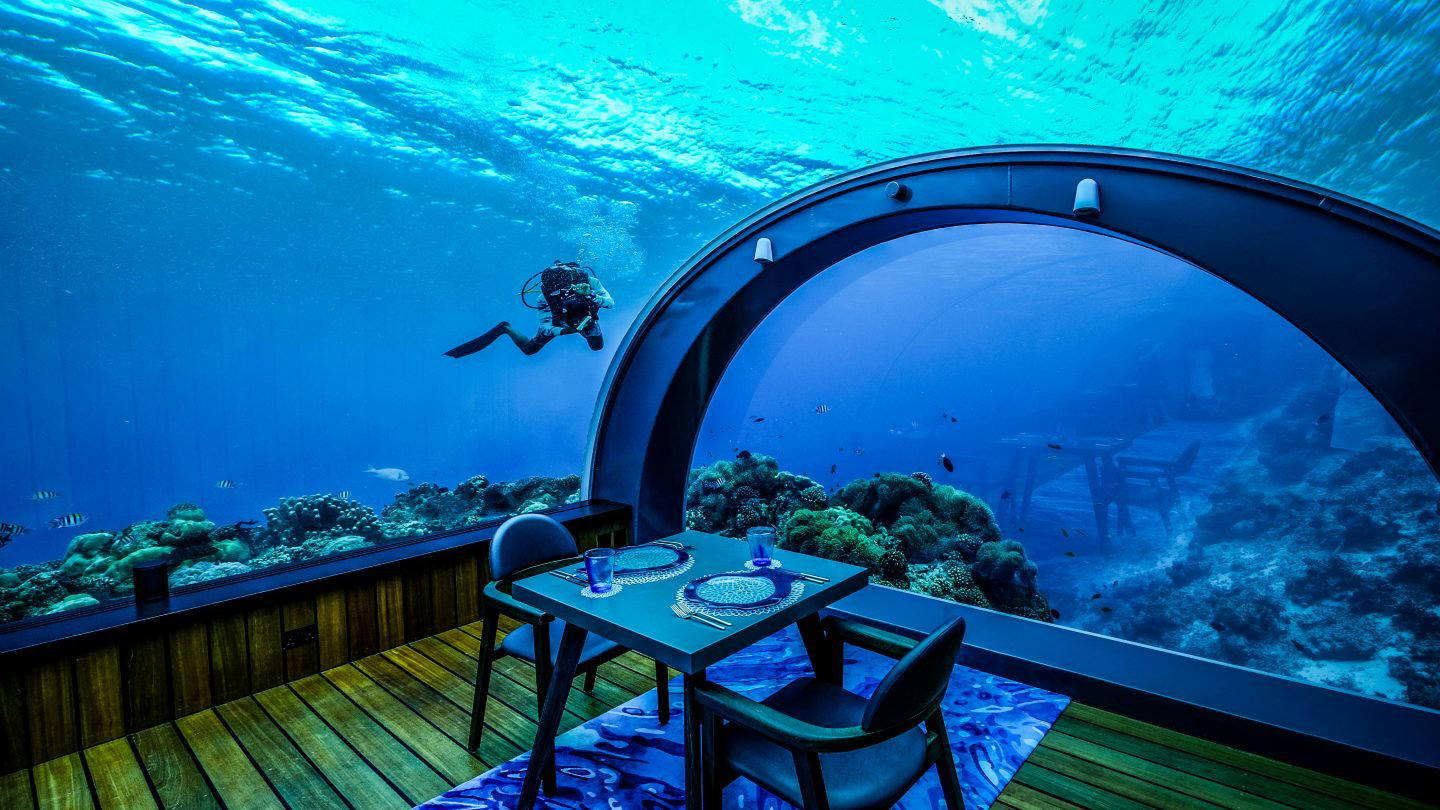
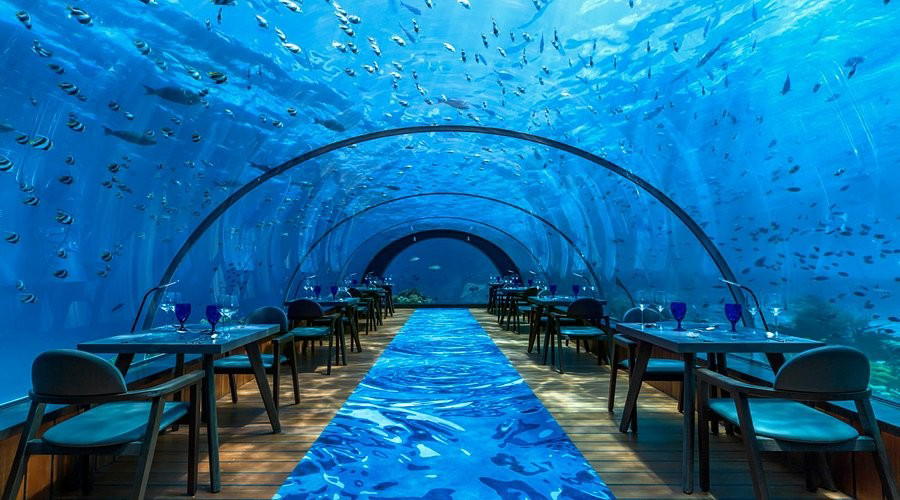
There is a particular quality of light at reef depth that no architect can manufacture on land. It filters in layers — diffuse at the water's surface, then progressively cooler and more diffuse as the reef canopy takes over. At 5.8 Undersea Restaurant, set within Hurawalhi Island Resort in Lhaviyani Atoll, that light becomes the primary design element. The tunnel descent from the island above is short, but the shift in atmosphere is immediate: the ambient noise of the atoll disappears, replaced by the muffled pressure of open water and the slow movement of reef fish across curved acrylic panels.
At 5.8 metres below the ocean surface, the restaurant sits within what is consistently cited as the largest all-glass underwater structure used for dining anywhere in operation. The geometry matters as much as the depth: the curved panels wrap the room on multiple sides, removing the framed-window effect common to most underwater viewing installations and replacing it with something closer to full immersion. The reef does not feel displayed. It feels present.
What the Atoll Provides
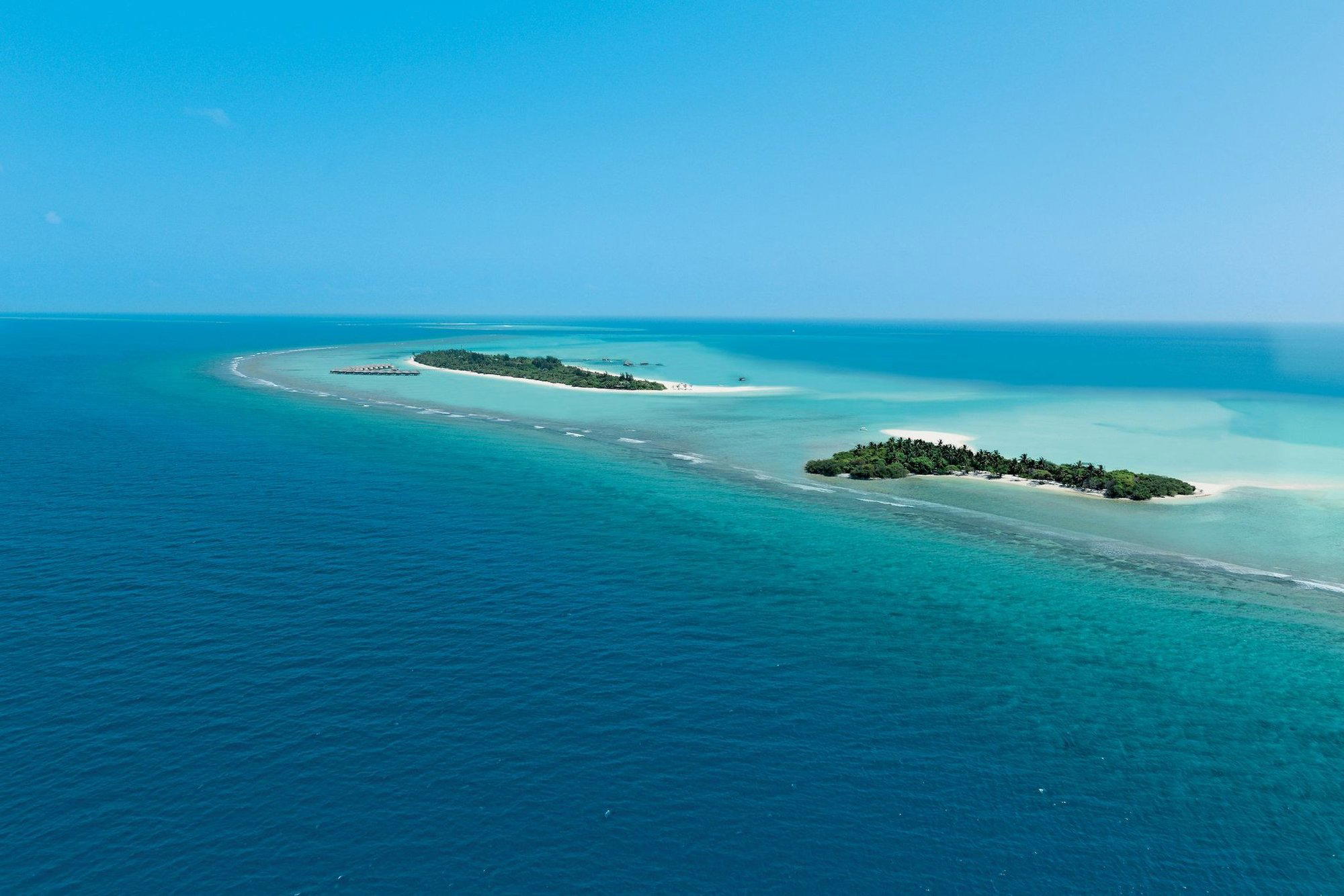
Lhaviyani Atoll sits roughly 140 kilometres north of Malé, separated from the more heavily trafficked central atolls by enough distance that its reef systems have retained measurable biodiversity. The atoll is known within Maldivian dive culture for consistent visibility and a resident population of larger pelagic species alongside the smaller reef community. That context is not incidental to the dining experience at 5.8 — it determines it. The species visible through the restaurant's panels on any given evening depend on the season, the tidal cycle, and the atoll's own biological patterns.
In Maldivian resort dining more broadly, ingredient sourcing operates within a specific set of constraints. The islands are remote, freshwater is limited, and agricultural land is essentially non-existent. This means that the food arriving on any resort table in the atolls has traveled considerable distances, and the question of sourcing is less about local farms than about supply chain discipline and what the ocean itself provides. For an underwater restaurant positioned on an active reef, the surrounding marine environment functions as both the visual subject of the meal and, in any competently run kitchen, a direct reference point for what belongs on the plate. Reef-adjacent menus that draw on Indian Ocean fish species, caught through responsible supply lines rather than reef extraction, hold a coherence that menus assembled purely from imported product cannot replicate.
This is a tension that the wider Maldives dining circuit has begun to address more directly. Properties like Aragu at Velaa Private Island and Le 1947 at Cheval Blanc Randheli have built menus that engage with provenance at the fine-dining level, while others operate more squarely in the international luxury hotel register. For our full overview of how different Maldives properties handle this, see our full Lhaviyani Atoll restaurants guide.
The Underwater Dining Category in Context
Underwater restaurants represent a small and specialist segment of destination dining globally. The format poses genuine operational challenges, pressurised access, structural maintenance of large acrylic panels, and kitchen logistics that have to function across a descent that most conventional hospitality builds never contend with. The few properties that have executed the format at scale tend to be in the Maldives, where resort infrastructure budgets and the physical environment align in ways that are difficult to replicate elsewhere.
The closest comparator within the Maldives is Ithaa at Rangali Island, which opened in 2005 and is widely credited as the first all-glass undersea restaurant globally. Sea Underwater Restaurant at Kihavah Huravalhi represents another point on the same spectrum. 5.8 at Hurawalhi differentiates on panel scale and depth, positioning itself as a structural advancement on what the format had previously achieved. For travellers comparing these properties directly, the relevant variables are reef quality at each location, the menu approach, and the access format, factors that shift materially between atolls.
For contrast from outside the underwater category, the Maldives' overwater and beach-facing fine dining options include Ozen Life Maadhoo, Terra Maldives at Ithaafushi, and Alba in Vommuli, each of which takes a different approach to how setting and cuisine interact. Outside the Maldives entirely, the closest reference points for destination dining where environment functions as an active element of the meal rather than backdrop are places like Le Bernardin in New York City, where the ocean as culinary subject is treated with similar seriousness, or Lazy Bear in San Francisco, where the setting's theatricality is structural to the format.
Planning the Visit
Hurawalhi Island Resort is accessible from Malé by seaplane, with the flight covering roughly 45 minutes across the northern atolls. Seaplane transfers in the Maldives operate within daylight hours, which makes arrival and departure timing a practical consideration for any multi-night stay. Reservations for 5.8 Undersea Restaurant are handled through the resort directly, and given the capacity constraints of an underground structure, demand from resort guests typically means advance booking is advisable. The restaurant operates as a destination experience within the broader resort, staying at Hurawalhi is the standard route to access. For travellers building a broader Maldives itinerary that includes dining at other properties, the comparison circuit also extends to Jing Restaurant at Constance Halaveli, Alizee Restaurant in Moofushi, and Li Long in the Maldives.
The optimal time to visit Lhaviyani Atoll for reef visibility is broadly the dry season, running from November through April, when surface conditions are calmer and underwater light penetration is at its highest. What you see through the panels is, ultimately, determined by the atoll, not the kitchen. That dependence on natural systems is precisely what makes the format compelling and, occasionally, unpredictable.
Frequently asked questions
Can I bring kids to 5.8 Undersea Restaurant?
Is 5.8 Undersea Restaurant formal or casual?
What's the must-try dish at 5.8 Undersea Restaurant?
How does 5.8 compare to other underwater restaurants in the Maldives, specifically Ithaa at Rangali?
Continue exploring
More in Lhaviyani Atoll
Restaurants in Lhaviyani Atoll
Browse all →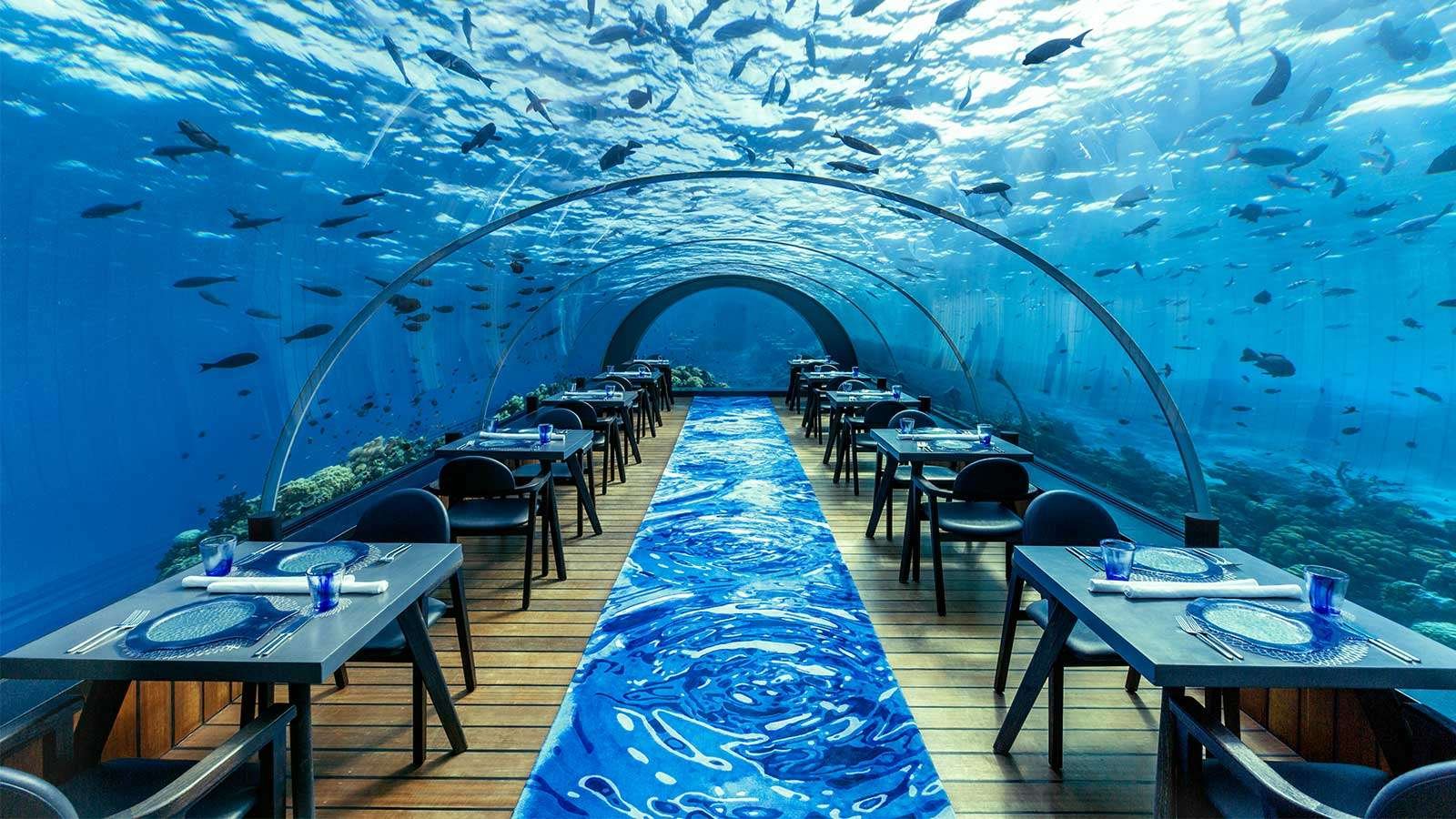
Bars in Lhaviyani Atoll
Browse all →
5.8 Undersea Restaurant
The wine
- Wine program
- Exceptional wine program
- Extensive wine list
- Sommelier-led
Details
- Romantic
- Intimate
- Elegant
- Scenic
- Sophisticated
- Well Known
- Date Night
- Special Occasion
- Celebration
- Private Event
- Waterfront
- Panoramic View
- Design Destination
- Hotel Restaurant
- Private Dining
- Extensive Wine List
- Sommelier Led
- Sustainable Seafood
- Waterfront
- Tasting Menu
- Prix Fixe
- Wine Pairing
- Vegetarian Friendly
- Vegan Options
- Gluten Free Options
- Allergy Accommodating
Current opening hours
- Monday
- 1:30–10 PM
- Tuesday
- 1:30–10 PM
- Wednesday
- 1:30–10 PM
- Thursday
- 1:30–10 PM
- Friday
- 1:30–10 PM
- Saturday
- 1:30–10 PM
- Sunday
- 1:30–10 PM
Hours can change for holidays and private events. Last verified .
Intimate and immersive underwater setting with glass walls and ceiling designed for quiet conversations among no more than 10 couples, surrounded by coral reef and sea creatures.