
1920 in Megève presents contemporary French gastronomy shaped by Alpine terroir and Anne-Sophie Pic’s refined touch. Must-try dishes include Berlingots revisited, Bar Caviar 2.0 and Chevreuil de chasse. The Michelin-starred tasting menus (Menu Midi €95, Menu Dégustation €155, Menu “1920” €210) pair foraged mountain produce with Savoyard cheeses for clear, vivid flavors. Housed inside the Four Seasons Hotel Megève, the dining room’s cognac-toned interior and a terrace-edge round table frame sweeping mountain views, while carefully prepared courses emphasize vegetable-led compositions, delicate fish, and precise technique that make each course taste of place.
 Discover on Pearl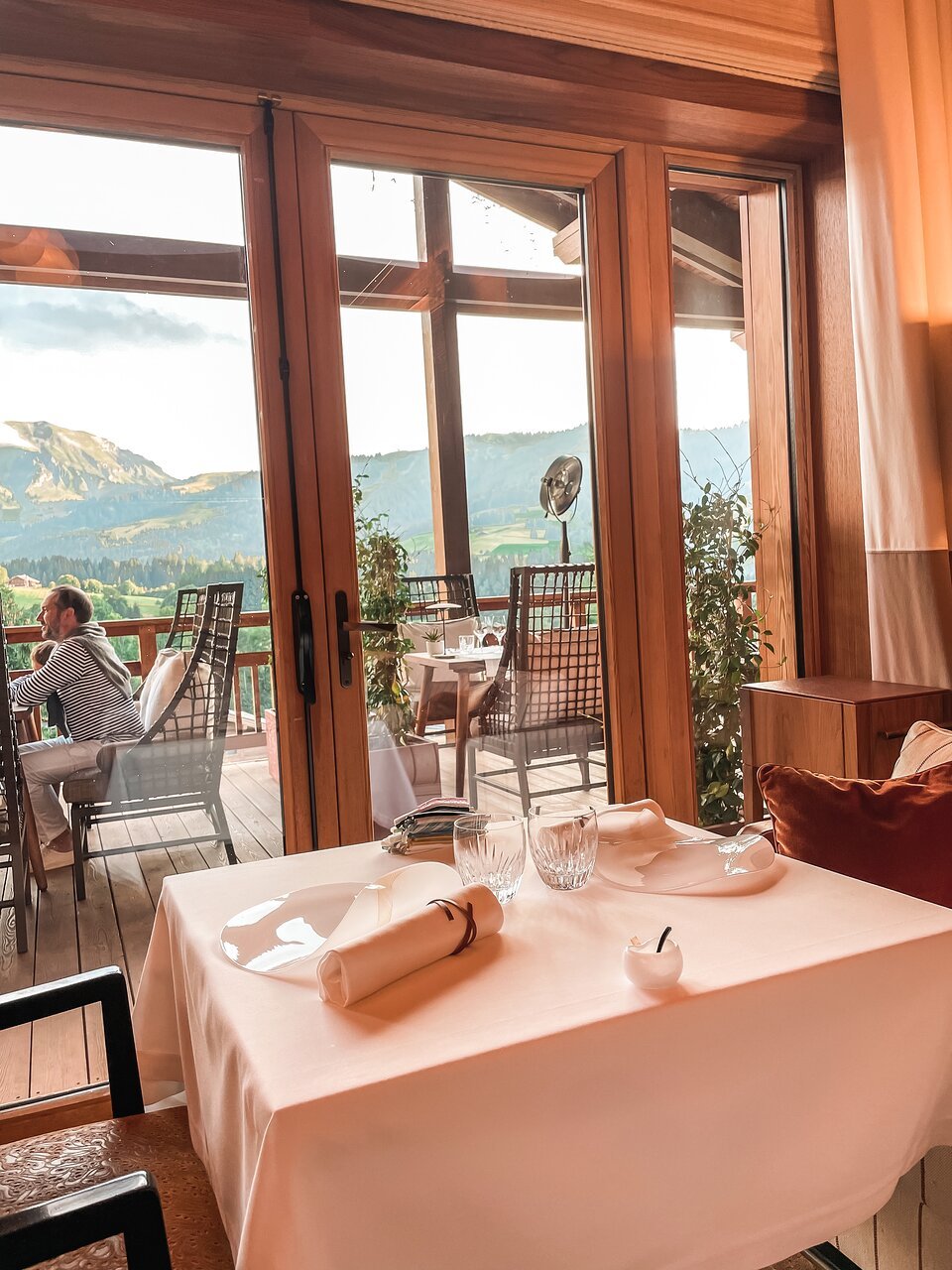
Where the Alps Meet the Archipelago
The approach to 1920 along Chemin des Follières already signals a departure from the village center's busier axis. Megève's mountain light has a particular quality in both seasons — hard and blue in winter, amber-soft in summer — and arriving here, with the chalet architecture framing what happens inside, you register that the setting is doing deliberate work. The name references the year Megève established itself as a serious resort destination, but the cooking makes no attempt at period nostalgia. What unfolds across the menu is a sustained, technically demanding conversation between classical French structure and Japanese aesthetic discipline.
A Franco-Japanese Dialogue in the Haute-Savoie
French-Japanese cooking has developed several identifiable registers: the Paris bistro riff with miso butter and dashi stocks; the haute-cuisine laboratory approach where Japanese technique becomes a precision tool; and something closer to kaiseki thinking, where the course sequence itself carries meaning and the cook's restraint is the argument. 1920 operates in that third register. Chef Julien Gatillon builds menus around seasonal progression in the kaiseki sense, where each course exists not only to satisfy appetite but to articulate a moment in the culinary calendar. Mountain ingredients , the chamois-grazed herbs, the lake fish, the dairy from nearby farms , arrive at the table as if being shown rather than merely served.
The shortlist, unlocked.
Hard-to-book tables, cellar releases, and concierge-planned trips.
Get Exclusive Access →Kaiseki's philosophical core is the idea that a meal should reflect the season without imposing itself on it. That principle aligns usefully with the Haute-Savoie's own gastronomic identity, which has always leaned on proximity and altitude rather than accumulated technique. The combination is less a fusion exercise than a structural parallel: two traditions that both insist the ingredient comes first and the cook's ego last. In the French Alpine context, this produces cooking that reads simultaneously as rooted and formally rigorous.
For comparison against other French-Japanese approaches further afield, Miro Kaimuki in Honolulu and Zest by Konishi in Hong Kong both work within the same hyphenated tradition, though each draws on very different local ingredient vocabularies.
Recognition and Competitive Positioning
Opinionated About Dining, which assesses European restaurants through aggregated critic and enthusiast scoring rather than inspector visits alone, ranked 1920 at number 100 on its Classical Europe list in 2023, then adjusted to number 143 in 2024. The movement is less significant than the sustained presence in that bracket: OAD Classical rankings weight consistency and culinary seriousness, and holding a top-150 position across consecutive years in a competitive field places 1920 among a defined peer group of French restaurants operating at serious critical attention levels. Google reviewers hold it at 4.6 across 68 reviews, a figure that skews meaningfully positive given the typically demanding expectations of guests at this price and profile tier.
Within Megève specifically, the restaurant occupies a different tier from the village's other high-end addresses. Flocons de Sel, Emmanuel Renaut's three-Michelin-star property, remains the benchmark for Alpine fine dining in the French tradition. La Table de l'Alpaga works the Modern Cuisine register at one-star level. 1920 sits alongside these as a distinct proposition rather than a direct competitor: the French-Japanese dual-tradition approach gives it a different critical audience and a different reason-to-visit calculus. Those comparing Japanese-focused addresses in the village should also consider Anata and Kaito, both operating at the €€€€ tier, though neither applies the Franco-Japanese synthesis in the same formal structure.
The broader French fine dining context in which 1920 competes stretches well beyond the Alps. The OAD Classical Europe list places it in conversation with restaurants like Alléno Paris au Pavillon Ledoyen, Mirazur in Menton, Troisgros in Ouches, Auberge de l'Ill in Illhaeusern, Bras in Laguiole, and Paul Bocuse in Collonges-au-Mont-d'Or. Being listed alongside these addresses in a critical ranking is a meaningful signal of seriousness, even at rank 143.
The Kitchen's Seasonal Logic
The kaiseki structure that shapes 1920's menus is not arbitrary imported aesthetics. It is a working philosophy about how a meal accumulates meaning across its arc. In kaiseki, the earliest courses tend toward lightness and suggestion; the progression builds weight and density before retreating again. Translated into an Alpine French context, this creates a menu structure that moves through the mountain seasons with genuine attention: spring's lighter, more acidic register giving way to summer's herbaceous intensity, then autumn's root-and-fungi depth. The disciplined minimalism that Japanese cooking demands of its practitioners functions here as an editorial constraint , fewer ingredients per plate, more coherent intention per course.
Chef Gatillon's training positions him to operate within this discipline rather than simply gesturing at it. The cooking at 1920 reflects a practiced understanding of both traditions, not a superficial combination of visual cues. That rigor is what separates a restaurant that genuinely synthesizes French and Japanese approaches from one that merely adds yuzu to a sauce.
Planning Your Visit
1920 operates Tuesday through Saturday from 12pm to 3pm and 5pm to 10pm, with Sunday service running slightly longer through 4pm. Monday is the weekly day off. The address is 373 Chemin des Follières, 74120 Megève , a short drive or taxi from the village center. Given its OAD ranking and the compressed dining windows of ski season, booking ahead is sensible; weekends and peak Alpine season dates fill first. Vous is another modern option in the village worth considering if 1920's calendar is full. For broader context on the destination, see our full Megève restaurants guide, our Megève hotels guide, our Megève bars guide, our Megève wineries guide, and our Megève experiences guide.
373 Chem. des Follières, 74120 Megève
+33 4 50 78 62 65
A Quick Peer Check
A compact peer snapshot based on similar venues we track.
| Venue | Cuisine | Price | Awards | Notes |
|---|---|---|---|---|
| 1920 | French - Japanese | Opinionated About Dining Classical in Europe Ranked #143 (2024); Opinionated Abo… | This venue | |
| Flocons de Sel | Contemporary French, Modern Cuisine | €€€€ | Michelin 3 Star | Contemporary French, Modern Cuisine, €€€€ |
| La Table de l'Alpaga | Modern Cuisine | €€€€ | Michelin 1 Star | Modern Cuisine, €€€€ |
| Le Refuge | Traditional Cuisine | €€€ | Traditional Cuisine, €€€ | |
| Anata | Japanese | €€€€ | Japanese, €€€€ | |
| Le Saint-Nicolas - Au Coin du Feu | Creative | €€€€ | Creative, €€€€ |
Need a table?
Our members enjoy priority alerts and concierge-led booking support for the world's most difficult tables.
Get Exclusive AccessThe shortlist, unlocked.
Hard-to-book tables, cellar releases, and concierge-planned trips.
Get Exclusive Access →