

Sun Gardens Dubrovnik sits in Orašac, a quiet stretch of the Dalmatian coast about 12 kilometres northwest of Dubrovnik's Old Town. A 2025 member of Leading Hotels of the World, the property occupies a position in the upper tier of Croatian coastal accommodation, where scale, setting, and resort infrastructure matter as much as room count. For travellers looking beyond the city walls, it offers a low-density alternative to Dubrovnik's dense hotel core.
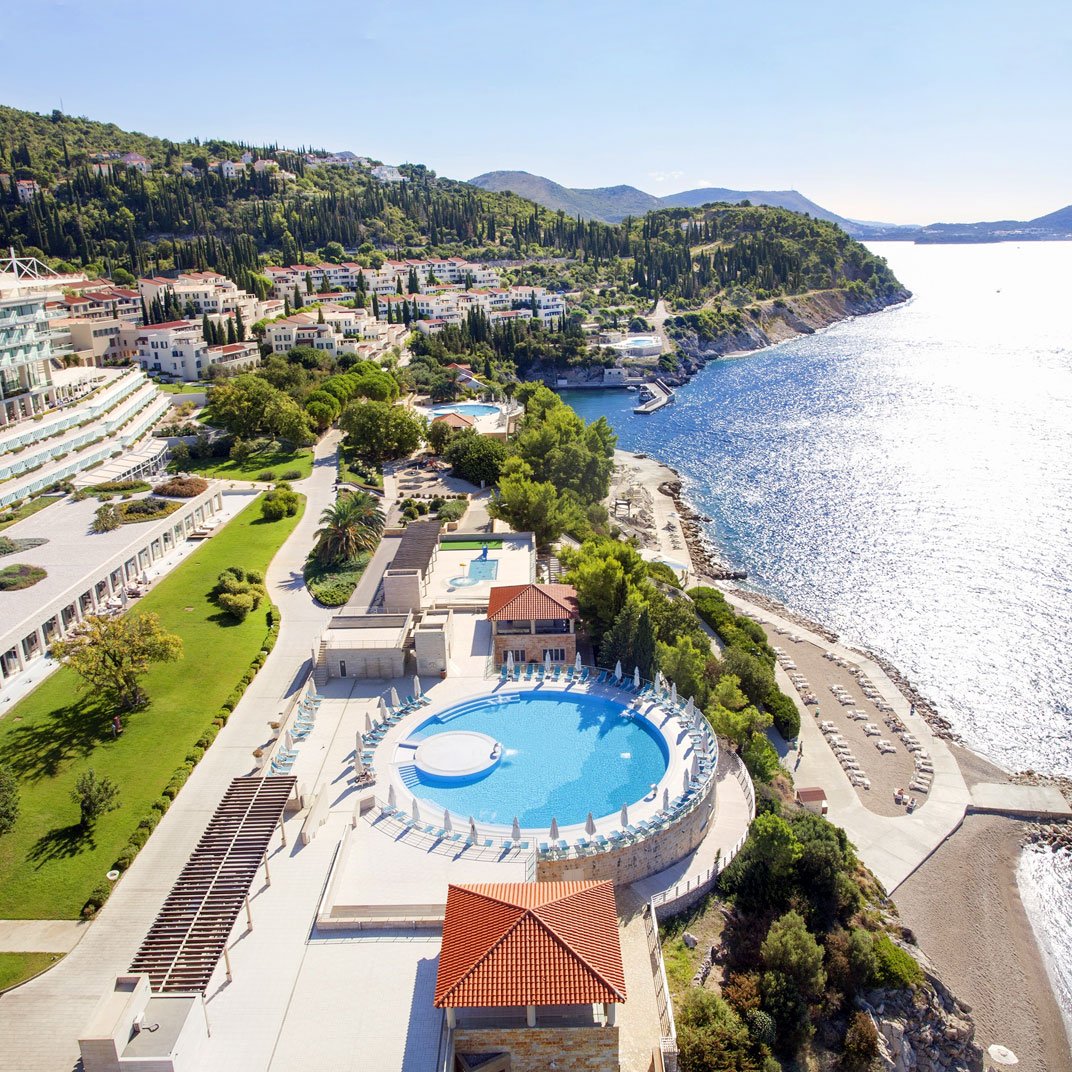
Stone, Sea, and the Architecture of Distance
The Dalmatian coast has a long tradition of building into the rock rather than on leading of it. The limestone terraces that define this stretch of shoreline between Split and Dubrovnik have shaped how properties here meet the Adriatic: horizontally, in stages, with each level dropping toward the water. Sun Gardens Dubrovnik, situated in Orašac at the address Na Moru 1, follows that coastal logic. Approaching from the main coastal road, the property reveals itself in layers rather than all at once, the kind of arrival sequence that the Leading Hotels of the World membership tends to signal, where the physical experience of arrival is treated as deliberately as anything that follows.
Orašac sits roughly 12 kilometres northwest of Dubrovnik's Old Town along the Adriatic Highway, placing it outside the congestion that defines the city's own hotel district in high summer. That geographic remove is a design decision in itself. Properties at this distance from Dubrovnik trade city-centre convenience for a different proposition: space, privacy, and a relationship with the coast that denser urban hotels cannot offer. The Dubrovnik Riviera, as this corridor is known, has attracted serious resort development precisely because the Old Town's capacity constraints push demand outward.
The shortlist, unlocked.
Hard-to-book tables, cellar releases, and concierge-planned trips.
Get Exclusive Access →Where Croatian Coastal Luxury Positions Itself
Croatia's premium accommodation tier has split along recognisable lines in recent years. On one side, design-led boutique properties with limited room counts and architecture that responds to local materials, seen clearly at places like Maslina Resort in Stari Grad and Lešić Dimitri Palace in Korčula. On the other, larger resort formats that justify their footprint through facility depth: pools, dining variety, beach access, and enough programming that guests may choose not to leave the grounds at all. Sun Gardens Dubrovnik occupies the latter camp, a resort-scale property whose Leading Hotels of the World affiliation, awarded or renewed in 2025, places it within a global peer set that includes some of the most demanding hospitality standards in the industry.
Leading Hotels of the World membership is not self-reported. The organisation applies independent inspection criteria, and properties must maintain standards across service, physical product, and guest experience to retain the designation. In Croatia, that membership is relatively selective; properties like Hotel Bellevue Dubrovnik and Palace Elisabeth Hvar Hotel occupy similar ground, and the cohort reflects a tier of Croatian hospitality that competes regionally rather than just locally. Within the broader Adriatic context, comparable properties include Grand Park Hotel Rovinj by Maistra Collection in Istria and D-Resort Šibenik further north on the Dalmatian coast.
The Physical Logic of a Terraced Resort
What distinguishes the better resort properties along this coast is not amenity lists but spatial organisation. The question is how a property uses its terrain to create distinct zones, and whether those zones have coherent character or simply accumulate facilities without a governing idea. Sun Gardens Dubrovnik's position above the water, on ground that almost certainly drops in terraced stages toward a private beach, is the kind of site that rewards thoughtful design and punishes lazy planning. The leading Adriatic resorts use level changes to create privacy gradients, where the higher terraces offer panoramic views traded for greater distance from the sea, and lower levels give immediacy to the water at the cost of outlook.
The Dubrovnik Riviera's stone and Mediterranean vegetation, olive trees, rosemary, and pine, provide the raw materials for a particular visual register that differentiates this stretch of Croatian coast from the more manicured resort environments further north. Properties here have an advantage if they work with that material rather than against it. For the broader context of how Croatian coastal hotels approach design and landscape, see our full Orašac hotels guide.
Dining, Bars, and the Resort Self-Sufficiency Question
Resort-scale properties on the Dubrovnik Riviera face a specific challenge: Dubrovnik's restaurant scene is a genuine draw, but the drive into the Old Town during July and August is sufficiently arduous that guests at properties like Sun Gardens Dubrovnik frequently choose to eat on-site rather than deal with city traffic and parking. The properties that handle this well build enough dining variation into their own offering that the choice feels like a preference rather than a compromise. For reference points on what the wider area offers beyond the resort, our full Orašac restaurants guide covers options in the immediate vicinity, and our full Orašac bars guide maps the local drinking scene.
Croatian coastal wine is a relevant consideration at any property in this region. The Pelješac peninsula and the islands produce Plavac Mali at a quality level that now generates serious regional interest, and properties that engage with local producers rather than defaulting to international wine lists reflect both a local commitment and a more interesting experience for the guest. For wine-oriented travel in the area, our full Orašac wineries guide and properties like Villa Korta Katarina and Winery in Orebić or Meneghetti Wine Hotel and Winery in Bale provide context.
Planning a Stay
The Dubrovnik Riviera operates on a compressed season. June through August sees the highest demand and the sharpest price increases across every accommodation tier in the region. Orašac, sitting between the airport at Čilipi and the Old Town, benefits from being closer to the airport than most central Dubrovnik hotels, which has practical value on arrival and departure days. The coastal road (the Jadranska Magistrala) connects the property to Dubrovnik in roughly 20 to 25 minutes outside peak hours; in high summer, that journey can lengthen significantly. Travellers arriving in May or September trade crowd density for softer light and calmer water, and many resort properties along this corridor offer better rate structures in those shoulder months. For broader trip planning, our full Orašac experiences guide covers what the area offers beyond the beach.
For comparative reference across Croatia's wider premium tier, the following properties reflect the range of approaches the country's hospitality sector has developed: Boutique and Design Hotel Navis in Opatija, Boutique Hotel Alhambra in Mali Lošinj, Ikador Luxury Boutique Hotel and Spa in Ika, Palazzo Rainis Hotel and Spa in Novigrad, San Canzian Hotel and Residences in Buje, Hotel Ambasador Split, Hotel Supetar in Cavtat, and Falkensteiner Hotel and Spa Iadera in Petrčane. Beyond Croatia, Leading Hotels of the World properties in other contexts include Esplanade Zagreb Hotel, The Fifth Avenue Hotel in New York City, Aman New York, and Aman Venice.
The shortlist, unlocked.
Hard-to-book tables, cellar releases, and concierge-planned trips.
Get Exclusive Access →Frequently Asked Questions
Quick Comparison
These are the closest comparables we have in our database for quick context.
| Venue | Cuisine | Price | Awards | Notes |
|---|---|---|---|---|
| Sun Gardens Dubrovnik | (2025) Leading Hotels of World Member | This venue | ||
| Lešić Dimitri Palace | ||||
| Maslina Resort | ||||
| Meneghetti Wine Hotel & Winery | ||||
| Villa Korta Katarina & Winery | ||||
| Grand Park Hotel Rovinj by Maistra Collection | World's 50 Best |
Preferential Rates?
Our members enjoy concierge-led booking support and priority upgrades at the world's finest hotels.
Get Exclusive AccessThe shortlist, unlocked.
Hard-to-book tables, cellar releases, and concierge-planned trips.
Get Exclusive Access →