Six Senses Con Dao

Six Senses Con Dao holds a Michelin Key distinction (2025) and sits among Vietnam's most remote luxury addresses, occupying a national-park coastline accessible only by short-haul flight or ferry from the mainland. The property belongs to the design-led, low-footprint tier of Southeast Asian resort hospitality, where architecture defers to landscape and room count stays deliberately limited.
Pearl is the En Primeur Club membership app — saves, bookings, and concierge access live there. Same editors, same standards.
- Address
- Town, Con Dao Islands, Vietnam
- Phone
- +84 254 3831 222
 Saves & bookings on Pearl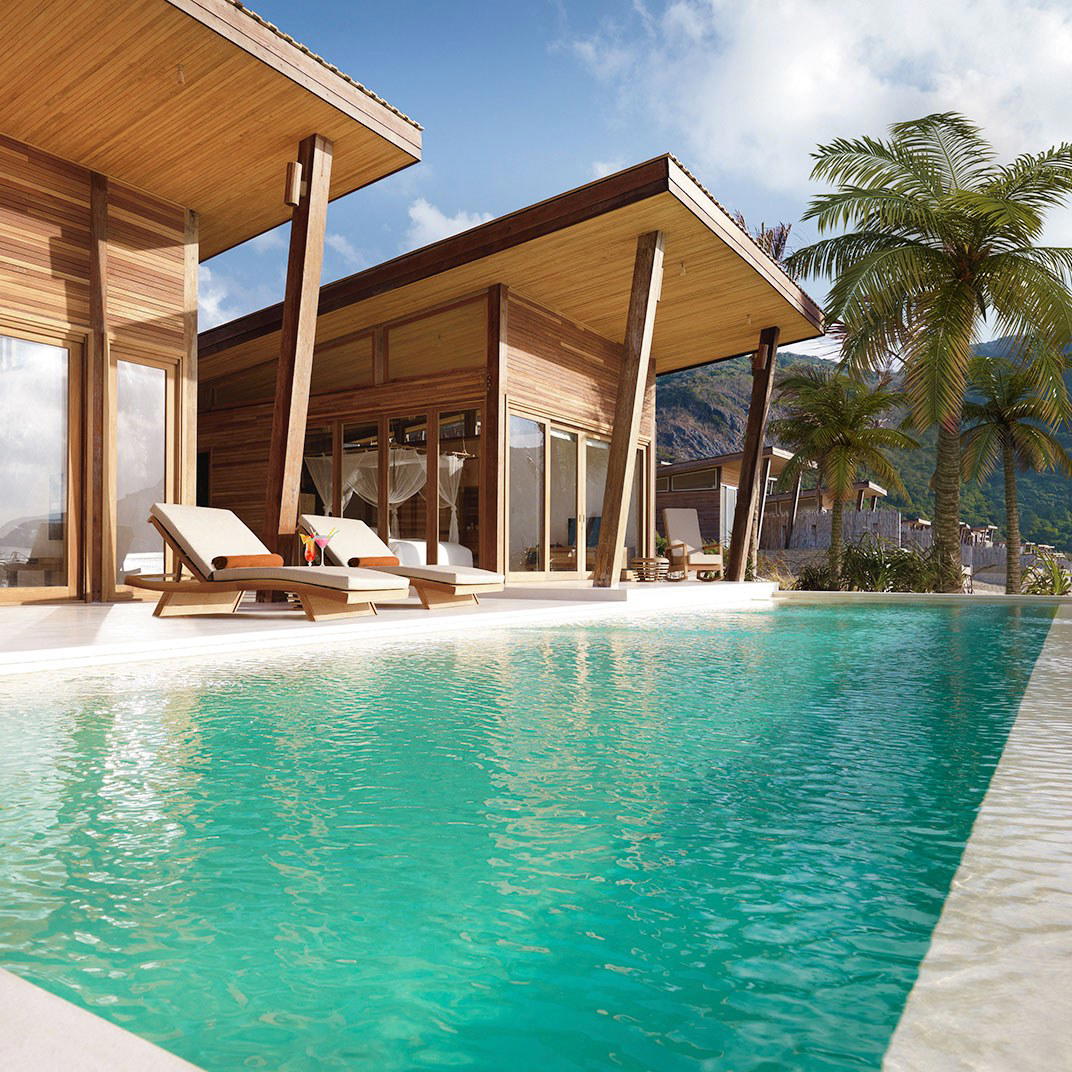
Arriving at the Edge of the Archipelago
Con Dao is not incidental to the Six Senses experience here, it is the entire premise. The archipelago sits roughly 185 kilometres south of Vung Tau, reachable by a 45-minute flight from Ho Chi Minh City or a longer ferry crossing, and the relative difficulty of getting there functions as a filter. The guests who arrive have chosen to be removed from the mainland in a meaningful way, and the resort's physical presence is calibrated to that intention. Low-rise timber villas track the shoreline and disappear into the tree canopy; there is no visual competition with the Con Dao National Park, which covers the majority of the island chain and places strict limits on development density. Walking into the property for the first time, the architecture reads less as construction than as a continuation of the coastal topography.
Design Philosophy and the Weight of Material Choices
Southeast Asian luxury has spent the last decade splitting between two distinct orientations: large-footprint international brands that import a consistent global product, and design-led properties that treat local materials and environmental integration as load-bearing elements of the guest offer. Six Senses Con Dao belongs firmly to the second category. Six Senses has built its identity around low-intervention architecture and wellness programming that responds to place rather than replicating a formula. On Con Dao specifically, the villas use dark timber, thatch, and stone in proportions that absorb rather than reflect the tropical light. Interiors are spare, high ceilings, louver panels, outdoor bathing areas that dissolve the boundary between room and garden. The aesthetic argument is restraint, and it is made consistently across the property rather than in a single signature structure.
This approach places Six Senses Con Dao in a comparable set that includes Amanoi in Vinh Hy and Banyan Tree Lăng Cô in Lăng Cô, properties where the site itself is considered an architectural element and the human infrastructure is asked not to dominate it. In Vietnam's broader luxury hotel market, which includes dense urban properties like Amanaki Saigon Boutique Hotel in Ho Chi Minh City and the colonial-heritage tier represented by Sofitel Legend Metropole Hanoi, Con Dao operates in a category almost entirely defined by its natural setting.
Michelin Recognition and What It Signals
The 2025 Michelin Key distinction, awarded as part of Michelin's hotels programme, places Six Senses Con Dao among a small group of Vietnamese properties to receive formal recognition from the guide. Michelin's hotel keys use criteria that weight design coherence, service character, and sense of place alongside physical facilities. For a remote island resort, earning that recognition signals that the property performs across the full hospitality register, not just on accommodation hardware. Among Vietnam's Michelin-recognised stays, Con Dao sits at the more isolated end of the geographic spectrum, which makes the designation read as a statement about the quality of execution in a logistically demanding context. Comparable recognition in the country's luxury tier has gone to properties in Hanoi, Da Nang, and Hoi An corridors, where supply chains and staffing are considerably easier to manage.
The Con Dao Context
Understanding what the hotel offers requires understanding what Con Dao is. The islands carry a layered history: French colonial-era prisons, Vietnamese wartime detention sites, and now a protected natural reserve with some of the least-disturbed marine environments in the South China Sea. The national park status limits visitor numbers and prohibits the kind of resort clustering that characterises Phu Quoc, compare L'Azure Resort & Spa in Phu Quoc, or coastal Mui Ne, where The Anam Mui Ne in Mui Ne and Asteria Mui Ne Resort in Phan Thiet compete for a mainstream beach market. On Con Dao, there is no such market. The Six Senses property is effectively the anchor of the island's premium hospitality offer, which means guests are choosing the island as much as they are choosing the brand.
Sea turtle nesting grounds on the beaches adjacent to the property bring an ecological dimension that is not decorative. The national park's monitoring programmes have operated for decades, and the conservation overlay shapes what guests can do and when, certain stretches of beach are restricted during nesting season. This seasonality is part of the texture of staying here rather than a limitation to be managed around.
Wellness Programming and the Six Senses Framework
The Six Senses brand has positioned wellness not as a secondary amenity but as an organising principle across its portfolio. On Con Dao, where the surrounding environment is already doing significant work, clean air, low ambient noise, no urban intrusion, the programming builds on that baseline rather than trying to manufacture a wellness atmosphere from scratch. The brand's integration of biohacking-adjacent health diagnostics, sleep programming, and locally-sourced nutritional approaches has been a consistent differentiator across its properties globally, and the Con Dao outpost operates within that framework. Guests who have stayed at other Six Senses properties will recognise the vocabulary; guests who haven't will encounter a more structured health offer than most luxury resorts provide.
Planning Your Stay
The logistics of reaching Con Dao deserve attention. VASCO's Airlines operates scheduled flights from Ho Chi Minh City to Con Dao Airport, with journey times around 45 minutes; availability can be limited, particularly over Vietnamese public holidays and during the dry season from November through April, which is also the period of strongest visibility for diving and snorkelling. The ferry option from Vung Tau takes several hours and is weather-dependent. Building travel buffer into the itinerary is practical rather than cautious given the island's connectivity constraints. Booking directly through the Six Senses website is the standard route. Guests considering Vietnam's broader luxury circuit might also look at Garrya Mu Cang Chai in Lao Cai Province for a northern highland counterpoint, or Hotel de la Coupole - MGallery in Sapa for a different terrain entirely.
At-a-Glance Comparison
Comparable venues nearby, for context on price, style, and recognition.
| Venue | Cuisine | Price | Awards | Notes |
|---|---|---|---|---|
| Six Senses Con DaoThis venue — the venue you are viewing | Contemporary luxury resort designed to evoke a traditional Vietnamese fishing village using sustainable materials and eco-conscious architecture. | $$$$ | 5-Star | Not listed |
| Hotel de l'Opera Hanoi | Boutique luxury with theatrical opera theme | $$$$ | 5-Star | Hoan Kiem |
| Hotel de l'Opera - MGallery Hanoi | French colonial architecture with contemporary furnishings and operatic interiors | $$$$ | 5-Star | Hoan Kiem |
| Jiva Hoa Lu Retreat | Vietnamese-inspired luxury retreat with handcrafted details and open-air pavilions designed to harmonize with the natural landscape | $$$$ | 5-Star | Hoa Lu District |
| Namia River Retreat - Wellness Inclusive Resort | Sustainable luxury wellness resort inspired by local Vietnamese villages and nature | $$$$ | 5-Star | Cẩm Thanh |
| Peridot Grand Luxury Boutique Hotel | Art deco flair with Vietnamese influences in a contemporary luxury setting | $$$$ | 5-Star | Hoan Kiem |
Recognition history
Dated appearances from independent guides and award organizations, with the underlying list record or original source where available.
Michelin 1 Key
Michelin
At a Glance
- Scenic
- Rustic
- Elegant
- Quiet
- Romantic
- Honeymoon
- Romantic Getaway
- Family Vacation
- Wellness Retreat
- Anniversary
- Beachfront
- Private Villa
- Infinity Pool
- Destination Spa
- Panoramic View
- Private Dining
- Garden
- Spa
- Pool
- Beach Access
- Kids Club
- Restaurant
- Bar
- Concierge
- Room Service
- Airport Transfer
- Waterfront
- Mountain
- Garden
- Spa
- Pool
- Beach Access
- Kids Club
- Restaurant
- Bar
- Concierge
- Room Service
- Airport Transfer
Serene and natural with open-air bathrooms and living spaces designed to capture sea breezes, timber interiors, and minimalist neutral décor that emphasizes the surrounding landscape.