

SAINT TEN Hotel in Belgrade is a boutique luxury accommodation blending 1929 Vejković architecture with contemporary comfort. Guests enjoy L’Adresse Restaurant’s Mediterranean menus, the curated Saint Ten Reserve wine and cheese selection, and a wellness spa with sauna and massage vouchers. The 54-room property pairs handcrafted furniture, natural stone bathrooms and soundproofed rooms for restful stays. Located in Vračar within walking distance of Saint Sava Temple, Saint Ten Hotel offers refined, personalized service through its hospitality team and membership in Small Luxury Hotels of the World. Expect warm, inviting public spaces, crisp linens, and attentive service that makes cultural exploration and business travel effortless and memorable.
 Discover on Pearl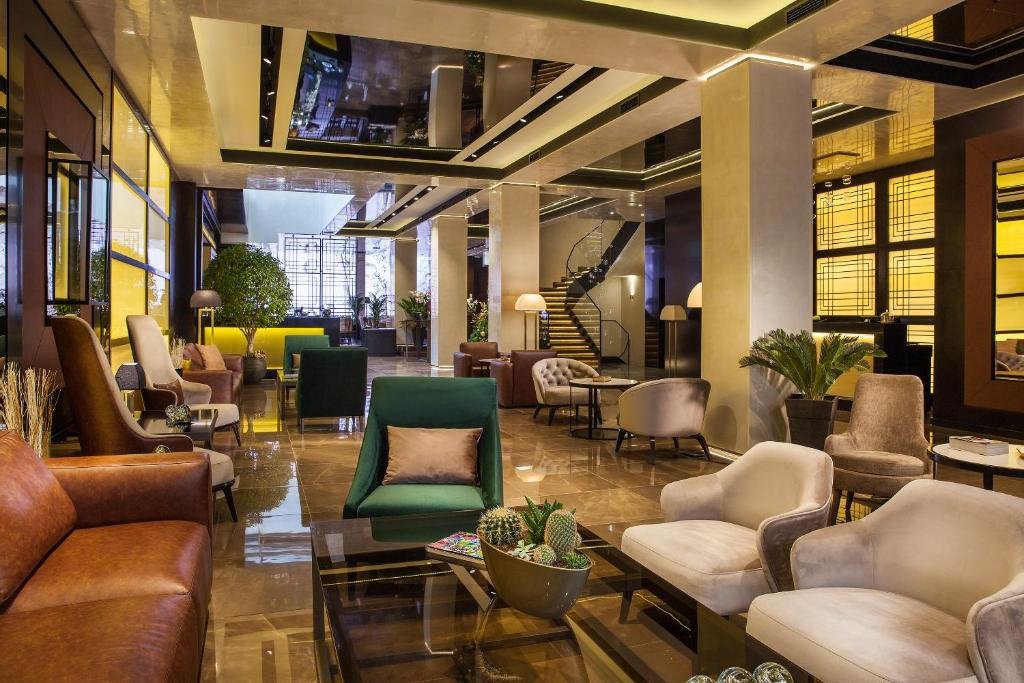
A 1929 Building That Still Commands Attention
Vračar is not Belgrade's flashiest address, but it may be its most considered one. The central district sits on a plateau above the city's river-facing neighbourhoods, its streets defined by pre-war apartment blocks, Orthodox church spires, and a boulevard cadence that feels closer to Bucharest or Vienna than to the Balkan capitals further south. Into this context, architect Stojan Vejković placed a building in 1929 that would outlast the political systems that subsequently occupied it. SAINT TEN Hotel now occupies that structure at Svetog Save 10, and the address itself is the first design decision: a landmark in a neighbourhood that rewards walkers over taxi-takers.
Belgrade's boutique hotel scene arrived later than its regional peers. While Warsaw, Prague, and Bucharest absorbed the first wave of international design-led hotels through the 2000s and early 2010s, Belgrade's hospitality infrastructure remained dominated by socialist-era towers and early post-transition business hotels. That delay has produced an unexpected dividend: the newer generation of Belgrade boutique properties, including Square Nine Hotel and The Bristol Belgrade, arrived with a more architecturally conscious brief than the first wave often managed. SAINT TEN belongs to this cohort, where the historic shell and the contemporary interior are treated as a deliberate conversation rather than a conflict.
What Vejković Built, and What Came After
The building's 1929 origins place it in the interwar period when Belgrade was expanding rapidly as the capital of the Kingdom of Yugoslavia, and when Central European modernism was beginning to influence Serbian architecture. Vejković's façade carries the formal weight of that era: symmetrical, stately, built for permanence. Over the following decades, the property accumulated layers of political history during the Cold War, the kind of institutional gravity that leaves a building feeling denser than its dimensions suggest.
The contemporary intervention takes that weight seriously. Rather than stripping the building to a neutral canvas, the design approach has produced interiors that are thoroughly contemporary in finish while remaining sober in register. This is a discipline that eludes many adaptive-reuse hotel projects, which tend to err either toward aggressive minimalism that erases history or nostalgic pastiche that performs it. The result here is large spaces with luxe finishes, a material palette that doesn't compete with the architecture, and glass-walled stone bathrooms equipped with rain showers or soaking tubs. The 54 rooms sit at rates from approximately $246 per night, positioning the property in Belgrade's upper-mid tier, below the full international luxury of The St. Regis Belgrade but above the city's transient business stock.
For reference points in adaptive-reuse hotel design at the international level, the discipline that SAINT TEN practices has its more resourced counterparts in properties like Hotel Sacher Wien in Vienna or HOTEL THE MITSUI KYOTO in Kyoto, where historic buildings have been absorbed into contemporary hotel programs without losing their civic presence. The scale and budget are different, but the design problem is the same.
The Interior Logic
The guest room program reflects a particular understanding of what sober luxury actually requires: space before spectacle, quality materials over decorative volume, and functional details that register only when they're missing elsewhere. Espresso machines and well-positioned bedside reading lights are the kinds of inclusions that reveal a brief written by people who stay in hotels rather than simply photograph them.
The lobby bar operates as an all-day lounge rather than a dedicated evening destination, which makes it genuinely useful for business conversations in the morning and cocktails in the late evening without the programmatic awkwardness that single-purpose bars in smaller hotels often produce. The Sanctus restaurant runs a dual format: a semi-formal dining room during daylight hours that transitions to a fine-dining register at night. This kind of programmatic flexibility is more common in larger urban hotels, and its presence in a 54-room property in Vračar signals an ambition that goes beyond simply serving breakfast to guests.
Wellness offer includes a sauna, massage room, and a cardio meditation room, a combination that covers the essential bases without the excess infrastructure that larger properties use to justify their rate premiums. In a city where most boutique hotels at this price point offer little beyond a gym with two treadmills, the offering is proportionate and considered.
Vračar as Context
Neighbourhood location matters for how SAINT TEN functions as a base. Vračar's street grid makes it one of the more walkable areas of central Belgrade, with the Temple of Saint Sava, one of the largest Orthodox churches in the world by floor area, a short distance away. The local restaurant and café density along and around Šumadijska and Njegoševa streets gives the area a neighbourhood character that the river-facing Savamala district, for all its nightlife credibility, often lacks during daylight hours.
For guests using the city as a regional base, Belgrade's practical logistics have improved considerably. The airport sits roughly 18 kilometres from Vračar, and taxi or ride-share transfers run to around 20-25 minutes outside peak traffic. The city connects by road and rail to Novi Sad, Niš, and, with more time, to Sarajevo and Skopje for those building multi-city Balkan itineraries. Explore our full Belgrade hotels guide, our full Belgrade restaurants guide, our full Belgrade bars guide, our full Belgrade experiences guide, and our full Belgrade wineries guide for broader city coverage.
Where It Sits in the Wider Boutique Tier
The global boutique hotel tier that SAINT TEN most closely resembles is the historically-grounded, design-conscious independent that treats its building as primary content. Properties like Castello di Reschio in Lisciano Niccone, Casa Maria Luigia in Modena, or at the more accessible end of the spectrum, The Fifth Avenue Hotel in New York City, all operate in the same register: the building is the argument, and the contemporary program is the proof. At $246, SAINT TEN prices itself accessibly within that tradition.
For travelers whose reference points are properties like Aman New York, Cheval Blanc Paris, Hotel Plaza Athénée in Paris, or Badrutt's Palace Hotel in St. Moritz, the comparison is more instructive than the price suggests. Belgrade is not Paris or New York, and SAINT TEN does not pretend otherwise. What it does offer is a building with genuine historical weight, a contemporary interior that respects that weight, and a location in a neighbourhood that makes the city legible in a way that river-view prestige addresses often don't. Properties like Aman Venice, Cipriani in Venice, Hotel Bel-Air in Los Angeles, Hotel Du Cap-Eden-Roc in Cap d'Antibes, Hôtel de Paris Monte-Carlo, Amangiri in Canyon Point, Hotel Esencia in Tulum, and Bvlgari Hotel Tokyo each represent a different axis of the boutique-to-luxury spectrum, but the underlying logic of using a strong building and considered interiors to anchor a hotel's identity is the same one at work in Vračar.
Planning Your Stay
Rates from $246 per night for 54 rooms position this as a property where room availability is tighter than at Belgrade's larger hotels. Booking through the hotel's own channels or a preferred travel program is advisable, particularly during the spring and autumn months when Belgrade sees its highest concentration of leisure visitors. The Vračar address is served by tram lines connecting to the wider city centre, and the walking distance to the Temple of Saint Sava makes it a practical base for guests covering the city on foot.
Frequently Asked Questions
Quick Comparison
A compact peer snapshot based on similar venues we track.
| Venue | Cuisine | Price | Awards | Notes |
|---|---|---|---|---|
| SAINT TEN Hotel | Saint Ten offers heavenly comfort among the stately boulevards and sweeping view… | This venue | ||
| Square Nine Hotel | ||||
| The Bristol Belgrade | ||||
| The St. Regis Belgrade |
Preferential Rates?
Our members enjoy concierge-led booking support and priority upgrades at the world's finest hotels.
Get Exclusive Access