
Pension Atra Doftana sits in Teșila village along the Doftana Valley, selected by the Michelin Guide Hotels 2025, a signal that small-scale, nature-rooted accommodation in Romania's Carpathian foothills has found its critical audience. The pension occupies a setting where forested ridgelines and river valley quiet define the experience as much as the rooms themselves.
Pearl is the En Primeur Club membership app — saves, bookings, and concierge access live there. Same editors, same standards.
- Address
- Valea Doftanei commune, Tesila village, Fundatura Cerbului 780B, Teșila, Romania
- Phone
- 40.735.02.01.10
 Saves & bookings on Pearl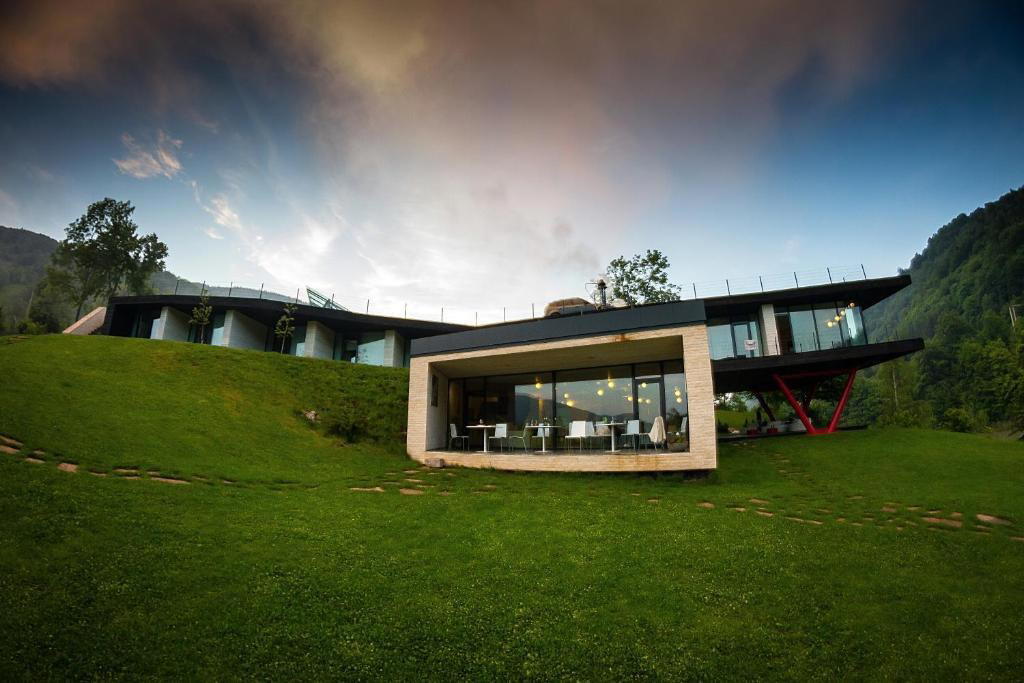
A Valley Property in Romania's Carpathian Foothills
The Doftana Valley runs south from the Carpathian arc into Prahova County, a corridor of pine forest, fast-moving river water, and villages that have remained largely off the international radar. Teșila sits within this valley, a settlement small enough that the address itself, Fundatura Cerbului, meaning roughly "Deer's End", signals how far from urban density you've come. Pension Atra Doftana occupies that address, and its inclusion in the Michelin Selected Hotels 2025 list places it inside a cohort of European small-scale properties that Michelin's hotel editors have identified as worth the journey.
Michelin's hotel selection, distinct from its restaurant star system, operates as a quality filter across accommodation formats, from grand city palaces like Le Bristol Paris and Hotel Sacher Wien down to rural pensions with a fraction of the room count. Atra Doftana's selection in that context is not a proximity prize, it reflects editorial judgment that this property meets a defined standard of hospitality character within its category.
The Physical Setting: Timber, Terrain, and Deliberate Remoteness
Properties in Romania's mountain pension tradition tend to share an architectural vocabulary: timber-frame construction, pitched roofs designed for heavy snowfall, and a ground-level relationship with the surrounding landscape that glass-and-concrete resort architecture rarely achieves. The Doftana Valley enforces this approach by geography, the valley walls are close, the forest is dominant, and the river sets the ambient sound register. A building that fought those conditions would lose. A building that accepted them, using local materials and a scale calibrated to the site, becomes part of the place rather than an imposition on it.
This is the editorial angle that matters most at Atra Doftana. The design philosophy of small Carpathian pensions, and this property sits within that tradition, is one of material honesty: wood sourced regionally, rooms oriented toward views rather than internal corridors, communal spaces that open onto terrain rather than parking. That approach is what separates the Doftana Valley's leading small accommodation from the generic resort formats found closer to Bucharest or along the Prahova Valley's busier tourist axis.
For context on how Romanian mountain hospitality has split into distinct tiers, properties like Swissôtel Poiana Brașov represent the larger-format, ski-resort-adjacent end of the spectrum, while Matca Hotel in Simon and Bethlen Estates Transylvania occupy a design-conscious, lower-key niche. Atra Doftana sits closer to the latter category, where the surrounding landscape is the primary product and the built environment supports rather than competes with it.
The Doftana Valley as a Destination
The Doftana Valley has a dual identity in Romanian cultural memory: it is known both for its natural character and for the remains of Doftana Prison, a historic detention facility that held political prisoners during the interwar and communist periods and now operates as a museum. That layered history gives the valley a depth that purely scenic mountain destinations sometimes lack. Visitors who arrive for the forest and river stay longer when they understand the surrounding context.
The valley's relative inaccessibility, winding roads, limited public transport connections, no major ski infrastructure, has kept visitor volumes lower than the Prahova Valley to the east. That is not a weakness for a property like Atra Doftana; it is the condition that makes the experience coherent. The guests who reach Teșila have, by definition, chosen quiet over convenience. That self-selection shapes the atmosphere at properties along the valley in ways that higher-traffic mountain areas cannot replicate.
Romania's broader hospitality scene has been developing more regionally ambitious accommodation in recent years. Properties like Singureni Manor Equestrian Retreat and Hotel Snagov Club represent the country's appetite for destination stays outside Bucharest. The Doftana Valley sits in this emerging pattern, a region gaining slow traction among travellers who have already worked through the better-known Transylvanian circuits and are looking for less-documented terrain.
Placing Atra Doftana in Its comparable set
Globally, the small-pension format with a strong regional identity has found renewed critical attention. Properties that might once have been overlooked in favour of branded resort accommodation now appear regularly in Michelin's hotel selections and in the itineraries of travellers who are deliberately moving away from the predictable. Atra Doftana occupies that space in the Romanian context, a property whose appeal rests on specificity of place rather than amenity breadth.
This contrasts with properties built around comprehensive facilities: the Lebada Luxury Resort and Spa in the Danube Delta or the Qosmo Brasov Hotel in Brașov County offer a different proposition, where amenity stacking is part of the value equation. At a Doftana Valley pension, the value equation is simpler: forest access, mountain air, and a built environment that doesn't interrupt the silence. For some travellers, that is worth more than a spa floor or a rooftop pool.
The international comparable set for this kind of property includes rural stays across the Alpine arc, the Portuguese interior, and the Slovenian highlands, all places where Michelin's hotel editors have increasingly flagged properties that deliver place-specific hospitality at modest scale. Atra Doftana's selection puts it in that conversation.
Planning a Stay
Teșila is accessible by road from Câmpina, the nearest larger town, which sits on the Bucharest-Ploiești-Brașov rail and road corridor. The drive from Câmpina into the Doftana Valley takes under 30 minutes and transitions quickly from light industrial suburbs into forested valley terrain. Travellers arriving from Bucharest can reach Câmpina in under two hours by train, with the valley drive adding a short leg. Given the pension's rural address and the absence of public transport into the valley, a car is the practical option for the final approach.
The Doftana Valley receives significant snowfall in winter, which changes the access dynamics and the character of the stay, some travellers specifically seek it in that season for the forest-under-snow atmosphere. Spring and autumn bring clearer conditions and lower visitor numbers than the summer peak, when Romanian domestic tourism in mountain areas reaches its seasonal high. For those considering comparable properties across different international contexts, the design-led rural-stay format appears in places as varied as Castello di Reschio in Umbria and Hotel Esencia in Tulum, evidence that the appetite for properties shaped by their physical setting rather than their brand identity is consistent across markets and price tiers.
A Quick Peer Check
Comparable venues nearby, for context on price, style, and recognition.
| Venue | Cuisine | Price | Awards | Notes |
|---|---|---|---|---|
| Pension Atra DoftanaThis venue — the venue you are viewing | Exclusive lakeside resort with avant-garde architecture that harmonizes with the natural environment; award-winning design by TECON Architects. | $$$ | 3-Star | Not listed |
| Qosmo Brasov Hotel | Contemporary hospitality with dynamic spaces and immersive atmospheres | $$$ | 4-Star | Cartier Coresi |
| Ecletico Villa | Renovated historic villa with modern luxury | $$$ | 4-Star | Bucharest City-Centre |
| Kronwell Brasov Hotel | Contemporary luxury boutique hotel with late modernist design aesthetic positioned as a high-design urban lodging destination. | $$$ | 4-Star | Centrul Nou |
| Moxy Bucharest Old Town | Trendy boutique hotel blending industrial design with Romanian elements for millennials. | $$ | 3-Star | Old Town |
| Swissôtel Poiana Brașov | Discreet Carpathian luxury with spacious elegance and secluded comfort | $$$$ | 5-Star | Poiana Brașov |
Recognition history
Dated appearances from independent guides and award organizations, with the underlying list record or original source where available.
Michelin Selected
Michelin
At a Glance
- Romantic
- Quiet
- Modern
- Scenic
- Sophisticated
- Minimalist
- Romantic Getaway
- Weekend Escape
- Celebration
- Group Retreat
- Waterfront
- Panoramic View
- Private Dining
- Garden
- Terrace
- Design Destination
- Restaurant
- Waterfront
- Mountain
- Restaurant
Contemporary and serene with natural light flooding through expansive windows; sophisticated yet intimate atmosphere enhanced by lakeside setting and forest surroundings.