McMenamins Kennedy School
A converted Northeast Portland elementary school turned hotel, bar, and entertainment complex, McMenamins Kennedy School occupies a 1915 building that has been reimagined as a community-rooted gathering place. The property sits within the McMenamins network of historically preserved Oregon venues, where adaptive reuse and local programming define the experience rather than conventional hospitality amenities.
Pearl is the En Primeur Club membership app — saves, bookings, and concierge access live there. Same editors, same standards.
- Address
- 5736 NE 33rd Ave, Portland, OR 97211
- Phone
- +1 503 249 3983
- Website
- mcmenamins.com
- Directions
- Get directions
 Saves & bookings on Pearl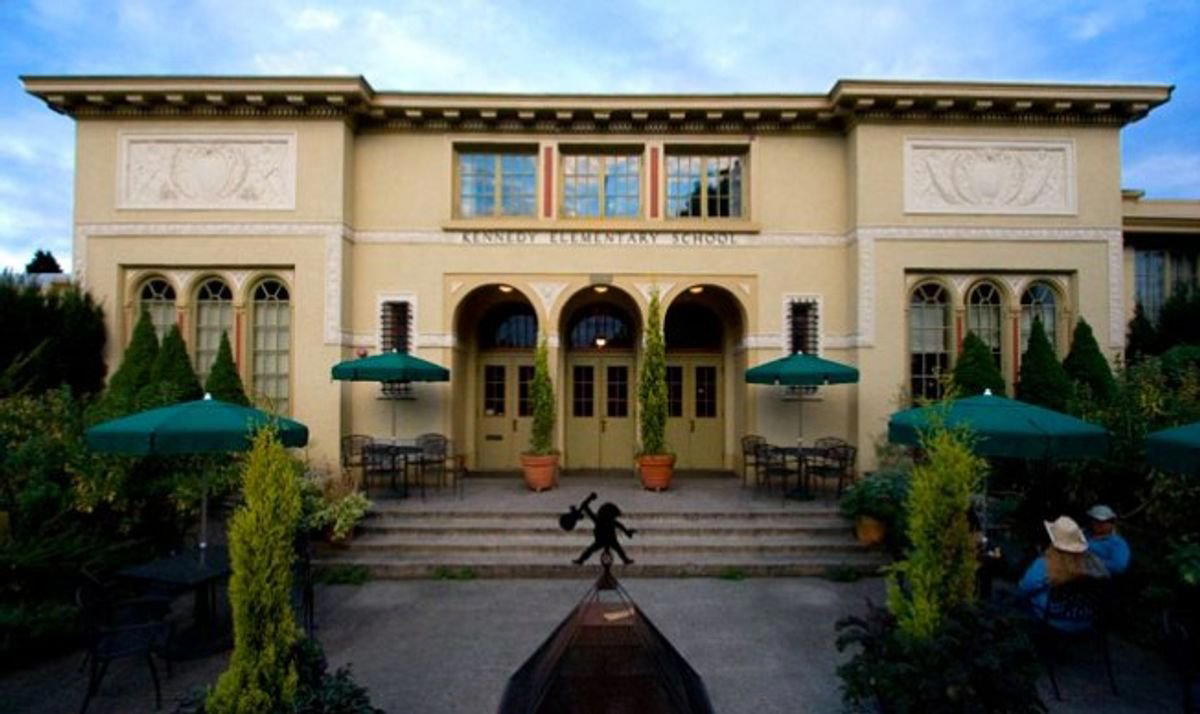
A School Bell That Never Quite Stopped Ringing
Northeast Portland has always operated on a different register from the Pearl District's polished loft-and-restaurant corridor. The stretch of NE 33rd Avenue that runs through the Concordia neighbourhood carries the low-density, front-porch character of a residential Portland that predates the city's current food-and-design reputation. It is in this context that McMenamins Kennedy School works well: not as a hotel dropped into a neighbourhood, but as a neighbourhood institution that happens to offer rooms for the night.
The building itself dates to 1915, constructed as a public elementary school serving the surrounding Concordia community. The adaptive reuse model McMenamins has applied here, and across dozens of Oregon and Washington properties, is less about historic preservation as aesthetic exercise and more about embedding community infrastructure into ongoing use. The hallways are still hallways. The classrooms, now guest rooms, still have blackboards. The principal's office has become a bar. This is not themed hospitality in the conventional sense; the school's institutional bones are load-bearing in both the literal and conceptual meaning.
Adaptive Reuse as a Sustainability Position
The broader American hotel industry has spent two decades debating the relative sustainability of new-build versus adaptive reuse. McMenamins settled that debate for itself through practice rather than policy statement. Kennedy School is one of the clearest examples in the Pacific Northwest of what happens when a historic structure is treated as the asset rather than the obstacle. The embodied carbon in a 1915 brick-and-timber school building is not replaced; it is repurposed. The neighbourhood streetscape is maintained rather than disrupted by a ground-up development footprint.
McMenamins has applied this approach across properties that include former poor farms, Masonic lodges, and grain warehouses, creating a network where the commitment to historic structures functions as both an environmental stance and a community one. At Kennedy School specifically, the surrounding Concordia neighbourhood retains a residential character precisely because the anchor building did not become a surface parking lot or a generic mixed-use tower. For travellers whose interest in sustainability extends beyond towel-reuse programmes to questions of place-making and urban fabric, this is a materially different offer from what the Pearl District's newer hotels provide.
Visitors staying at properties like The Hoxton, Portland or Woodlark are choosing the concentrated downtown experience. Kennedy School requires a short trip northeast, a 15-minute drive or a direct TriMet bus connection from the central city, but that distance is also what keeps the property embedded in an actual neighbourhood rather than a hospitality district.
What the Building Holds
The Kennedy School complex functions as a full-service social hub rather than a conventional hotel with a restaurant attached. The Courtyard restaurant operates in the school's original open-air courtyard, now enclosed, making it usable year-round. The property also holds multiple bars including the Boiler Room, a movie theatre that screens films nightly, and an outdoor soaking pool. McMenamins brews its own beer across its Oregon properties, and Kennedy School pours from that in-house production, which means the tap list reflects decisions made at the company's own production facilities rather than standard distributor relationships.
This level of programming density is unusual for a property of this scale. The social infrastructure is designed for the community as much as for overnight guests, which explains the neighbourhood-heavy crowd on weekend evenings. The theatre charges a nominal admission fee and operates on a calendar that mixes first-run films with repertory programming, keeping it relevant as a community venue rather than purely a hotel amenity.
The comparable set Question
Portland's hotel market has stratified sharply in the post-pandemic period. At the leading end, The Ritz-Carlton, Portland and Hotel Eastlund serve the conventional luxury and upscale business traveller. In the alternative and design-led tier, Caravan - The Tiny House Hotel and properties like Blind Tiger Portland – Carleton Street and Blind Tiger Portland – Danforth Street occupy a smaller, more idiosyncratic niche. McMenamins Kennedy School does not compete cleanly with either group. Its comparable set is better understood as a category of its own: historic-building hospitality with community programming at the centre, priced accessibly, and located in a working residential neighbourhood.
Nationally, the closest analogues are properties built around similar principles of place-preservation and community anchoring, such as Troutbeck in Amenia, which operates from a similarly historic rural estate, or SingleThread Farm Inn in Healdsburg, where the connection to local production systems shapes the entire experience. The investment philosophies differ, but the underlying rejection of generic hospitality infrastructure is shared.
Planning Your Visit
Kennedy School sits at 5736 NE 33rd Ave in Portland's Concordia neighbourhood, accessible from downtown by car or by TriMet's bus network. The property functions seven days a week as a restaurant, bar, and entertainment venue whether or not guests are staying overnight, which means walk-in visits for a drink or a film screening are entirely practical. The outdoor soaking pool is available to overnight guests.
Travellers calibrating Kennedy School against high-end alternatives should understand the difference in what is being offered. Properties such as AC Hotel Portland Downtown/Waterfront or, at greater luxury scale, The Ritz-Carlton, Portland deliver predictable service formats in central locations. Kennedy School delivers an experience that is specific to this building, this neighbourhood, and the McMenamins model of hospitality as community infrastructure. Those are different propositions, and the right choice depends on what the traveller wants in Portland.
A Pricing-First Comparison
Comparable venues nearby, for context on price, style, and recognition.
| Venue | Cuisine | Price | Awards | Notes |
|---|---|---|---|---|
| McMenamins Kennedy SchoolThis venue — the venue you are viewing | Not listed | $$ | Not listed | Not listed |
| Hotel Rose - A Staypineapple Hotel | Not listed | $$$ | Not listed | Downtown, Funky boutique with colorful, eclectic design |
| The Society Hotel - Portland | Not listed | $$ | Not listed | Old Town Chinatown, Historic boutique hostel-hybrid in renovated cast-iron building |
| The Hotel Zags Portland | Not listed | $$$ | Not listed | Downtown, Modern boutique blending Pacific Northwest nature and urban play |
| Sentinel | Not listed | $$$ | 4-Star | Downtown, Historic luxury with modern boutique spirit |
| Hotel Eastlund | Lloyd District, modern boutique hotel | $$$ | 4-Star | Not listed |
Continue exploring
More in Portland
Hotels in Portland
Browse all →
Bars in Portland
Browse all →
Restaurants in Portland
Browse all →
At a Glance
- Whimsical
- Rustic
- Cozy
- Historic
- Well Known
- Weekend Escape
- Family Vacation
- Celebration
- Historic Building
- Wi Fi
- Pool
- Restaurant
- Bar
- Wi Fi
- Pool
- Restaurant
- Bar
Fanciful and artistic with historic charm, original artwork, vintage decor, and a lively neighborhood gathering atmosphere.