
What began as a seven-room lakeside guesthouse in the Kakheti wine country has grown into a 232-room, 60-hectare retreat in the Caucasus foothills. Lopota Lake Resort occupies a rare position in Georgian hospitality: genuinely large in scale, yet grounded in the landscape that surrounds it, with its own vineyard, estate winery, and trails threading through forest to the water's edge.
 Discover on Pearl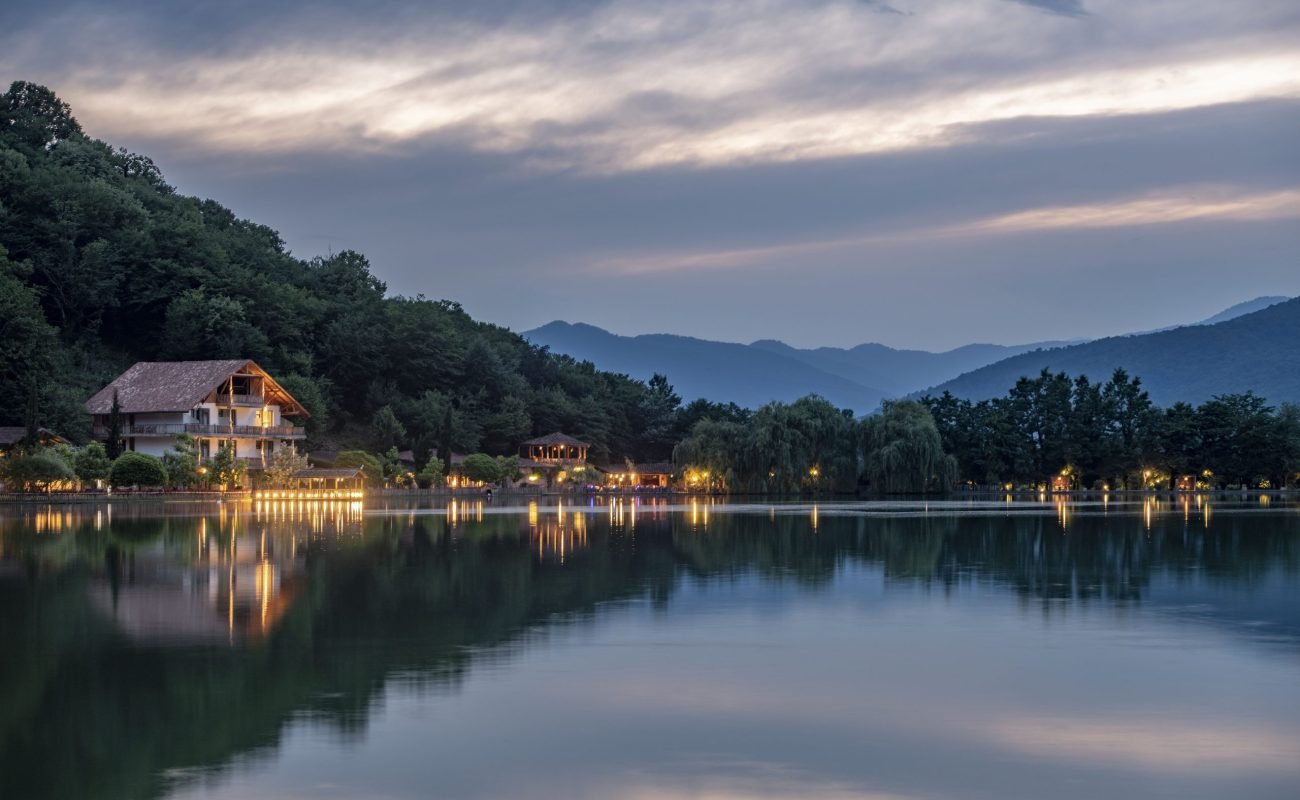
A Resort Built Into the Kakheti Landscape
The road into Napareuli drops through terraced vineyards and walnut groves before opening onto the lake. Arriving at Lopota, the first thing you register is not a lobby or a facade but a horizon: water in the foreground, the Caucasus ridge rising behind it, and 60 hectares of resort grounds occupying the space between. Georgia's wine country has seen a wave of hospitality investment over the past decade, and the properties that have aged leading are those that let the terrain do the architectural work. Lopota belongs to that category.
The resort's physical spread is considerable. Forest trails, a working vineyard, outdoor and indoor pools, equestrian facilities, spa buildings, and more than 200 guest rooms are arranged across the grounds in a way that avoids the herded-corridor feeling common to large-footprint properties. At 232 rooms, Lopota sits in a tier of Georgian hospitality largely occupied by international-brand hotels in Tbilisi and Batumi. In the Kakheti region specifically, that scale is unusual. Properties like Tsinandali Estate, A Radisson Collection Hotel and Vazisubani Estate operate with far fewer keys and position against a boutique traveller. Lopota's bet is different: it offers the breadth of a full resort alongside the setting of an estate, priced at approximately $164 per night.
The shortlist, unlocked.
Hard-to-book tables, cellar releases, and concierge-planned trips.
Get Exclusive Access →The Architecture of Scale Without Anonymity
Large-resort design typically resolves the tension between capacity and character in one of two ways: it either leans into grandeur (marble atria, monumental corridors) or it disappears into neutral minimalism. Lopota takes a third route, one rooted in the accumulated logic of a property that grew organically from a seven-room guesthouse rather than being conceived at full scale from a masterplan. The result is a campus-like quality where different areas of the property have distinct characters, tied together by the lake view and the consistent presence of the surrounding agricultural landscape.
Stone, timber, and local materials recur throughout the structures, keeping the built environment in visual conversation with the Caucasus foothills. This is an approach that places Lopota in the same broad design tradition as destination resorts that use vernacular architecture as their primary aesthetic language, properties like Amangiri in Utah's canyon country or Castello di Reschio in Umbria, where the landscape is the dominant design element and the buildings are calibrated not to compete with it. The ambition at Lopota is analogous, even if the execution sits at a different price point.
For guests interested in how Georgia's premium hospitality scene has evolved, our full Napareuli hotels guide places Lopota in the context of the region's wider accommodation options.
Vineyards, Horses, and the Logic of the Estate
Kakheti produces roughly 70 percent of Georgia's wine, and the region's premium properties increasingly treat viticulture as a hospitality amenity rather than a separate agricultural operation. Lopota's own Château Buera winery sits within the estate grounds, which means guests move between tasting and sleeping and dining without leaving the property. This integration of production and guest experience is a model familiar from wine-country estates in Burgundy, Napa, and Tuscany, and it gives Lopota a structural coherence that goes beyond scenic setting.
The equestrian programme adds a layer that few Caucasus properties can match at this scale. Horseback access to the surrounding terrain shifts the relationship between guest and landscape from passive to active, which is relevant for travellers who find conventional spa-and-pool resort programming underuses the environment it is set in. Our full Napareuli experiences guide covers the broader activity options available in the region, including those that extend beyond the resort grounds.
The kitchen's orientation toward garden produce follows a logic that has become standard at ambitious rural properties globally: sourcing proximity reduces the distance between ingredient and plate and allows the menu to reflect the season in a way that imported supply chains cannot. Georgia's agricultural traditions, particularly in Kakheti, provide an unusually rich base for this approach, with indigenous grape varieties, walnut-based sauces, herb-forward salads, and slow-cooked meat dishes forming the structural vocabulary of local cooking.
Where Lopota Sits in the Georgian Hospitality Picture
Georgia's premium hotel market has developed along two distinct tracks. In Tbilisi, design-led conversions like Rooms Hotel Tbilisi have defined a local aesthetic that emphasises industrial materials, cultural programming, and a self-consciously urban sensibility. In the wine country, the challenge is different: the environment provides the drama, and the question is how much infrastructure to build around it without compromising the reason guests chose the region in the first place.
Lopota's answer has been to build substantially, but to anchor the expansion in the estate's own agricultural and natural assets. The 60-hectare footprint is large enough to absorb 232 rooms without those rooms feeling stacked, and the vineyard, lake, and trail network give the scale a functional justification. Compared to international estate properties at similar or higher price points, such as Casa Maria Luigia in Modena or Hotel Esencia in Tulum, Lopota's room count is notably higher, which means it can absorb families, groups, and multi-night stays without the sold-out pressure that characterises smaller estate properties.
For travellers planning around the Kakheti wine harvest, late September and October represent the period of highest agricultural activity in the region. Arrivals during that window coincide with active pressing at wineries throughout the valley, including at Château Buera. The shoulder months of May and June offer milder temperatures and fewer visitors. For context on the full spectrum of eating and drinking options in the area, see our full Napareuli restaurants guide, our full Napareuli bars guide, and our full Napareuli wineries guide.
Planning a Stay
Rates at Lopota begin at approximately $164 per night, which positions the property well below comparable estate resorts in Western Europe and the Americas while operating at a scale and breadth of amenity that most sub-$200 properties in the post-Soviet Caucasus do not offer. The 232-room inventory means availability is generally more accessible than at boutique competitors in the region, but the harvest season window in September and October books with the region's tourist peak, and advance planning is advisable for those periods. Guests travelling from Tbilisi should allow roughly two to three hours for the drive east into Kakheti, depending on the specific route and traffic through the capital's outskirts.
The shortlist, unlocked.
Hard-to-book tables, cellar releases, and concierge-planned trips.
Get Exclusive Access →Frequently Asked Questions
At-a-Glance Comparison
These are the closest comparables we have in our database for quick context.
| Venue | Cuisine | Price | Awards | Notes |
|---|---|---|---|---|
| Lopota Lake Resort & Spa | Price: $164 Rooms: 232 Rooms What began as a seven-room guesthouse on a peacef… | This venue | ||
| Rooms Hotel Tbilisi | ||||
| Stamba Hotel | ||||
| The Blue Fox Hotel | ||||
| The Telegraph Hotel | ||||
| Tsinandali Estate, A Radisson Collection Hotel |
Preferential Rates?
Our members enjoy concierge-led booking support and priority upgrades at the world's finest hotels.
Get Exclusive AccessThe shortlist, unlocked.
Hard-to-book tables, cellar releases, and concierge-planned trips.
Get Exclusive Access →