kodō hotel


Selected by the Michelin Guide Hotels 2025, kodō hotel occupies a converted space on South Santa Fe Avenue in the Arts District, placing it inside Los Angeles's growing tier of design-led independent properties. The address puts guests within reach of the neighbourhood's gallery circuit, restaurant row, and the particular energy of an industrial corridor undergoing long-term reinvention.
Pearl is the En Primeur Club membership app — saves, bookings, and concierge access live there. Same editors, same standards.
- Address
- 710 S Santa Fe Avenue, Los Angeles Area, CA, USA
- Phone
- (833) 993-3193
- Website
- kodohotel.com
 Saves & bookings on Pearl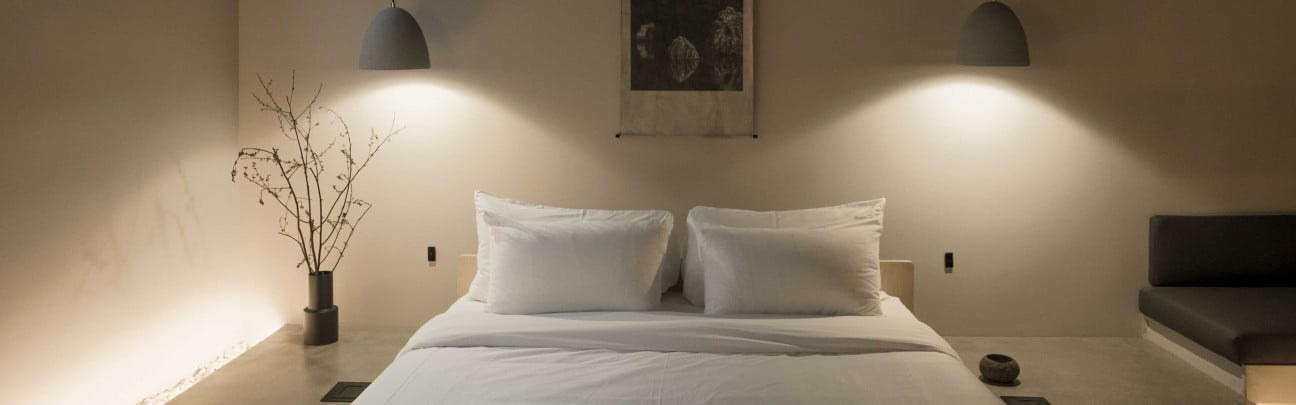
The Arts District Wellness Proposition
Los Angeles has always offered two distinct modes of recovery: the resort escape out to the coast or the desert, and the urban recalibration that comes from staying somewhere considered enough to slow you down without removing you from the city. The Arts District, stretching east of downtown along the LA River corridor, has become the more credible address for the second mode. The neighbourhood's converted warehouses and low-rise industrial blocks create physical conditions that are inherently calming compared to the noise of West Hollywood or Midtown Wilshire, and a cluster of independently operated hotels here has capitalised on that character. kodō hotel, situated at 710 S Santa Fe Avenue in Los Angeles Area, is a hotel with a nightly rate from $194 and a Michelin Selected 2025 listing.
In the Los Angeles hotel market, which runs from large international footprints like Andaz West Hollywood through mid-scale lifestyle brands like Freehand Los Angeles and down to boutique independents, Michelin's hotel selection tends to identify properties where design coherence and a legible point of view have been achieved without the operational scale of a major group. kodō sits in that smaller, quieter tier. Compare that to coastal peers such as Hotel Erwin Venice Beach or Hotel Oceana Santa Monica, both of which foreground proximity to the water as their primary draw, and the Arts District address reads as a deliberate counter-positioning: interior depth over exterior spectacle.
What the Address Actually Offers
South Santa Fe Avenue sits in the part of the Arts District that saw its most concentrated transformation between roughly 2015 and 2022, when gallery relocations from Culver City, a wave of chef-driven restaurants, and design-trade showrooms changed the character of the corridor from light industrial to what the city now markets as a creative hub. For a guest arriving with wellness priorities, that context is genuinely useful. Walkable access to independent coffee roasters, plant-forward restaurants, and a density of design stores removes the car-dependency that makes recovery harder in most parts of Los Angeles. You can leave the property, spend three hours walking a radius of six blocks, and return without having moved the car once, which is not something that can be said of most LA hotel addresses.
The Arts District's industrial fabric also shapes the sensory environment in ways that matter for sleep and decompression. Warehouse buildings with heavy walls, high ceilings, and minimal street-front glazing tend to produce quieter interiors than glass-tower hotels on Sunset or Wilshire. Natural light arrives at angles rather than flooding directly, which softens the experience of being in a city where the outdoor light is among the more intense on the West Coast. Those physical conditions, rather than any programmed wellness offering, form the base-layer recovery argument for properties in this part of town.
Situating kodō in the Los Angeles Retreat Spectrum
The retreat spectrum in and around Los Angeles is wide. At one end sit full-immersion properties like Canyon Ranch Tucson, where the programming is the product. At the other end, urban hotels offer location and design without structured wellness content. kodō, as an independent boutique property, operates in the middle band: somewhere that functions as a base for self-directed urban recovery rather than a resort delivering curated programmes. Guests making an active wellness decision here are likely to be building their own itinerary from the neighbourhood, the hotel's design quality, and the relative quiet of an address that sits off the main arterials.
That positions kodō differently from Hotel June Malibu, which frames the Pacific coast as its wellness context, or from Post Ranch Inn in Big Sur, where the landscape does the heavy lifting. It also differs from Amangiri in Canyon Point and Kona Village, A Rosewood Resort, both of which are destination retreat properties in the full sense. kodō's argument is urban and architectural, not landscape-led, which suits a different kind of guest: someone whose recovery requires remaining connected to the city rather than withdrawing from it entirely.
Among Arts District-adjacent hotels, Gold Diggers and Hollywood Volume both lead with music culture and social programming, which puts them in a different register. kodō's Michelin recognition suggests a more curated, less programmatically loud approach, even if the specifics of what that means in practice are best confirmed at the time of booking.
Planning a Stay
The Arts District is most navigable from late morning onward; weekend mornings see the highest foot traffic around the galleries and coffee spots, while weekday afternoons offer the neighbourhood at its quietest. For guests arriving from out of state, Union Station is approximately fifteen minutes by rideshare, and LAX is a workable forty-five minutes outside peak hours. Given that the Michelin Selected designation tends to bring a meaningful visibility bump in the year of publication, the 2025 listing suggests booking in advance rather than testing availability on arrival, particularly for weekend dates from late spring through summer, when Arts District occupancy tightens alongside the broader LA travel calendar.
Guests considering kodō alongside other independently operated Michelin-recognised properties in different markets might look at Troutbeck in Amenia, SingleThread Farm Inn in Healdsburg, or Meadowood Napa Valley for a sense of the tier. For larger-footprint recognised properties in international markets, Badrutt's Palace Hotel in St. Moritz, Hôtel de Paris Monte-Carlo, and Aman Venice each illustrate how the same Michelin selection process applies across different scale and context.
Credentials Lens
Comparable venues nearby, for context on price, style, and recognition.
| Venue | Cuisine | Price | Awards | Notes |
|---|---|---|---|---|
| kodō hotelThis venue — the venue you are viewing | Minimalist Japanese ryokan-style boutique hotel in a historic fire station. | $$$$ | Not listed | Not listed |
| Bonaventure Brewing Co. | rooftop brewery event space | $$ | Not listed | Financial District |
| Burton House Beverly Hills | Contemporary lifestyle boutique hotel with a polished residential feel and strong sense of Beverly Hills place-making. | $$$ | 3-Star | Westside / near Beverly Hills |
| Hotel Normandie LA | Historic boutique hotel with Spanish Colonial and Renaissance Revival accents. | $$$ | Not listed | Wilshire Center |
| Palihotel Westwood Village | Neighborhood boutique hotel with highly-stylized, fun and approachable accommodations. | $$$ | Not listed | Westwood Village |
| Hotel Lucile | Intimate urban boutique hotel set in a preserved 1930s church, positioned as a stylish neighborhood hub in Silver Lake. | $$$ | Not listed | Silver Lake |
Recognition history
Dated appearances from independent guides and award organizations, with the underlying list record or original source where available.
Mr & Mrs Smith Smith Seal of Approval
Mr & Mrs Smith
Tablet Hotels Best New Hotel Designs (USA & Canada)
Tablet Hotels · Tablet Hotels Design Awards 2026: Best New Hotel Designs (USA & Canada)
Michelin Selected
Michelin
Continue exploring
More in Los Angeles
Hotels in Los Angeles
Browse all →
Bars in Los Angeles
Browse all →

Restaurants in Los Angeles
Browse all →
Wineries in Los Angeles
Browse all →
At a Glance
- Minimalist
- Modern
- Serene
- Elegant
- Romantic Getaway
- Wellness Retreat
- Weekend Escape
- Design Destination
- Wi Fi
- Concierge
- Wi Fi
- Concierge
Zen minimalist Japanese design with serene, nature-inspired elements, neutral palette, high wood-beamed ceilings, and a spiritual connection to simplicity.