Hotel Greulich

Hotel Greulich occupies a converted residential building on Herman-Greulich-Strasse in Zurich's District 4, a neighbourhood better known for its independent restaurants and late-night bars than for hotel infrastructure. The property sits in a quieter category than the lakefront giants: smaller in scale, closer to the city's working residential fabric, and positioned for travellers who want proximity to the centre without the ceremony of a grand-hotel address.
Pearl is the En Primeur Club membership app — saves, bookings, and concierge access live there. Same editors, same standards.
- Address
- Herman-Greulich-Strasse 56, 8004 Zürich, Switzerland
- Phone
- +41 43 243 42 43
- Website
- greulich.ch
- Directions
- Get directions
 Saves & bookings on Pearl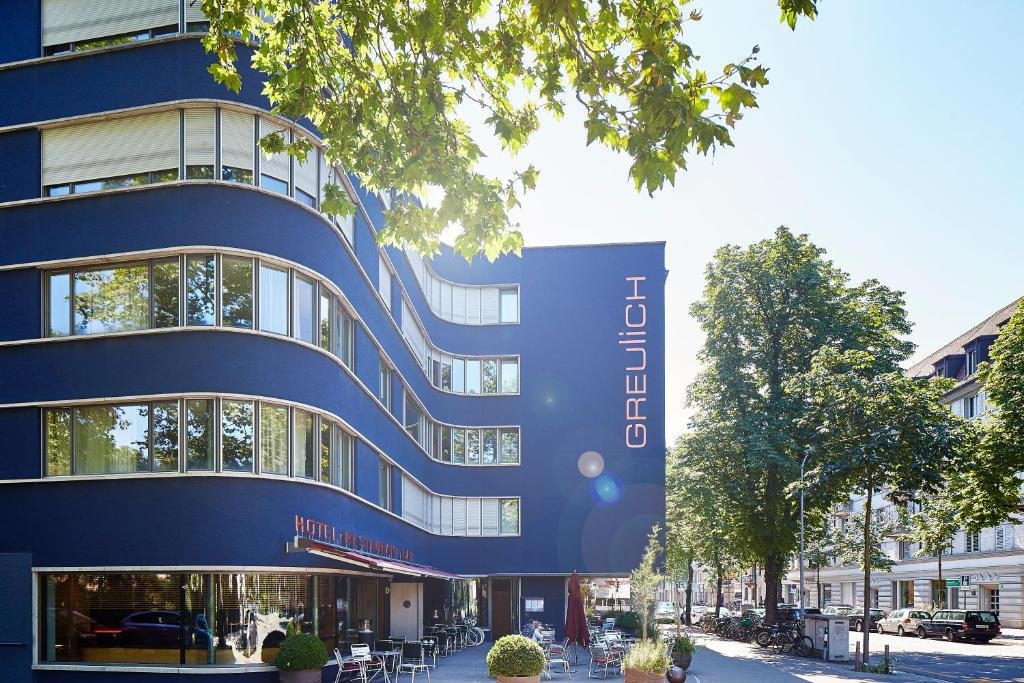
District 4 and the Case for Staying Off the Lake
Zurich's hotel market divides along a familiar fault line. On one side sit the lakefront properties, Baur au Lac, La Réserve Eden au Lac Zurich, The Dolder Grand, anchored by water views, grand lobbies, and price points that reflect all of the above. On the other sit a smaller number of design-conscious independents embedded in residential neighbourhoods, where the surrounding streets do as much work as the hotel itself. Hotel Greulich belongs to the second group, on Herman-Greulich-Strasse in District 4, a part of the city that has shifted over two decades from post-industrial neglect to a dense mix of independent dining, wine bars, and the kind of everyday urban life that Zurich's tourist infrastructure rarely puts front and centre.
That neighbourhood context is not incidental. District 4, specifically the Langstrasse corridor and its surrounding streets, is where a meaningful portion of Zurich's most interesting food and drink happens, well away from the polished tourist circuits of the Old Town and the lake promenade. Staying here puts the city's working culture within a short walk, which is either an asset or an irrelevance depending on what kind of traveller you are. For those who want to move between the hotel and the city's independent restaurant scene without returning to a grand-hotel bubble, the address is well-chosen. For those who prioritise a lake view and white-glove formality, properties like the Widder Hotel in the Old Town or the Baur au Lac are the more obvious fit.
The Retreat Instinct in an Urban Setting
The wellness conversation in Swiss hospitality tends to default to the mountain resort format. Properties like the Grand Resort Bad Ragaz, with its thermal spa infrastructure, or The Alpina Gstaad, set against alpine terrain, represent the dominant model: large-scale, nature-adjacent, built around dedicated wellness programming. Urban properties operating in that register typically do so at a different register entirely, the Dolder Grand, for instance, carries a full spa operation within a city-edge position.
Hotel Greulich occupies a different position in this spectrum. The property's character is shaped less by programming and more by the physical qualities of the conversion itself: a residential building that retains a domestic scale, removed from the noise of the main transit corridors, with an internal courtyard that functions as a buffer between the street and the rooms. In Swiss urban hospitality, this kind of quietude is not incidental, it reflects a broader tendency among smaller design hotels to treat atmosphere and proportion as wellness tools in themselves, rather than constructing formal spa facilities. The retreat logic here is spatial rather than programmatic: the building is calm in a city that, for all its efficiency, does not lack stimulation. Travellers arriving after a day of meetings in Zurich's financial district, or after a long-haul connection through Zurich Airport, will find the scale of the place a genuine counterpoint to both.
This approach to urban retreat is not distinctive to Greulich in Switzerland's smaller hotel market. Properties like the Boutique Hotel Restaurant Krone Regensberg outside Zurich, or the 7132 Hotel in Vals, operate on a similar logic of environment-as-recovery, where the building itself does the work that a spa menu would do elsewhere. The difference is context: Greulich keeps you inside the city rather than extracting you from it, which is a meaningful distinction for business travellers or those with appointments that make a mountain retreat impractical.
Position Within Zurich's Design Hotel Tier
The city's design-conscious independent hotel category is not large. Beyond Greulich, the properties most often discussed in the same breath include the 25hours Hotel Zürich Langstrasse, also in District 4, with a more deliberately playful identity, and the 25hours Hotel Zürich West further towards the Hardbrücke area. The Helvetia and the Ambassador Zurich Hotel round out a comparable set that prioritises character over scale. Within that group, address matters: being on the same street that gives the hotel its name, in a building that reads as residential rather than commercial, is a specific kind of positioning that distinguishes Greulich from the 25hours properties, which lean further into brand identity and programming.
For travellers considering how Greulich fits against Switzerland's wider hotel range, the comparison set shifts significantly when you move beyond the city. The Badrutt's Palace Hotel in St. Moritz, Beau-Rivage Palace in Lausanne, or the Beau-Rivage Geneva are operating in an entirely different category of scale, formality, and infrastructure. Greulich does not compete with them and makes no attempt to. It is, rather, part of a category of Swiss hospitality that treats restraint as a value proposition, smaller, quieter, with a local address that places you in the city rather than above it.
Planning a Stay
Hotel Greulich sits at Herman-Greulich-Strasse 56 in the 8004 postal district, placing it roughly equidistant between Zurich's central station (Hauptbahnhof) and the southern reaches of District 4. The neighbourhood is walkable to the Langstrasse and the broader District 4 and 5 restaurant concentration, which means the hotel functions well as a base for evenings spent in the city's more independent dining rooms. Travellers connecting through Switzerland who want a contrast with the resort-scale properties might also consider the Castello del Sole Beach Resort and Spa in Ascona or the CERVO Mountain Resort in Zermatt as complementary stops that offer the landscape and spa infrastructure that an urban property of this scale cannot.
Recognition, Side-by-Side
Comparable venues nearby, for context on price, style, and recognition.
| Venue | Cuisine | Price | Awards | Notes |
|---|---|---|---|---|
| Hotel GreulichThis venue — the venue you are viewing | Modern Bauhaus architecture with minimalist interiors | $$$ | 4-Star | Not listed |
| Hotel Glockenhof | Modern 4-star urban hotel with historic charm and green courtyard oasis | $$$ | 4-Star | Aussersihl |
| Sorell Hotel Zürichberg | Traditional boutique hotel in a 19th century Art Nouveau building with modern extensions | $$$ | 4-Star | Dolder |
| Ambassador Zurich Hotel | Neo-baroque heritage building with contemporary luxury interiors; combines turn-of-the-century elegance with modern amenities and Swiss textile history references. | $$$$ | 4-Star | Enge |
| Alma Hotel | Contemporary boutique in renovated 19th-century villa | $$$ | 3-Star | Riesbach |
| 25hours Hotel Zürich West | Sport-themed boutique hotel in a former industrial area. | $$$ | 4-Star | Industriequartier |
Recognition history
Dated appearances from independent guides and award organizations, with the underlying list record or original source where available.
Michelin Selected
Michelin
Continue exploring
More in Zürich
Hotels in Zürich
Browse all →
Bars in Zürich
Browse all →

Restaurants in Zürich
Browse all →

At a Glance
- Minimalist
- Modern
- Cozy
- Quiet
- Intimate
- Romantic Getaway
- Weekend Escape
- Garden
- Terrace
- Wi Fi
- Parking
- Restaurant
- Bar
- Garden
- Concierge
- EV Charging
- Garden
- Wi Fi
- Parking
- Restaurant
- Bar
- Garden
- Concierge
- EV Charging
Minimalist design with abundant natural light, cozy atmosphere blending purist style and birch grove serenity.