Hôtel de JoBo occupies a townhouse on Rue d'Ormesson in the Marais, positioning itself in the growing tier of design-led boutique hotels that trade scale for neighbourhood immersion. Its address places guests within walking distance of Place des Vosges and the concentrated restaurant circuit of the 4th arrondissement, making it a considered base for those who want Paris at street level rather than from a grand boulevard.
Pearl is the En Primeur Club membership app — saves, bookings, and concierge access live there. Same editors, same standards.
- Address
- 10 Rue d'Ormesson, 75004 Paris, France
- Phone
- +33 1 48 04 70 48
- Website
- hoteldejobo.paris
- Directions
- Get directions
 Saves & bookings on Pearl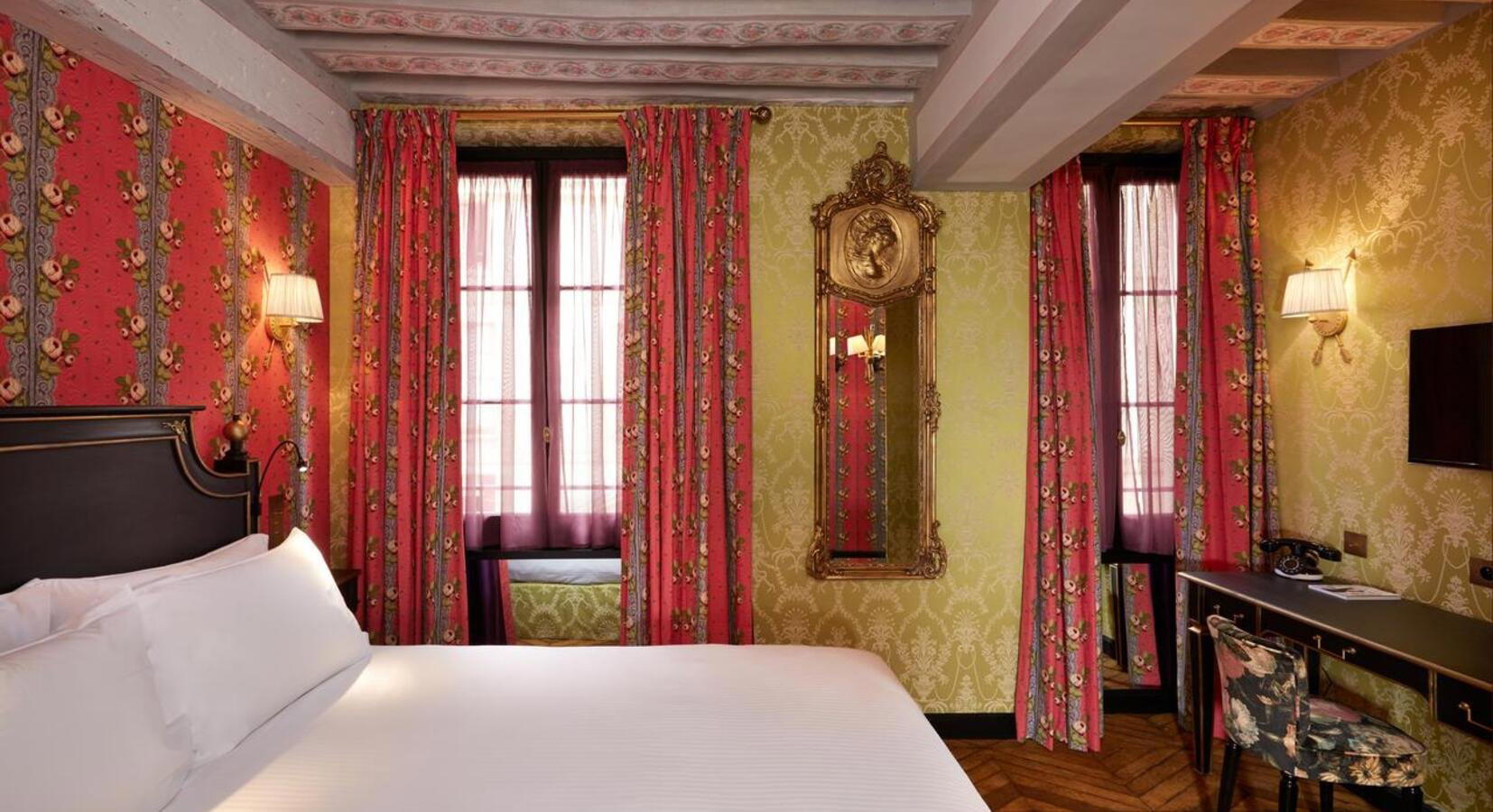
A Marais Address in a City That Rewards Specificity
Hôtel de JoBo is a 4-star hotel in Paris's 4th arrondissement, at 10 Rue d'Ormesson. The city's luxury tier has long been anchored on the Right Bank's 8th arrondissement, where properties like Four Seasons George V, Hotel Plaza Athénée, and Le Meurice cluster around the avenue and the Tuileries. But a separate tier has been growing steadily in the Marais, built around smaller-footprint hotels that situate guests inside one of the city's most walkable and culinarily dense quarters rather than staging them in its grandest boulevard.
Hôtel de JoBo, at 10 Rue d'Ormesson in the 4th arrondissement, belongs to that second category. The address places it a short walk from Place des Vosges, in a pocket of the Marais where the street grid compresses and the density of independent restaurants, wine bars, and market stalls becomes a genuine draw in its own right. In this part of Paris, the hotel is less a destination than a base from which the destination is accessed on foot.
The Boutique Position in Paris's Hotel Market
The Paris hotel market has stratified clearly over the past decade. At one end sit the grand palace hotels: Le Bristol Paris, Hôtel de Crillon, and Cheval Blanc Paris, each offering multi-starred dining, large-scale spa facilities, and the kind of institutional service apparatus that takes decades to build. At the other end sits a growing cohort of design-driven boutique properties, typically below fifty keys, that compete on character and location rather than on amenity breadth.
Hôtel de JoBo operates in the latter tier. In a city where the palace hotels price and programme at one level, and the anonymous business-category properties fill the mid-range, the design boutique occupies a specific niche: a guest willing to trade the grand lobby and the in-house starred restaurant for something more architecturally considered and geographically embedded. La Réserve Paris sits in its own category between these poles, but the JoBo model is more legible as a boutique play than a palace challenger.
This positioning is common across European capitals, and it has accelerated in Paris since the mid-2010s as travellers began selecting hotels more precisely by arrondissement character than by brand affiliation. The Marais, with its density of galleries, covered markets, and restaurants ranging from serious natural wine bars to long-established Jewish deli counters, is a natural home for this kind of property.
The Dining Programme and Its Context
The editorial angle on any Marais boutique hotel is inseparable from the question of food, because the neighbourhood functions as one of the more concentrated dining circuits in central Paris. A hotel in this postcode does not need to anchor its food programme with a flagship starred restaurant to be credible; the surrounding streets do that work for guests who know where to look. What matters is whether the property's own offer fits coherently into the fabric of the neighbourhood rather than trying to replicate what the palace hotels do at a smaller scale.
Boutique hotels in the Marais have generally taken one of two approaches: a compact all-day café format that serves as both breakfast room and neighbourhood bar, or a more structured dining room with an identifiable culinary point of view. Particularly successful in recent years have leaned into the latter while keeping covers low enough that the room retains the feel of a private house rather than a hotel restaurant. The street-level programming of any hotel on Rue d'Ormesson draws from a neighbourhood that has, over the past decade, become one of the more interesting eating quarters in the city for mid-priced, ingredient-focused cooking.
For guests who want the full Paris palace dining experience, properties such as Cheval Blanc Paris or Le Meurice represent a different register entirely. For those whose primary interest is the city's independent restaurant scene, a Marais base makes more practical sense.
Where JoBo Sits Relative to Comparable French Properties
France's broader hotel scene offers useful comparison points for understanding what the boutique Marais format trades in and out. Properties like Domaine Les Crayères in Reims or Baumanière Les Baux-de-Provence have built their reputations around culinary programmes that are inseparable from the property identity, where the restaurant exists before the hotel does in the guest's imagination. Les Sources de Caudalie in Bordeaux and Royal Champagne Hotel & Spa in Champillon similarly tie their offer to a specific regional food and wine identity.
The Marais boutique model is structurally different. It borrows culinary credibility from the neighbourhood rather than generating it internally. This is neither a weakness nor a compromise; it is a deliberate editorial choice about what kind of stay the property is building. For guests arriving from the French countryside, properties like La Bastide de Gordes or Villa La Coste function as self-contained retreats, the urban boutique format asks for a different kind of engagement with place.
Internationally, the closest analogues are properties like The Fifth Avenue Hotel in New York City, which operates in a similar register of design-led urban boutique without competing directly against the city's palace tier. Aman Venice occupies its own category of neighbourhood immersion, though at a price point and scale that places it elsewhere entirely.
The Practical Case for a Marais Stay
The 4th arrondissement is one of the few central Paris postcodes where walkability genuinely replaces the need for a taxi or metro for most of a day's activity. Place des Vosges is within a few minutes on foot from Rue d'Ormesson. The Picasso Museum, the Pompidou Centre, and the concentration of covered passages around the Temple quarter are all reachable without a vehicle. The Marché des Enfants Rouges, Paris's oldest covered market and still one of its most animated, sits just north of the hotel's immediate quarter.
For those building a longer French itinerary that extends to the coast or mountains, Paris properties like Hôtel de JoBo function well as city bookends before or after time at properties such as Hotel Du Cap-Eden-Roc in Cap d'Antibes, The Maybourne Riviera in Roquebrune-Cap-Martin, or Cheval Blanc Courchevel in winter.
In Context: Similar Options
Comparable venues nearby, for context on price, style, and recognition.
| Venue | Cuisine | Price | Awards | Notes |
|---|---|---|---|---|
| Hôtel de JoBoThis venue — the venue you are viewing | Eccentric tribute to Joséphine Bonaparte in a historic convent setting with Napoleonic aesthetics. | $$$$ | 4-Star | Not listed |
| Hôtel du Petit Moulin Paris | Le Marais | Haute couture boutique hotel in a historic bakery building | $$$$ | 4-Star | Le Marais |
| Hôtel Paradis | Contemporary Parisian boutique with Art Deco touches and 19th-century heritage. | $$$$ | 4-Star | 10th Arr. |
| Le Relais Saint Germain | Historic 17th-century Parisian townhouse revived as a family-like boutique inn. | $$$$ | 4-Star | Saint-Germain-des-Prés |
| Les Plumes Hôtel | Literary-themed boutique hotel blending traditional Parisian style with avant-garde decor. | $$$$ | 4-Star | 9th arrondissement |
| Hilton Paris Opera | Historic Hilton blending Belle Époque grandeur with modern luxury. | $$$$ | 4-Star | 8th arrondissement |
Continue exploring
More in Paris
Hotels in Paris
Browse all →
Bars in Paris
Browse all →
Restaurants in Paris
Browse all →
Wineries in Paris
Browse all →
At a Glance
- Romantic
- Elegant
- Whimsical
- Ornate
- Intimate
- Sophisticated
- Romantic Getaway
- Anniversary
- Weekend Escape
- Garden
- Terrace
- Historic Building
- Design Destination
- Wi Fi
- Room Service
- Concierge
- Airport Transfer
- Garden
- Garden
- Street Scene
- Wi Fi
- Room Service
- Concierge
- Airport Transfer
- Garden
Intimate and flamboyant with colorful, rose-filled neoclassical Directoire elegance, leopard prints, pinks, and lozenge motifs creating a romantic, rock'n'roll eccentricity.