Google: 4.0 · 4,160 reviews
Grotta Palazzese occupies a sea cave carved into the limestone cliffs of Polignano a Mare, on Puglia's Adriatic coast. The restaurant's dining terrace sits directly above open water, making it one of the most architecturally specific dining settings in southern Italy. Booking well ahead is strongly advised, particularly for summer evenings when demand peaks sharply.

Dining Inside the Rock: What Grotta Palazzese Actually Is
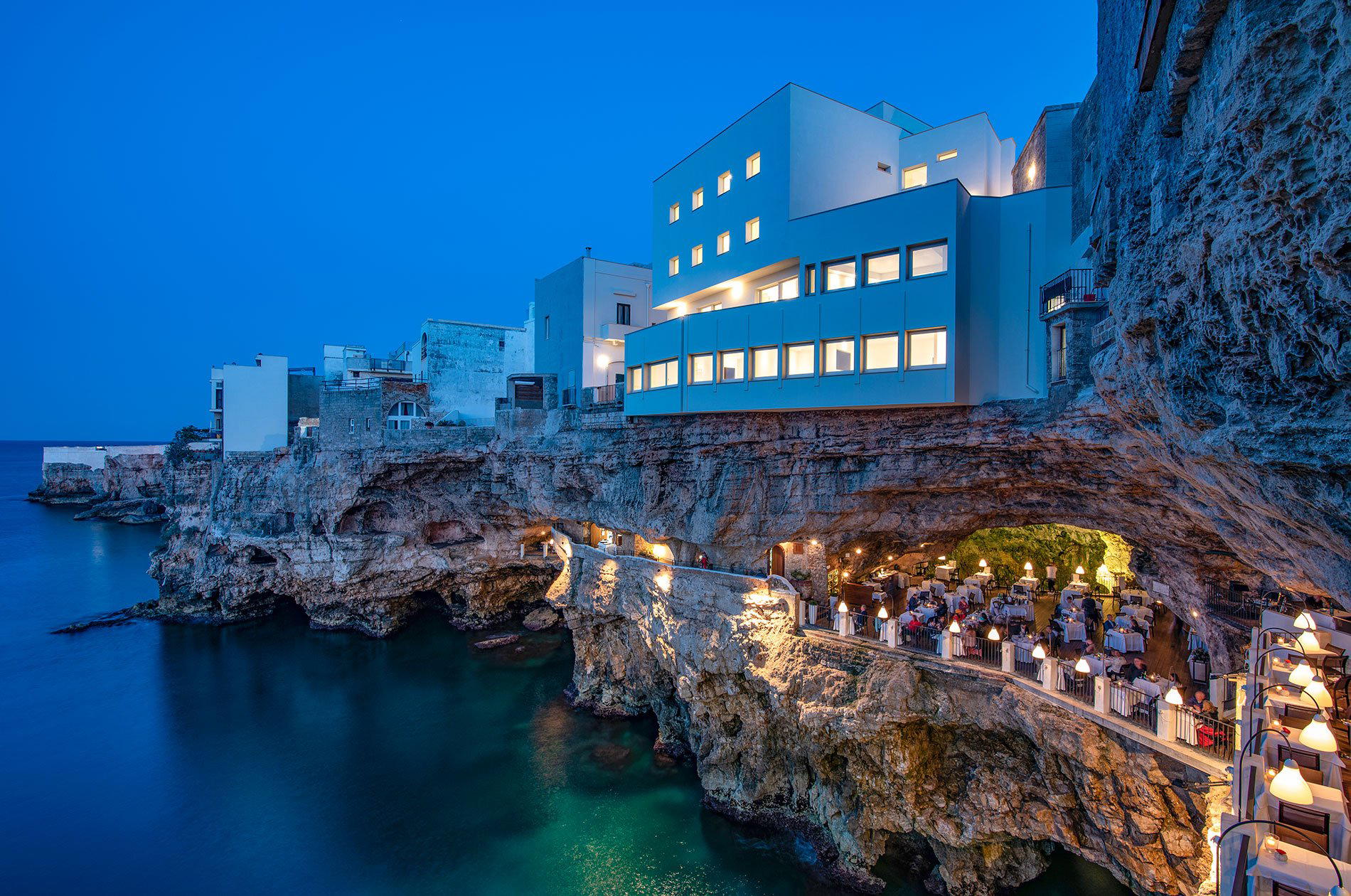
There is a particular category of dining venue that derives its entire premise from a geological accident. Grotta Palazzese, on the cliff edge of Polignano a Mare in Puglia, belongs to that category. The restaurant occupies a natural sea cave, its terrace suspended over Adriatic water that shifts from green to deep blue depending on the light and the hour. The limestone walls of the cave are the architecture. No designer imposed this. The rock was here long before the tables.
Polignano a Mare itself is a small town on the Adriatic coast of Puglia, roughly 35 kilometres south of Bari and reachable from Bari Centrale by regional train in under 30 minutes. The historic centre sits atop limestone promontories, with the sea visible from nearly every angle. The town has drawn visitors for decades, but the cliff-cave setting of Grotta Palazzese operates at a different register of spectacle from anything else along this coastline. For the broader context of what Polignano's dining scene offers, see our full Polignano restaurants guide.
The Architecture of the Cave
The physical structure at Grotta Palazzese is not a designed space in the conventional sense. The cave is a karst formation, the kind produced over millennia by seawater dissolving the limestone bedrock of this coastline. What has been added over time is the infrastructure to make it habitable as a dining room: terrace flooring, lighting, seating, and the technical systems needed to operate a restaurant in an environment that is essentially open to the sea on one side and raw rock on the others.
This creates a spatial experience that is difficult to replicate through design alone. The ceiling is stone. The walls are stone. The cave mouth frames an unobstructed view of the Adriatic. At night, artificial lighting throws the cave walls into relief, making the texture of the limestone visible in a way that daylight does not allow. The effect is theatrical, but the theatre is entirely geological in origin.
For comparison, other properties across Italy that make strong architectural claims, including Aman Venice and Four Seasons Hotel Firenze, work with historic built structures. Grotta Palazzese works with something older and less controllable. That is both its strength and its constraint: the setting cannot be modified without destroying what makes it the setting.
Positioning Within the Puglia Coastal Scene
Puglia has developed a significant luxury hospitality infrastructure over the past two decades, concentrated largely around the Valle d'Itria and the Fasano coast. Properties like Borgo Egnazia in Savelletri di Fasano represent the resort-scale end of that development, while Polignano a Mare operates as a destination of a different type: a historic town where the primary draw is the town itself, and within it, specific set pieces of which Grotta Palazzese is the most photographed.
This positioning matters for understanding what kind of experience Grotta Palazzese delivers. It is not a resort. It is not a hotel property with a restaurant attached (though accommodation does exist in connection with the site). It is, at its core, a dining venue whose reputation rests almost entirely on its physical location. The question of whether the cuisine matches that location is one visitors assess differently depending on what they came for. Those who come for the cave leave with the cave. Those who come expecting food at the level of Italy's leading coastal restaurants may recalibrate expectations before arrival.
For reference, the southern Italian coastal dining scene at its most ambitious can be found at properties like Borgo Santandrea on the Amalfi Coast and Il San Pietro di Positano, where the culinary program is as deliberate as the setting. Grotta Palazzese competes on a different axis.
Seasonality and Timing
The cave restaurant operates seasonally, with summer the primary window. The Puglia coast runs hot and dry from June through September, which is when the Adriatic light at sunset turns the cave's limestone walls amber and the water below shifts through its full colour range. This is also when demand is at its highest, and when booking becomes a serious logistical consideration.
Visiting in shoulder season, April to May or October, brings thinner crowds, cooler temperatures on the terrace, and the possibility of a table at shorter notice. The cave's natural acoustics change without a full room, becoming quieter and more spatially present. For visitors staying in the region, properties such as Borgo Egnazia or closer to the Salento coast make for convenient bases. The Bari airport, roughly 40 kilometres north, handles direct flights from major European hubs, making Polignano accessible as a day trip or short stay from within Italy and from abroad.
The Broader Tradition of Cliff Dining in Southern Italy
Grotta Palazzese belongs to a small and specific tradition of venues built around dramatic coastal geology rather than constructed around it. The Amalfi Coast has its versions, including terraces cantilevered over the sea at Bellevue Syrene 1820 in Sorrento. Capri has settings that trade on vertical cliff exposure, as at JK Place Capri. What makes the Polignano site different is the enclosure: you are inside the rock, not in front of it. The cave creates a sense of being held by the landscape rather than simply looking at it.
That distinction is meaningful to the experience. Enclosed cave acoustics, the sound of water amplified by stone walls, the compression of the ceiling above and the openness of the sea view ahead, these are spatial conditions that no terrace above open water can replicate. They are also conditions that photographs, which have made Grotta Palazzese one of the most circulated dining images in Italy, struggle to convey. The images show the view. They rarely convey the sound, or the smell of salt air channelled through limestone, or the temperature differential between the cool rock interior and the warm Adriatic evening outside.
Planning Your Visit
Grotta Palazzese is located at Via Narciso 59 in Polignano a Mare, on the southern cliff edge of the historic centre. The approach on foot from the town square takes several minutes along narrow streets that open abruptly onto cliff-edge views. Bari Centrale is the nearest major rail hub, and the regional train to Polignano runs frequently. For those staying in the region at properties like Borgo Egnazia, a car is the most practical option for the evening.
Booking in advance is strongly advised for summer dinner service. The demand for tables with the leading cave position, directly facing the sea opening, exceeds supply for most of the summer season. Contact the venue directly through its official website or by email for reservation enquiries; specific booking procedures and current availability are subject to seasonal variation and should be confirmed at time of planning.
For those building a wider Italian itinerary, the EP Club covers comparable properties across the country that combine setting and culinary substance: Passalacqua in Moltrasio on Lake Como, Il Pellicano in Porto Ercole on the Tyrrhenian coast, and Rosewood Castiglion Del Bosco in Montalcino for interior Tuscany. Each sits in a different tier of the Italian luxury scene, but all share a clarity of concept that Grotta Palazzese, in its own geological way, also possesses.
Peer Set Snapshot
These are the closest comparables we have in our database for quick context.
| Venue | Cuisine | Price | Awards | Notes |
|---|---|---|---|---|
| Grotta Palazzese | This venue | |||
| Aman Venice | Michelin 3 Key | |||
| Cipriani, A Belmond Hotel, Venice | Michelin 3 Key | |||
| Four Seasons Hotel Firenze | Michelin 2 Key | |||
| Rosewood Castiglion Del Bosco | Michelin 3 Key | |||
| Bulgari Hotel Roma | Michelin 1 Key |
At a Glance
- Romantic
- Scenic
- Elegant
- Iconic
- Intimate
- Sophisticated
- Honeymoon
- Romantic Getaway
- Anniversary
- Celebration
- Beachfront
- Waterfront
- Panoramic View
- Private Dining
- Historic Building
- Destination Spa
- Wifi
- Restaurant
- Bar
- Lounge
- 24 Hour Front Desk
- Private Parking
- Breakfast
- Beach Access
- Continental Breakfast
- Waterfront
Ethereal and romantic, with natural light filtering through cave openings, the gentle sound of waves, and the sea as a silent protagonist; designed to evoke unique emotions through refined elegance.