Fosshotel Glacier Lagoon

Fosshotel Glacier Lagoon sits at the edge of Iceland's most dramatic ice-and-water terrain, positioned as a base for the Jökulsárlón glacier lagoon and the wider Vatnajökull National Park. Michelin Selected in 2025, the property belongs to a tier of Icelandic hotels where location is the primary architectural argument, the landscape frames every window. Practical, unhurried, and purpose-built for serious southern Iceland itineraries.
Pearl is the En Primeur Club membership app — saves, bookings, and concierge access live there. Same editors, same standards.
- Address
- Hnappavellir, 785 Öræfi, Iceland
- Phone
- +354 514 8300
- Website
- islandshotel.is
- Directions
- Get directions
 Saves & bookings on Pearl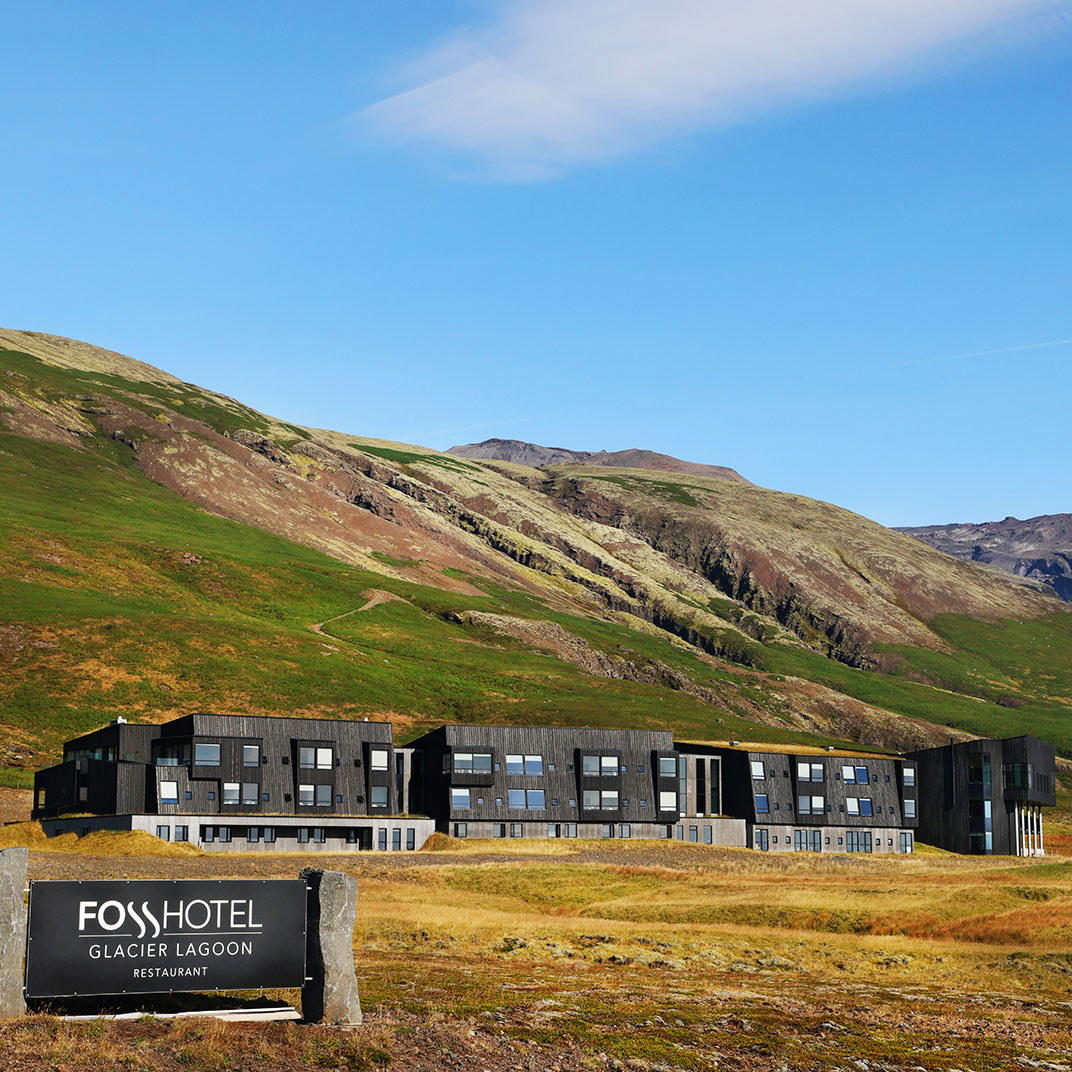
Where the Ice Sets the Design Brief
Iceland's southeast coast has produced a particular hotel typology: properties built not to compete with their surroundings but to frame them. The logic is direct by geography, when Jökulsárlón glacier lagoon sits within reach and Vatnajökull, Europe's largest glacier by volume, forms the skyline, the architectural challenge is primarily one of positioning and glass placement. Fosshotel Glacier Lagoon belongs to this tradition. The Michelin Guide Selected the property in its 2025 hotels list.
The hotel sits in Hnappavellir, a settlement that exists largely because of its proximity to one of Iceland's most-visited natural formations. That context matters when reading the property's design: this is not a hotel in a town that happens to have a view, but a structure positioned specifically to serve guests arriving for the glacier lagoon and the national park beyond. The building's relationship to the surrounding terrain, flat, open, dominated by sky and ice-grey water, shapes everything from room orientation to the logic of its public spaces.
The Architecture of Wilderness Accommodation
Iceland's premium hotel tier has split into two distinct design schools over the past decade. One school favours urban reference points, the sleek minimalism of Reykjavík properties like 101 Hotel Reykjavík or the design-forward ION Adventure Hotel in Nesjavellir, which carries a Design Hotels membership and uses volcanic landscape as its backdrop. The second school, to which Fosshotel Glacier Lagoon belongs, treats the absence of urban reference as the point. These are hotels where orientation toward a single natural feature drives room layout, facade treatment, and the hierarchy of interior spaces.
This approach has genuine architectural coherence when the feature in question is as visually forceful as Jökulsárlón. The lagoon's floating ice formations, which calve from the Breiðamerkurjökull glacier and shift colour from blue-white to amber depending on light conditions, create a constantly changing external installation. A hotel that positions itself correctly in relation to that view is, in effect, curating a changing exhibition for its guests. The discipline lies in restraint, in not competing with the landscape through over-designed interiors, but in creating spaces that recede appropriately.
Comparable properties in Iceland's southeast and north have applied similar logic with varying degrees of success. Fosshótel Vatnajökull in Höfn sits in the same general terrain and occupies a related position in the Fosshotel group's regional network. Highland Base Kerlingarfjöll takes a more remote approach, placing guests inside the highland interior rather than at a coastal formation. Each property makes a different argument about how close a hotel should position itself to its primary natural draw.
The Broader Range of Icelandic Wilderness Hotels
Iceland's accommodation offer for serious natural landscape itineraries has deepened considerably since the mid-2010s tourism surge. The Ring Road corridor now supports a range of properties calibrated to specific geological or geographical features: Harmony Seljalandsfoss in Hvolsvöllur anchors itself to its waterfall proximity, while Hotel Vík í Mýrdal uses the black sand coast of the south as its spatial context. Further along the north coast, Eleven Deplar Farm in Ólafsfjarðar operates in a different register entirely, a luxury all-inclusive format in a remote fjord that has more in common with exclusive wilderness lodges internationally than with the Ring Road hotel model.
What separates the Michelin Selected tier within this group is its focus on accommodation quality, consistency of service delivery, and the broader guest experience. For a property in a location like Hnappavellir, where the natural setting does much of the experiential heavy lifting, the Michelin assessment registers the hotel's contribution to the guest experience beyond the view.
Properties like Hotel Rangá in Hella, a long-established aurora-hunting base further west, or Vogafjós Farm Resort in Vogar near Lake Mývatn show how Iceland's wilderness hotel market has diversified from basic guesthouses into properties with clearly articulated identities. Fosshotel Glacier Lagoon occupies the formed, branded end of that spectrum: a Fosshotel group property with consistent design language, positioned at one of the country's most-visited natural sites, and carrying Michelin recognition from 2025 onward.
Planning Your Stay
The glacier lagoon draws visitors year-round, though the experience shifts significantly by season. Summer brings near-continuous daylight and the greatest volume of ice on the water; winter offers the possibility of northern lights reflections on the lagoon surface and a dramatically reduced crowd count. Shoulder season, April to May and September to October, tends to balance ice presence with manageable visitor numbers at the lagoon itself. For guests travelling the Ring Road in either direction, Hnappavellir sits roughly midway between Höfn to the east and Kirkjubæjarklaustur to the west, making the hotel a logical overnight anchor. Hótel Klaustur to the west and Fosshótel Vatnajökull to the east are the natural adjacent stops for multi-night Ring Road itineraries.
Given the remoteness of the location, booking well in advance is advisable for summer and peak aurora season (November through February).
Guests looking at Iceland's wider premium tier for comparison purposes will find the contrasts instructive. Hótel Búðir on the Snæfellsnes Peninsula and Hótel Reykjahlíð near Lake Mývatn each apply a similar philosophy, small, location-specific, designed around a single compelling natural feature, but in different parts of the country. For those travelling the south and east, the hotel remains the address that most directly places you at the intersection of the country's most dramatic glacial and water formations.
Comparable Spots, Quickly
Comparable venues nearby, for context on price, style, and recognition.
| Venue | Cuisine | Price | Awards | Notes |
|---|---|---|---|---|
| Fosshotel Glacier LagoonThis venue — the venue you are viewing | contemporary Icelandic retreat blending minimalist architecture with nature | $$$ | 4-Star | Not listed |
| Fosshótel Vatnajökull | Contemporary country hotel with Nordic minimalist design, emphasizing connection to natural landscape and sustainability. | $$ | 3-Star | Lindarbakki, Hornafjordur |
| Vogafjós Farm Resort | family-run farm guesthouse with log cabins | $$$ | 3-Star | Reykjahlíð |
| Kvosin Downtown Hotel | Historic boutique with modern apartment-style rooms | $$$ | 4-Star | Reykjavíkurborg |
| Black Sand Hotel | Contemporary Nordic luxury retreat harmonizing with volcanic landscape | $$$$ | 4-Star | Ölfus |
| Akureyri - Berjaya Iceland Hotels | Converted university building with modern Nordic hygge design | $$$ | 3-Star | center |
Recognition history
Dated appearances from independent guides and award organizations, with the underlying list record or original source where available.
Michelin Selected
Michelin
At a Glance
- Quiet
- Modern
- Scenic
- Minimalist
- Romantic Getaway
- Family Vacation
- Weekend Escape
- Panoramic View
- Wi Fi
- Spa
- Sauna
- Fitness Center
- Restaurant
- Bar
- Hot Tub
- EV Charging
- Mountain
- Waterfront
- Wi Fi
- Spa
- Sauna
- Fitness Center
- Restaurant
- Bar
- Hot Tub
- EV Charging
Calm Scandinavian-inspired interiors with clean lines, subtle greys, warm woods, soft furnishings, and vast windows connecting to raw natural beauty.