
Positioned on the Punta Skala peninsula outside Zadar, Falkensteiner Hotel & Spa Iadera is a design-led resort property that earned 92.5 points in the 2026 La Liste Top Hotels ranking. The architecture and spa facilities place it within the upper tier of Dalmatian coast resort offerings, making it a reference point for premium hotel stays in the Zadar region.
 Discover on Pearl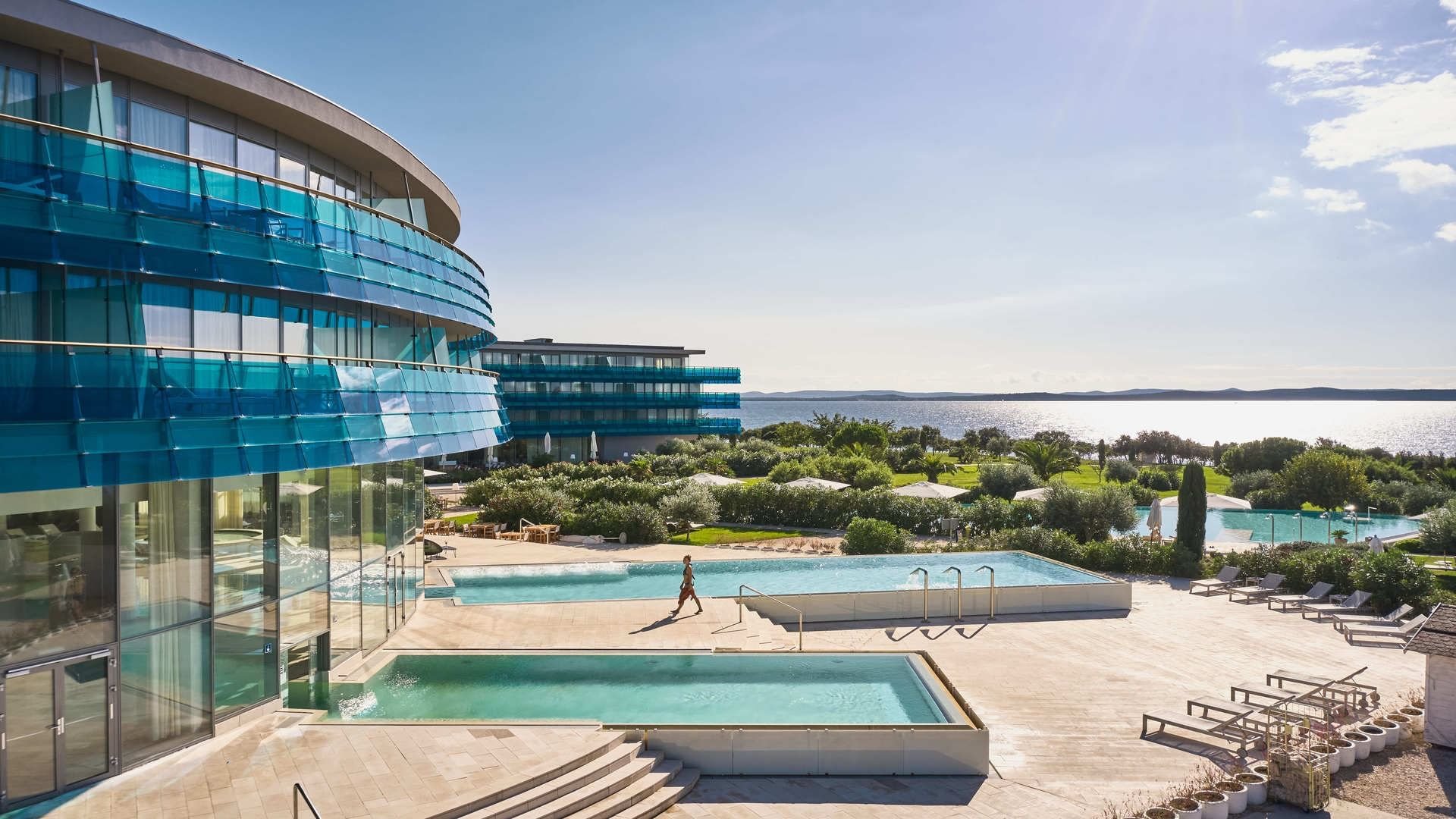
Stone, Water, and the Adriatic Light That Defines Punta Skala
Arriving at Resort Punta Skala, the peninsula that juts into the Adriatic just north of Zadar, the first thing you register is not a building but a relationship between materials: pale stone, still water, and the particular quality of Dalmatian light that turns the sea silver at midday and copper by late afternoon. Falkensteiner Hotel & Spa Iadera sits within this environment as a deliberately composed object, its architecture designed to read against the coastline rather than compete with it. That calibration, between structure and landscape, is the defining editorial fact about this property and the reason it occupies a distinct position among northern Dalmatia's resort hotels.
The Dalmatian coast has, over the past decade, developed a split between large-footprint international resort complexes and smaller, design-attentive properties where the physical experience of the building itself is part of the offer. Iadera belongs to the latter category. The architectural approach draws on the textures and tonalities of the Adriatic vernacular without retreating into pastiche, a balance that resort architecture along this coast rarely achieves cleanly. The result is a property that reads as a coherent spatial argument rather than a collection of amenities arranged for maximum room count.
The shortlist, unlocked.
Hard-to-book tables, cellar releases, and concierge-planned trips.
Get Exclusive Access →Design Discipline as a Competitive Signal
In the broader context of Croatian hotel design, the question of how a property handles its connection to water matters enormously. The Adriatic coast offers proximity to the sea as a near-universal selling point, which means the differentiator shifts to how that proximity is architecturally mediated. Properties that position their pools, terraces, and public spaces to draw the horizon into the guest experience operate at a different register than those that simply provide sea-view rooms. Iadera's spatial organisation appears to take the former approach, with the spa and common areas arranged to maintain visual and atmospheric continuity with the surrounding peninsula.
The 2026 La Liste Leading Hotels ranking awarded the property 92.5 points, placing it within a competitive tier that includes properties across the broader Croatian coastline. For context, La Liste's hotel rankings draw on a methodology that weights guest experience, service consistency, and physical environment alongside traditional hospitality metrics. A score at this level positions Iadera above the mid-market resort offering and within the same peer conversation as properties like Grand Park Hotel Rovinj by Maistra Collection in Rovinj and Meneghetti Wine Hotel & Winery in Bale, both of which anchor the upper end of the Istrian and Dalmatian design-hotel market.
That peer set is useful because it clarifies what Iadera is not competing against. It is not in the same category as the smaller, boutique-scale properties along the Dalmatian islands, such as LIOQA Resort on Ugljan or Littlegreenbay Hotel in Hvar, which trade on intimacy and limited-key positioning. Iadera operates at resort scale, and its architecture and spa infrastructure are calibrated for that format.
The Spa as Architectural Commitment
Among the design choices that define the property's identity, the spa complex carries particular weight. In the current wave of Adriatic resort development, spa facilities function as both amenity and spatial statement. Properties that invest in substantial aquatic and treatment infrastructure signal a different guest expectation than those where the spa is a secondary afterthought appended to a room-focused brief. The inclusion of spa as a named element in the property's title is an architectural declaration as much as a marketing one: it tells you the building was planned around the wellness program, not the other way around.
This positions Iadera within a specific segment of the Croatian hotel market where the physical envelope of the spa is considered part of the design narrative. Properties like Boutique & Design Hotel Navis in Opatija and Palazzo Rainis Hotel & Spa in Novigrad occupy analogous positions in their respective coastal subregions, where spa integration signals a particular tier of physical investment and design intention.
Petrčane and the Northern Dalmatia Resort Context
Petrčane itself sits roughly ten kilometres north of Zadar, a small settlement whose profile has been shaped almost entirely by the Punta Skala resort development rather than by any pre-existing urban or culinary identity. This is a relevant distinction when comparing it to competitors located within or adjacent to historic towns. Properties like Hotel Kastel in Motovun or Lešić Dimitri Palace in Korčula draw part of their character from their location within layered historic environments. Iadera makes no such claim. Its argument is purely spatial and sensory: the peninsula, the sea, and the architecture designed to frame both.
For guests travelling to northern Dalmatia, Zadar functions as the practical hub, with connections to the wider Croatian coast and onward to Istrian properties like Lone Hotel by Maistra Collection or island options such as Kastil in Bol and Aminess Korčula Heritage Hotel. Petrčane's location makes it a viable base for day trips to Zadar's old town, the Krka National Park, and the Kornati islands, though the property's internal amenities are substantial enough that many guests will find the peninsula itself sufficient. For a broader overview of dining and accommodation options in the area, see our full Petrčane restaurants guide.
Planning a Stay at Iadera
The Dalmatian high season runs from late June through August, when coastal properties operate at full capacity and the light on the peninsula is at its most intense. Shoulder season, particularly May and September, offers the same architectural and aquatic experience with considerably reduced occupancy, which changes the character of the spa and pool areas substantially. For guests whose priority is the design experience rather than the social energy of peak summer, the shoulder window is the more considered choice.
Booking through the Falkensteiner group's direct channels or through travel agents with access to premium Adriatic inventory is the standard approach for properties at this tier. Comparable design-led resort hotels in Croatia, including those in the La Liste reference tier, tend to operate best-rate-guarantee policies through direct booking that make third-party platforms less efficient for value-conscious guests.
Among Croatia's design-conscious resort options, Iadera occupies a specific coordinate: resort-scale infrastructure, peninsula setting, architectural coherence, and a La Liste score that places it within the upper register of Dalmatian coast hospitality. Guests comparing it against other Croatian reference properties such as D-Resort Šibenik, Hotel Ambasador Split, or Brown Beach House Croatia in Trogir will find that the differentiator here is the coherence of the physical environment rather than urban access or boutique scale.
Frequently Asked Questions
- What's the vibe at Falkensteiner Hotel & Spa Iadera?
- The property operates at resort scale on a dedicated peninsula outside Zadar, which means the atmosphere is defined by the spatial relationship between the architecture and the Adriatic rather than by proximity to a city or town. The La Liste 2026 score of 92.5 points places it in the upper tier of Croatian coastal hotels, where the guest profile tends toward those prioritising design environment and spa facilities over urban programming. It is a considered, physically anchored experience rather than a socially animated one.
- What room should I choose at Falkensteiner Hotel & Spa Iadera?
- Without verified room-category data in our records, specific room recommendations are outside what we can responsibly advise. As a general principle at properties of this design tier and La Liste standing, rooms with direct sea orientation and terrace access tend to deliver the most complete version of what the architecture promises. Direct inquiry with the property about sea-facing categories and their spatial relationship to the spa and pool areas will give you the information needed to make that call with confidence.
Quick Comparison
These are the closest comparables we have in our database for quick context.
| Venue | Cuisine | Price | Awards | Notes |
|---|---|---|---|---|
| Falkensteiner Hotel & Spa Iadera | This venue | |||
| Lešić Dimitri Palace | ||||
| Maslina Resort | ||||
| Meneghetti Wine Hotel & Winery | ||||
| Villa Korta Katarina & Winery | ||||
| Grand Park Hotel Rovinj by Maistra Collection | World's 50 Best |
Preferential Rates?
Our members enjoy concierge-led booking support and priority upgrades at the world's finest hotels.
Get Exclusive AccessThe shortlist, unlocked.
Hard-to-book tables, cellar releases, and concierge-planned trips.
Get Exclusive Access →