
The Travesía Atacama-Uyuni is a lodge-to-lodge private expedition crossing from Chile's Atacama Desert into Bolivia's Uyuni Salt Flat, one of the largest on earth. Spanning 6 to 11 nights, the format pairs expert-guided 4×4 travel with small lodges established in partnership with local families. For travellers who orient around landscape scale and remoteness, it occupies a category of its own in South American expedition travel.
Pearl is the En Primeur Club membership app — saves, bookings, and concierge access live there. Same editors, same standards.
- Address
- Calle 11 S/N
- Directions
- Get directions
 Saves & bookings on Pearl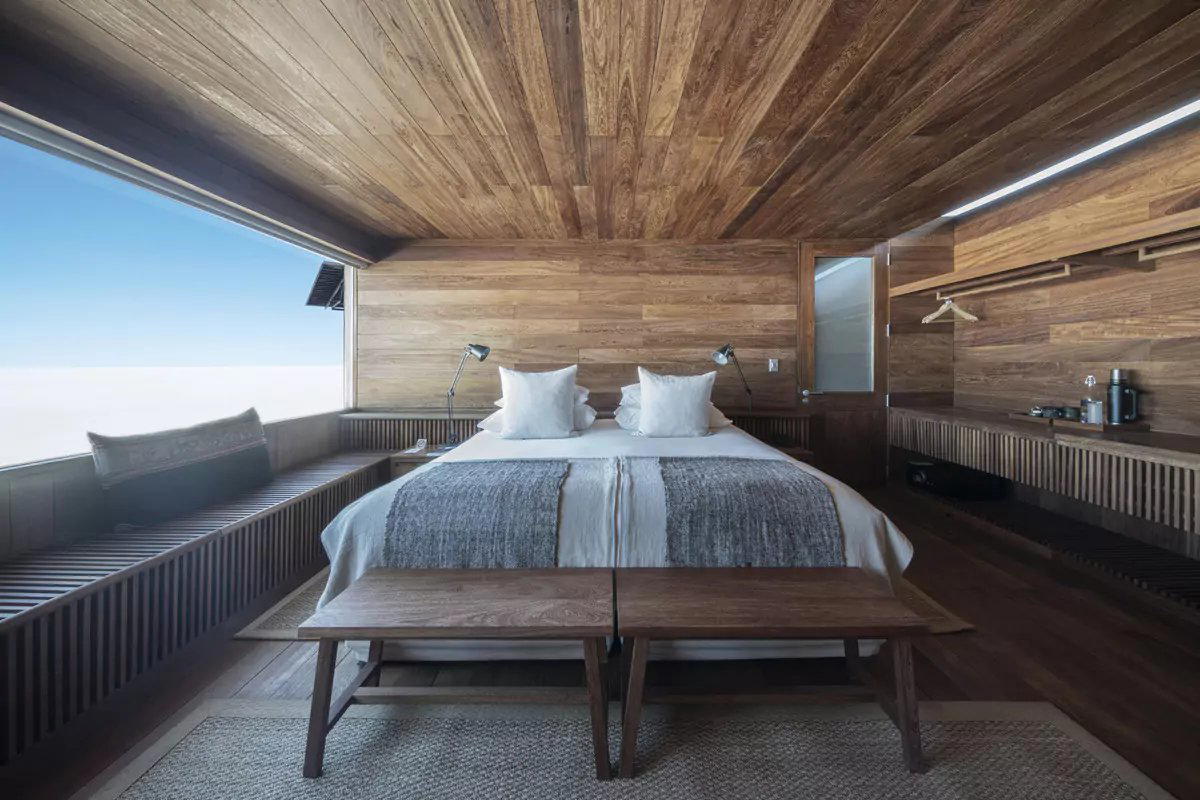
Where Silence Has Scale
There are landscapes that resist easy description, and the high plateau between Chile's Atacama Desert and Bolivia's Salar de Uyuni is among the more demanding of them. At over 3,600 metres above sea level, the altiplano operates on its own atmospheric logic: light that flattens shadows at midday and turns terracotta mountains into something close to luminous at dusk, air so dry it seems to amplify sound rather than carry it, and a salt flat so vast, roughly 10,500 square kilometres, that the horizon line becomes a physical concept rather than a visual one. The Travesía Atacama-Uyuni, Explora's private lodge-to-lodge crossing of this region, is designed around the proposition that these conditions require more than a two-night stopover to register. Itineraries run from 6 to 11 nights, and the pacing is deliberately slow by adventure-travel standards.
The Architecture of the Crossing
Expedition travel at this altitude has historically involved a trade-off: the landscapes that justify the journey are also the ones that make comfortable infrastructure nearly impossible to maintain. Explora's structural answer is a chain of small lodges rather than a single base property, a format that has become increasingly common among serious wilderness operators, but one that demands genuine logistical commitment to execute at this remove. The Uyuni lodge is one of Explora's route lodges, and the design decision shapes both the physical character of the spaces and the knowledge that informs the guiding.
The physical format of the Travesía is worth understanding before booking. Guests travel between lodges in a 4×4 vehicle accompanied by an expert Explora guide and a local driver. The lodges serve as bases for daily explorations rather than destinations in themselves, which positions this as a fundamentally different product from resort-style wilderness stays. The comparison isn't with a luxury tented camp where the accommodation is the experience; it's closer in logic to a hut-to-hut alpine traverse, scaled up to cover one of the remotest overland routes in the Americas. For properties that sit at the opposite end of the experiential spectrum, urban, maximalist, or architecture-forward, see Aman New York in New York City or Cheval Blanc Paris in Paris.
Two Landscapes, One Logic
The route connects two of the world's most studied extreme environments. The Atacama is frequently cited as the driest non-polar desert on earth, a reputation built on its hyper-arid core rather than its fringes. The Uyuni Salt Flat, on the Bolivian side, holds a different kind of record: it contains a significant share of the world's known lithium reserves beneath its crust, and during the wet season (roughly November through March) a thin layer of water transforms the surface into a near-well-suited mirror, producing the disorienting visual effect that has made it among the more photographed natural sites in South America. The Travesía is designed to pass through both environments in sequence, crossing the Chilean-Bolivian border via the 4×4 route rather than the standard overland bus corridor.
Seasonality matters considerably here. The dry season (April through October) offers the classic bone-white salt flat surface and clear skies, while the wet season produces the mirror effect but also introduces road conditions that require genuinely capable four-wheel-drive handling. Neither season is objectively superior; they offer different visual registers. What changes is the logistical tolerance required of the traveller. Explora's itinerary range, 6 to 11 nights, allows guests to calibrate depth of engagement: the shorter options cover the primary sites at a reasonable pace, while the longer itineraries push further into less-visited corners of the altiplano.
What the Guiding Model Implies
The guide-and-driver pairing built into every Travesía departure carries more weight than it might initially appear. On terrain this remote, where altitude sickness, vehicle recovery, and navigation through unmarked salt flat are all realistic variables, the competence of the person leading the journey is a primary safety consideration, not a hospitality add-on. Explora's guide training program is one of the more developed in South American wilderness travel, and the pairing of an Explora guide with a local driver reflects an understanding that regional knowledge, the kind that comes from growing up near the landscape rather than studying it, is not replicable through formal training alone.
This model places Explora in a specific tier of the expedition market: properties and programs where the staff-to-guest ratio and guide credentials are primary selling points. It's a different logic from the urban luxury tier, where Atix Hotel in La Paz or the design-led properties of Europe represent a competing set. The more useful peer comparison is with properties like Amangiri in Canyon Point, where landscape access and specialist programming define the value proposition, or One&Only; Mandarina in Riviera Nayarit, where remoteness is treated as an asset rather than a limitation.
Placing Explora in the Wider Market
The market for high-end South American expedition travel has expanded considerably over the past decade, with an increasing number of operators offering multi-night itineraries through Patagonia, the Amazon basin, and the Andean altiplano. Within that field, the lodge-to-lodge crossing format that Explora uses for the Travesía remains relatively rare. Most operators base guests at a single property and run day trips, a format that is logistically simpler but produces a fundamentally different relationship with the terrain. The Travesía's structure, by contrast, requires the guest to be genuinely mobile and to accept that the journey between lodges is as much a part of the experience as the lodges themselves.
For travellers whose reference points are primarily urban or resort-based, Castello di Reschio in Lisciano Niccone, Hotel Esencia in Tulum, HOTEL THE MITSUI KYOTO in Kyoto, the Travesía represents a genuine category shift. The measure of quality here is not thread count or wine list depth but terrain access, guide competence, and the physical honesty of the experience. See also our full Uyuni restaurants guide for the broader dining and travel context of the region.
Planning the Travesía
Itineraries run from 6 to 11 nights, departing from Explora's Atacama lodge in Chile and concluding at the Uyuni lodge in Bolivia. The route crosses the border by road; guests should carry valid passports and verify Bolivia's current visa requirements for their nationality before departure. Altitude acclimatisation is a practical consideration: arriving in San Pedro de Atacama a day or two before the Travesía begins is widely recommended by high-altitude travel medicine practitioners. The Uyuni end of the route connects to internal Bolivian flights from Uyuni airport, with onward connections to La Paz. Booking is handled directly through Explora; given the private-departure format and lodge capacity constraints, lead times of several months are standard for peak-season slots. For reference points on how other properties in the premium tier handle remote-location logistics, Hotel Du Cap-Eden-Roc in Cap d'Antibes, Badrutt's Palace Hotel in St. Moritz, and Mandarin Oriental Bangkok in Bangkok each represent different versions of the same underlying principle: that a property's physical setting requires a matching level of operational commitment to justify the price point.
Side-by-Side Snapshot
Comparable venues nearby, for context on price, style, and recognition.
| Venue | Cuisine | Price | Awards | Notes |
|---|---|---|---|---|
| Explora UyuniThis venue — the venue you are viewing | Sustainable minimalist lodge designed for minimal environmental impact with low-profile architecture. | $$$$ | Not listed | Not listed |
| Hotel de Sal Luna Salada | Rustic Andean lodge with contemporary comfort, blending traditional Bolivian design elements with modern amenities in a remote salt flat setting. | $$$ | Not listed | Colchani |
| Atix Hotel | Contemporary boutique in upscale residential area with local Bolivian materials and art integration. | $$$$ | 4-Star | Zona Sur |
| Met Hotel La Paz | Contemporary luxury boutique hotel with Nordic-inspired spa design and Andean cultural elements | $$$$ | 5-Star | Alto Obrajes |
Recognition history
Dated appearances from independent guides and award organizations, with the underlying list record or original source where available.
Virtuoso Luxury Hotel Partner
Virtuoso
Continue exploring
More in Uyuni
Hotels in Uyuni
Browse all →
At a Glance
- Scenic
- Quiet
- Rustic
- Minimalist
- Romantic Getaway
- Weekend Escape
- Group Retreat
- Panoramic View
- Wi Fi
- Room Service
- Concierge
- Airport Transfer
- Mountain
- Wi Fi
- Room Service
- Concierge
- Airport Transfer
Minimalist contemporary design with large windows maximizing natural light and silence, fostering deep immersion in the vast Andean landscape for restful privacy.