
Designed by Pritzker Prize-winning architect Toyo Ito, Eslite Hotel occupies an 18-story curved tower in Taipei's Xinyi District, above the Eslite Spectrum department store. Its 104 rooms combine Cassina furniture and Bose sound systems with balconies overlooking Taipei 101 and Songshan Cultural and Creative Park. The property received the Golden Pin Design Award and remains one of the few Taipei hotels where the room itself is the primary experience.
 Discover on Pearl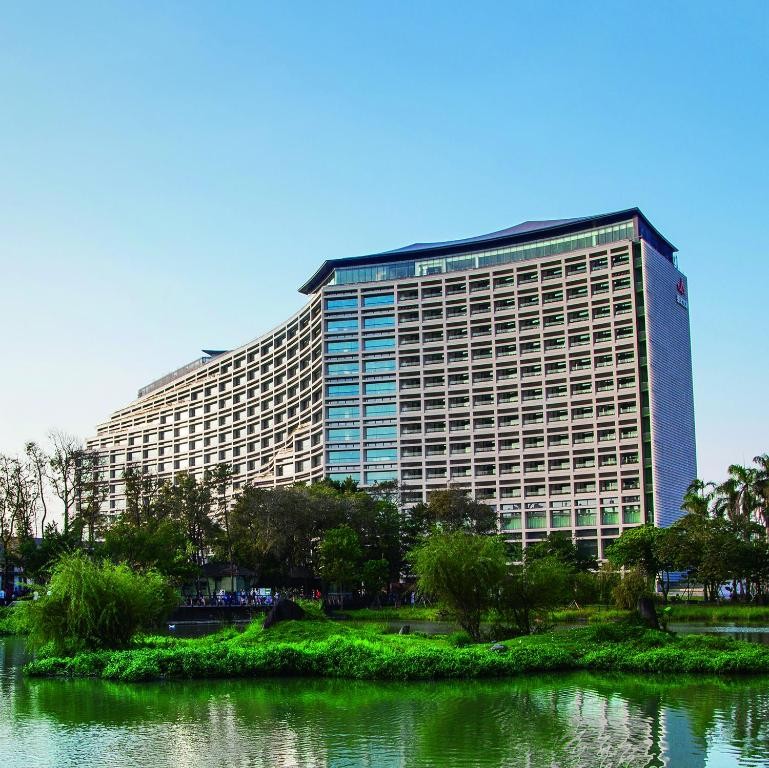
A Hotel Built Around the Idea of the Room
Xinyi District has been Taipei's commercial and shopping centre for decades, a neighbourhood where international brand flagships and glass-tower hotels cluster around the base of Taipei 101. Within that context, Eslite Hotel occupies an unusual position. The 18-story curved tower, conceived by Toyo Ito — one of a small number of architects to hold the Pritzker Prize — reads differently from its neighbours before you even enter. The slightly bowed exterior, finished in traditional brick and stone, signals that the building's logic comes from somewhere other than standard luxury-hotel development. That architectural statement continues inside, where the premise shifts from amenity accumulation to something closer to cultural immersion through the act of staying.
The property is physically integrated with the Eslite Spectrum department store below, which houses tea boutiques, lifestyle shops, restaurants, and one of the Eslite bookstores that have shaped Taiwan's literary culture since the 1980s. For guests, this adjacency is practical: the building functions as a vertical neighbourhood, with retail, food, and cultural programming accessible without leaving the structure. Among Taipei's comparable properties , Grand Hyatt Taipei, Mandarin Oriental, Taipei, and 's Far Eastern Plaza Hotel, Taipei , the Eslite sits in a distinct niche: smaller in scale at 104 rooms, oriented around design and cultural programming rather than grand ballrooms and conference facilities.
What Happens Inside the Room
The 104 guest rooms are where the hotel's editorial logic becomes most apparent. Toyo Ito's architecture informs the proportions and light, and the interiors work within a nature-inspired colour palette furnished with pieces by Cassina, the Italian manufacturer whose client list reads as a catalogue of 20th-century design history. The combination of Cassina furniture with 42-inch HDTVs, DVD players, Bose sound systems, and Nespresso coffee machines suggests a room calibrated for extended stays: comfortable to work in, comfortable to spend an afternoon in, comfortable to be in without agenda.
Every room comes with a private balcony, which the hotel itself notes is rare among Taipei properties. City View rooms look directly toward Songshan Cultural and Creative Park and Taipei 101. The balcony changes the room's relationship to the city in a way that floor-to-ceiling windows alone do not: there is physical access to Taipei's air and ambient sound rather than a mediated glass experience. For New Year's Eve specifically, rooms with views of Taipei 101 are in direct demand. The tower's fireworks celebrations are among the largest in Asia, and the hotel's position makes it one of the closer vantage points available. Those dates book out early and should be treated as a separate planning exercise entirely.
Bathroom amenities are L'Occitane throughout the standard rooms, a positioning that aligns with hotels at the design-boutique tier across Asia , properties like Kimpton Da An Taipei in Da'An District occupy comparable territory in terms of amenity approach and independently minded character. The Library Suite operates differently. At 1,464 square feet, it includes a dedicated reading area, an adjacent dining room, and more than 1,000 books covering film, literature, history, and linguistics. That suite swaps L'Occitane for Bulgari products, a detail that signals its position in the property's internal hierarchy.
Art as Infrastructure, Not Decoration
Taipei's design-led hotels generally treat art as accent. Eslite Hotel treats it as structural. Every floor features photography by local artists documenting Taiwanese life from the 1940s through the 1970s, a period spanning Japanese colonial withdrawal, the Republic of China government's relocation from the mainland, and Taiwan's early industrialisation. Walking the corridors is a vertical archive of a society in transition, which is a different experience from the abstract lobby sculpture or brand partnership that fills comparable spaces elsewhere.
The hotel entrance and Lobby Lounge carry work by Michael Lin, a Taiwanese artist whose large-scale paintings have appeared in institutions including the Palais de Tokyo and Art Basel. His presence at Eslite is not a local artist hire , it is a credential that places the property in a conversation with serious international contemporary art programming. The Golden Pin Design Award, which the hotel received after opening in 2015, is Taiwan's most recognised design prize, roughly analogous in local authority to a Red Dot or iF award in international terms.
The Lobby Lounge as Working Space
The Lobby Lounge holds approximately 5,000 volumes. Its character falls closer to a well-curated bookstore than a hotel lobby bar, which is partly intentional and partly a function of the Eslite brand's identity as a cultural retail platform. The space functions as a legitimate setting for business meetings , quieter and more considered than the lobbies of larger convention-oriented properties like the Taipei Marriott Hotel or Regent Taipei, both of which operate at a scale that generates different ambient energy. If a guest finds a title in the Lobby Lounge or in the Library Suite that they want to keep, staff can arrange the purchase of a new copy , a service detail that reflects the coherence of the hotel's overall concept.
Food, Wine, and the In Between Programme
In Between steakhouse operates within the hotel and centres on dry-aged beef. The wine programme draws on Eslite Wine Cellar, identified as one of Taiwan's leading importers, offering selections from both old-world and new-world producers. Taiwan's wine market has grown considerably over the past decade, with import duties adjusted and a broadening consumer base; an in-house programme connected to a significant importer is a tangible advantage over properties that manage wine as a standard F&B; afterthought. For a fuller picture of Taipei's dining scene, our full Taipei restaurants guide covers the range from night market eating to fine dining.
Xinyi District and the Hotel's Position in Taipei
Xinyi positions a guest within walking distance of Taipei 101, the Songshan Cultural and Creative Park, and a concentration of department stores and restaurants that make it the city's most accessible district for short-stay visitors. For guests who want a different urban register , Da'An's residential streets and independent cafés, for example , the MRT connects Xinyi to the broader city efficiently. Taipei's hotel market at this tier also includes Grand Victoria Hotel, Hotel Metropolitan Premier Taipei, and Palais de Chine, each with a distinct character and location logic. Eslite's integration with a cultural retail building and its emphasis on the room as primary experience makes it the property most oriented toward guests who treat the hotel itself as a destination within the trip rather than a logistical base.
Guests extending beyond Taipei will find that Taiwan's hotel infrastructure outside the capital has expanded significantly. Capella Taipei in Songshan District offers an alternative urban base with a different neighbourhood character; for resort experiences, Hoshinoya Guguan in Taichung, Hotel Beore Sun Moon Lake in Nantou, Grasse Grace Manor in Miaoli, and Volando Urai Spring Spa and Resort in Wulai District each represent distinct regional options. Our full Taipei hotels guide covers the complete picture, and our guides to Taipei bars, Taipei wineries, and Taipei experiences map the city's broader programming.
For international context, Eslite sits within a category of architect-designed hotels where the physical object and its cultural programming carry as much weight as the service infrastructure. Properties like Aman Venice, Amangiri in Canyon Point, and Bvlgari Hotel Tokyo each demonstrate that architecture and curation can define a property's identity as clearly as its service tier. At a more urban scale, The Fifth Avenue Hotel in New York City, Aman New York, and Badrutt's Palace Hotel in St. Moritz each anchor their identity in a specific cultural proposition rather than amenity volume. Eslite belongs in that conversation , a smaller property, in a mid-sized Asian capital, where the argument for staying is made most clearly by what happens inside the room.
Frequently Asked Questions
Comparison Snapshot
A quick look at comparable venues, using the data we have on file.
| Venue | Cuisine | Price | Awards | Notes |
|---|---|---|---|---|
| Eslite Hotel | Conceived by Pritzker-winning architect Toyo Ito, Eslite Hotel catches the eye w… | This venue | ||
| Grand Hyatt Taipei | ||||
| Mandarin Oriental, Taipei | ||||
| Shangri-La's Far Eastern Plaza Hotel, Taipei | ||||
| Regent Taipei | ||||
| Taipei Marriott Hotel |
Preferential Rates?
Our members enjoy concierge-led booking support and priority upgrades at the world's finest hotels.
Get Exclusive Access