
A pair of historic Mitte buildings — one mid-19th century, one early 20th — converted into a 93-room hotel where contemporary art and architectural preservation share equal billing. Each room contains an original artwork by a different living artist. At around $334 per night, Château Royal sits in the design-led boutique tier that defines Berlin's more considered approach to luxury hospitality.
Where Mitte's Architectural Memory Meets the Contemporary Art Circuit
Berlin's hotel market has long operated on a fault line between institutional grandeur and scrappy reinvention. On one side sit the flag-bearing addresses: Hotel Adlon Kempinski, The Ritz-Carlton, Berlin, and Hotel de Rome, properties that trade on historical prestige and Michelin Keys recognition. On the other sits a smaller, more deliberate cohort: hotels that use Berlin's architectural density and art-world connections as design material rather than backdrop. Château Royal, on Neustädtische Kirchstraße in Mitte, belongs firmly to that second group.
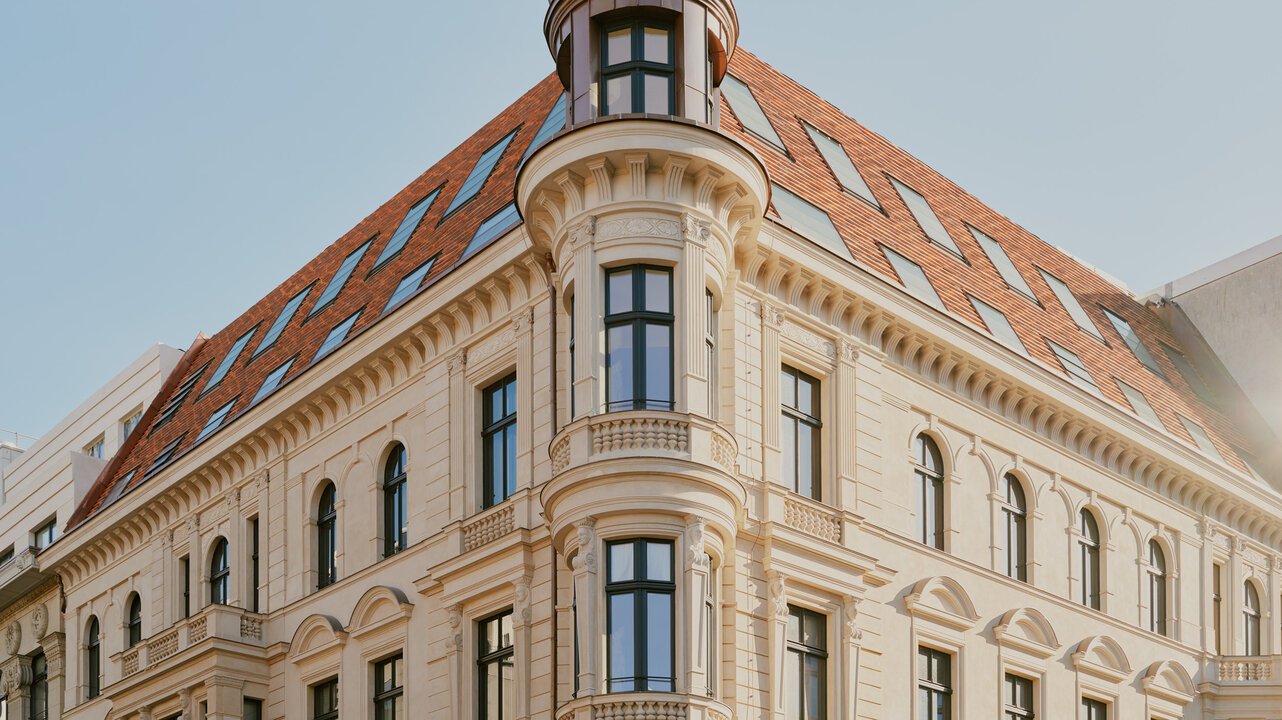
The building itself sets the terms before you step inside. From the street, the structure reads as conventionally European, a facade that wouldn't look out of place in Vienna or Prague. That legibility is the point. The hotel occupies two historic buildings, one dating to the mid-19th century and another to the early 20th, and the exterior preserves that layered timeline without commentary. The decision not to impose a contemporary skin on either structure reflects a particular kind of confidence, the understanding that Berlin's built environment is already interesting enough without architectural intervention.
Two Centuries of Construction, One Coherent Interior Logic
The tension between those two building eras becomes the organising principle inside. Herringbone parquet floors, handmade tiles, and period detailing anchor the spaces in their respective historical moments, while the curation of contemporary art pulls the eye decisively forward. This is not a restoration hotel in the traditional sense — no velvet ropes around the furniture, no historical recreations of vanished interiors. The period elements function as texture rather than theme.
This approach to adaptive reuse sits within a broader pattern in Mitte, where the neighbourhood's density of Wilhelmine and early modernist buildings has attracted hoteliers who treat architecture as a primary amenity rather than a container for amenities. Telegraphenamt, which also holds Michelin 2 Keys recognition, follows a related logic in its conversion of a former telegraph exchange. Roomers Berlin Steinplatz takes a different position in Charlottenburg, where the interwar architectural character demands a different interpretive register. What distinguishes Château Royal is the deliberate pairing of interior preservation with a live contemporary art program, rather than using art as decoration.
Ninety-Three Rooms, Ninety-Three Artworks
The art component here is structural, not supplementary. Each of the hotel's 93 rooms and suites contains an original work by a different contemporary artist, produced across media that span painting, photography, installation, and performance documentation. The range of media is significant: it prevents the collection from resolving into a coherent house aesthetic, which means each room genuinely differs from the last in ways that go beyond square footage or floor level.
One of the hotel's founders has a longstanding position in Berlin's contemporary art world, which matters here not as biography but as credential. Berlin's contemporary art scene, concentrated in Mitte and the adjacent districts of Prenzlauer Berg and Kreuzberg, is one of the few in Europe capable of sustaining a genuine institutional relationship with a hotel at this scale. The works are not acquired through a corporate art consultancy working from a mood board. That distinction is audible in the results.
For guests whose hotel stays normally involve reproductions of Post-Impressionist prints, a room at Château Royal requires a modest recalibration. The art is present as art, not as atmosphere management. Some pieces will reward attention; others will simply coexist with the herringbone floors and the warm, organic material palette that grounds the rooms. Smart televisions and other high-tech infrastructure are engineered out of sight when not in use, a choice that keeps the spatial logic from collapsing into gadget display.
Position and Pricing in Berlin's Design-Led Tier
At approximately $334 per night, Château Royal prices at a level that sits below the landmark grand hotels but above the mid-market boutique category. For context, Michelin 2 Keys properties like Hotel de Rome and Patrick Hellmann Schlosshotel operate with different programming logic, the former a Rocco Forte property with a heritage banking hall, the latter a Grunewald villa with a manor-house character. Château Royal's competitive set is less about amenity comparison and more about what kind of stay a guest is constructing: one anchored in institutional comfort, or one embedded in the city's cultural production.
The 93-key scale keeps the hotel within the range where individual room character remains feasible. Large-format luxury hotels in Berlin, those exceeding 200 rooms, tend to resolve the art question through uniformity. Château Royal's model depends on staying small enough to sustain differentiation room by room.
Mitte's position in central Berlin makes the hotel logistically coherent for most itineraries. The address at Neustädtische Kirchstraße 3 places guests within walking distance of the Museumsinsel complex, the galleries along Auguststraße, and the government district. For those building a wider German itinerary, properties like Fairmont Hotel Vier Jahreszeiten in Hamburg or Bülow Palais in Dresden offer regional counterparts at a similar level of considered luxury. For Alpine alternatives, Schloss Elmau and Das Kranzbach Hotel take the design-meets-heritage formula into a very different landscape. Internationally, Aman Venice and Aman New York represent the upper register of the art-integrated hotel model for comparative reference.
For those planning around Berlin's gallery and museum calendar, and the city's art fair season in particular, Château Royal's proximity to Mitte's gallery corridor and its direct connection to the contemporary art world make it a more deliberate choice than its room count alone might suggest. For further planning across the city, the full Berlin hotels guide, Berlin restaurants guide, and Berlin experiences guide provide broader context on where the hotel sits within the city's offer.
Frequently Asked Questions
- Which room category should I book at Château Royal Berlin?
- The hotel's defining feature — each of its 93 rooms contains a unique original artwork , means that room selection is genuinely a matter of which work you want to live with, not just which floor plan suits you. Suites offer more space to appreciate installation-based works, while standard rooms house painting and photography pieces that scale appropriately to the room's proportions. At around $334 per night for entry-level accommodation, the premium for a suite is worth factoring against the likelihood of a more spatially ambitious artwork.
- What's the standout thing about Château Royal Berlin?
- The structural integration of original contemporary art into every room is the element that most clearly separates Château Royal from the rest of Berlin's design hotel tier. This is not a curated collection in a lobby or corridor; it is 93 different artists, 93 different works, distributed across 93 rooms. In a city with genuine institutional depth in the contemporary art world, that program carries weight that a comparable effort in most other cities would not.
- Can I walk in to Château Royal Berlin?
- Château Royal does not publish specific walk-in policies, and at 93 rooms with a rate point around $334 per night, availability at short notice is not guaranteed, particularly during Berlin's gallery season and major cultural events. Advance booking is the more reliable approach. The hotel's website and direct contact channels are the appropriate routes for reservations; no phone number is listed in publicly available records.
- Is Château Royal Berlin better for first-timers or repeat visitors?
- First-time visitors to Berlin often prioritise proximity to the Museumsinsel and the Brandenburg Gate, both of which are accessible from the Mitte address. But the hotel's value compounds for repeat visitors who already know the city's standard sightseeing circuit and are looking for a stay that connects to Berlin's contemporary cultural life rather than its historical monuments. The art-per-room program rewards curiosity and gives returning guests a reason to request a different room on each visit.
- Does Château Royal Berlin have a connection to Berlin's gallery district?
- One of the hotel's founders is an established figure in Berlin's contemporary art scene, which directly shapes the program: the 93 artworks distributed across the hotel's rooms come from different artists working across painting, photography, installation, and performance, rather than from a single curatorial voice or corporate acquisition process. The hotel's Mitte address places it within walking distance of the Auguststraße gallery corridor, one of the denser concentrations of contemporary art spaces in the city.
For additional reference points across Berlin's hotel tier, see also Hotel Orania.Berlin, Hotel Bristol Berlin, and the Berlin bars guide for the broader hospitality context around Mitte and Kreuzberg.
Preferential Rates?
Our members enjoy concierge-led booking support and priority upgrades at the world's finest hotels.
Access the Concierge