Casa Bonita Tropical Lodge
Casa Bonita Tropical Lodge sits along the Barahona coastline at Km. 17 on the Carretera de la Costa, positioning it within one of the Dominican Republic's least-developed stretches of Caribbean shoreline. The property belongs to a small cohort of lodges in the southwest that trade resort-scale infrastructure for direct contact with the landscape. For travellers routing through Barahona province, it represents the most architecturally committed option in the area.
Pearl is the En Primeur Club membership app — saves, bookings, and concierge access live there. Same editors, same standards.
- Address
- Km. 17 Carretera de la Costa, Bahoruco, Barahona, Barahona, Dominican Republic
- Phone
- +1 809 540 5908
- Directions
- Get directions
 Saves & bookings on Pearl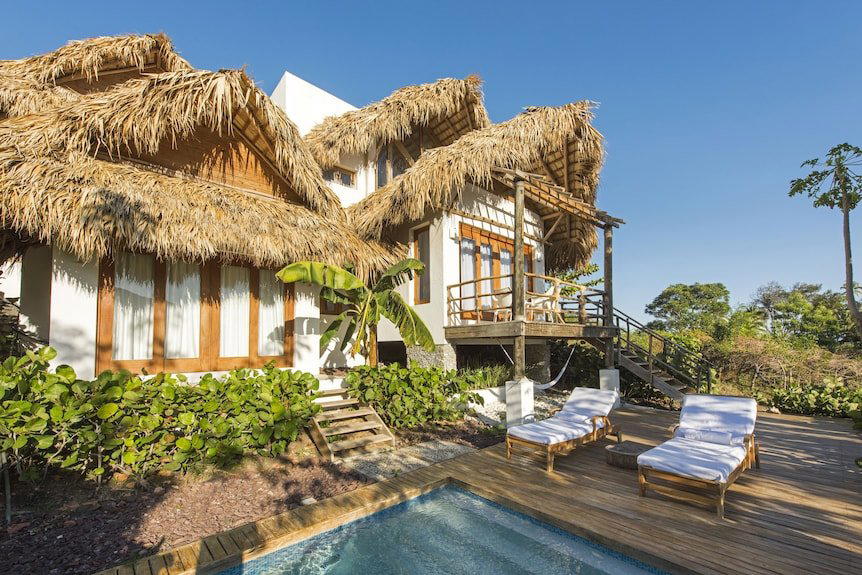
Where the Southwest Coast Defines the Architecture
The Dominican Republic's southwest coast operates on a different register than the resort corridors of Punta Cana or the marina developments of Cap Cana. Along the Barahona stretch of the Carretera de la Costa, the terrain does the framing: volcanic cliffs drop toward reef-fringed water, dry forest presses against the road, and the built environment remains sparse enough that individual properties carry disproportionate visual weight. Casa Bonita Tropical Lodge sits at Km. 17 of that road, in the community of Bahoruco, where the decision to build in sympathy with the hillside rather than against it reads immediately in the approach.
That architectural orientation, designing into the topography rather than levelling it, places Casa Bonita within a broader regional tradition that has gained traction among small lodges throughout the Caribbean's less-developed coasts. The approach is pragmatic as much as philosophical: on a slope above a working coastline, structures that follow the land hold their siting more honestly than flat-plan resort blocks. At Casa Bonita, the result is a cascade of accommodation that uses elevation differentials to separate units, reduce acoustic overlap, and frame views that a conventional horizontal layout would sacrifice. For travellers who have spent time at properties like El Morro Eco Adventure Hotel in Monte Cristi or Dominican Tree House Village in Samana, this vocabulary is recognisable: it is the architecture of terrain-led hospitality, where the site itself sets the design parameters.
The Barahona Context: A Province That Resists the Resort Template
Barahona province has not followed the development trajectory of the north coast or the east. There is no large-scale all-inclusive infrastructure here, no casino corridor, no golf course topology. What the province offers instead is one of the Dominican Republic's more geologically distinct coastlines, with the Sierra de Bahoruco descending to the Caribbean and a shoreline that alternates between black-pebble beaches and protected marine areas. The Jaragua National Park sits to the south; Lake Enriquillo, one of the lowest points in the Caribbean, lies inland. This is a landscape that rewards travellers who approach it as destination rather than backdrop.
For a property like Casa Bonita, that context is a competitive asset and a constraint simultaneously. The surrounding area generates its own interest, reducing pressure on the lodge to manufacture activity programming from scratch. But the relative isolation of the southwest also means that travellers need to be self-selecting: those accustomed to the service density of, say, Amanera in Playa Grande or the resort infrastructure of Casa de Campo Resort and Villas in La Romana will find the southwest's offer fundamentally different in character, not inferior, but demanding different expectations. The southwest is the Dominican Republic for travellers already comfortable with the country, returning to find a version of it that the main tourist circuits have not yet processed.
Design Logic and the Tropical Lodge Format
The tropical lodge format, as a typology, sits between boutique hotel and eco-retreat. It tends to prioritise material honesty, local sourcing of construction materials where possible, and the retention of site features that a conventional developer would remove. Open-sided dining structures, rooms with unglazed apertures that trade thermal comfort for connection to night sounds and sea air, and the use of natural slope drainage rather than engineered landscaping are recurring characteristics across the category.
At Casa Bonita, the lodge format aligns with the Bahoruco hillside address. The name itself, translating as beautiful house, carries an architectural expectation that the property's siting on a dramatic stretch of the coast sustains. Properties in this format sit in a different competitive tier from the large beachfront all-inclusives that dominate Dominican tourism statistics, and they price and book accordingly. Travellers comparing options across the Dominican Republic will find that the southwest lodge category has more in common with Natura Cabana Boutique Hotel and Spa in Sosua or Sublime Samana Hotel and Residences in Las Terrenas than with the volume-oriented east coast product. See our full La Cienaga restaurants guide for the dining context around the property.
Getting There and Practical Orientation
The Km. 17 address on the Carretera de la Costa places the property roughly within the La Cienaga district of Barahona municipality, accessible by road from Barahona city. Most travellers route through Santo Domingo's Las Américas International Airport, driving west and south through San Cristóbal and Azua before reaching Barahona, a journey that runs between three and four hours depending on conditions. The road south of Barahona along the coast is well-documented in regional travel reporting as one of the more scenically direct routes in the country, following the shoreline with minimal infrastructure interruption. Travellers combining the southwest with other Dominican destinations might consider bookending the region with stays at properties like Hodelpa Nicolás de Ovando in Santo Domingo before the drive out, or routing north toward Cayo Levantado Resort for a coastal contrast. The southwest's road access rewards travellers who build in time rather than rushing the transition.
The Southwest's Place in Dominican Luxury Travel
Dominican luxury travel has historically concentrated in a handful of nodes: the Punta Cana corridor, Cap Cana's marina and golf developments, the colonial city of Santo Domingo, and the Samaná peninsula. Properties like Eden Roc Cap Cana, Live Aqua Beach Resort Punta Cana, and Cayo Levantado Resort in Samaná sit within established demand corridors with predictable airlift and infrastructure. The southwest operates outside that network, which means properties in Barahona province have historically served a smaller, more intentional traveller base: researchers, naturalists, experienced Caribbean travellers, and Dominicans from the capital seeking distance from the tourist circuit.
That positioning has both protected the southwest's character and limited its development. For the traveller making the trip, that equation reads as a reasonable trade: less convenience, more authenticity of experience in a landscape that remains genuinely apart from the country's main tourism product.
Side-by-Side Snapshot
| Venue | Cuisine |
|---|---|
| Casa Bonita Tropical LodgeThis venue — the venue you are viewing | This venue |
Continue exploring
More in La Cienaga
Restaurants in La Cienaga
Browse all →
At a Glance
- Scenic
- Rustic
- Cozy
- Romantic
- Romantic Getaway
- Honeymoon
- Weekend Escape
- Panoramic View
- Terrace
- Pool
- Spa
- Wi Fi
- Tennis Court
- Concierge
- Laundry Service
- Mountain
- Waterfront
- Pool
- Spa
- Wi Fi
- Tennis Court
- Concierge
- Laundry Service
Peaceful and enchanting natural paradise with lush tropical foliage, offering relaxation amidst far-reaching scenery.
Know Before You Go
- Getting there
- Km. 17 Carretera de la Costa, Bahoruco, Barahona, Barahona, Dominican Republic