Google: 4.3 · 513 reviews
Arcosanti
Arcosanti is an experimental urban laboratory in the high desert of Yavapai County, Arizona, conceived by architect Paolo Soleri as a working demonstration of arcology — the fusion of architecture and ecology. Part construction site, part living community, part arts venue, it draws visitors drawn to mid-century idealism made physical. The bronze bell foundry, vaulted concrete apses, and ongoing resident program make it one of the more genuinely unusual destinations in the American Southwest.
 Discover on Pearl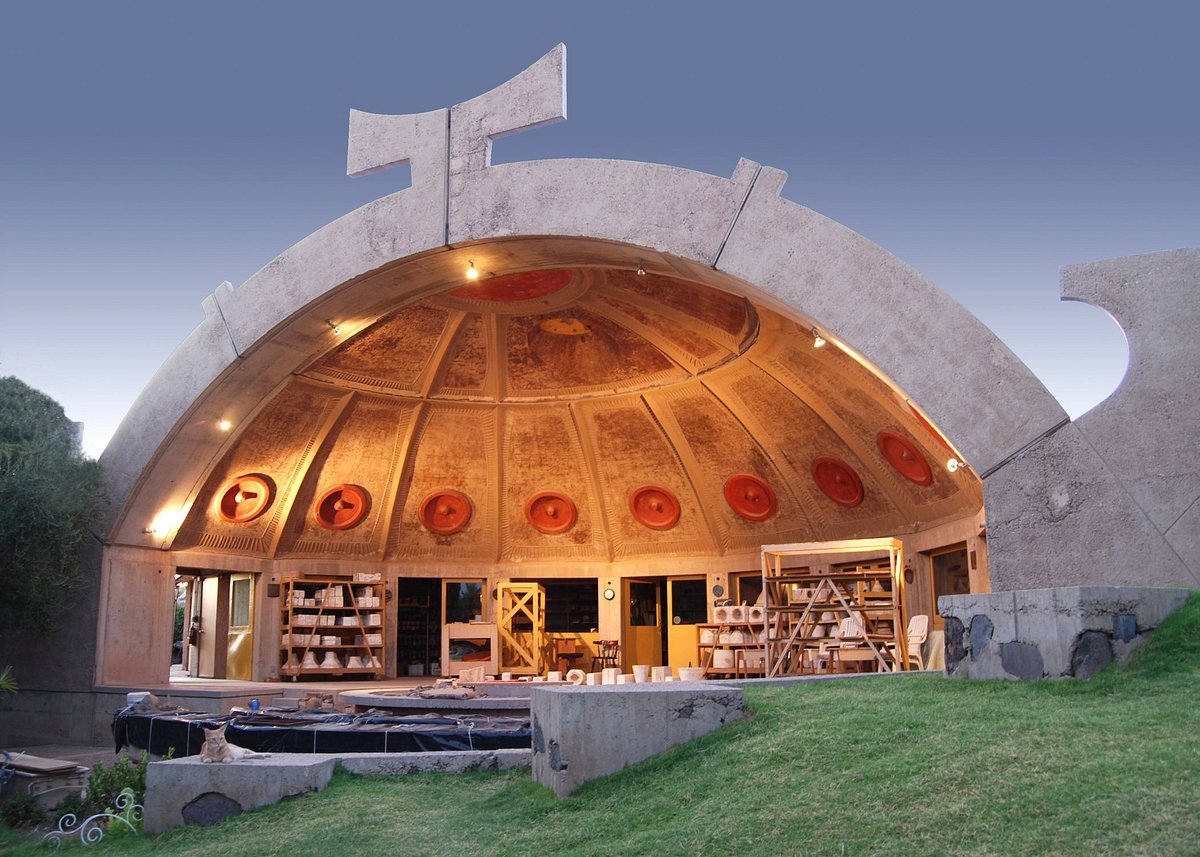
A Desert Experiment That Never Stopped Running
Roughly an hour north of Phoenix, where the Bradshaw Mountains meet the high Sonoran plateau, the built environment does something unexpected: it curves. The concrete apses of Arcosanti rise from the scrubland at 13555 S Cross L Rd in Mayer, Arizona, not as ruins and not quite as a finished city, but as something in between — a five-decade construction project still actively inhabited by the people building it. In an era when architectural ambition tends to express itself through glass towers and hotel lobbies, Arcosanti offers a counterargument cast in poured concrete and desert light.
For travelers accustomed to the polished legibility of places like Amangiri in Canyon Point or Ambiente in Sedona, arriving at Arcosanti requires a recalibration. This is not a resort. The appeal is the density of ideas made structural — the way a single architectural vision has accumulated, layer by layer, over decades of hands-on construction by residents, students, and volunteers.
The Architecture as Argument
Paolo Soleri, the Italian-American architect who founded Arcosanti in 1970, trained under Frank Lloyd Wright at Taliesin West before developing his own theory of urban form. He called it arcology: the proposition that dense, mixed-use, human-scaled cities could be integrated with their ecological surroundings rather than imposed upon them. Arcosanti was designed to house 5,000 people on roughly 25 acres, leaving the surrounding 860 acres of Sonoran high desert largely untouched. That ratio , extreme density inside, preserved landscape outside , remains the project's central spatial argument.
The structures themselves make that argument visible. The vaulted apses that define Arcosanti's silhouette are not decorative; they are passive solar devices, orienting to capture winter sun while shading interior spaces in summer. The curved concrete forms channel prevailing winds. The bronze bells cast in the on-site foundry , Arcosanti's primary commercial product and a significant funding source for the project , ring through the canyon below when the air moves. The architecture, in other words, is not static. It responds.
This places Arcosanti in a specific and underappreciated lineage of American desert architecture , one that runs from Wright's Taliesin West through Soleri's work and into the material-sensitive regional modernism practiced at properties like Post Ranch Inn in Big Sur and, in a more resort-oriented register, Amangani in Jackson Hole. What separates Arcosanti from that peer set is purpose: it was never conceived as hospitality infrastructure. The structures exist to prove a theory of how humans might live, not to provide comfort to those passing through.
What a Visit Actually Involves
Tours of Arcosanti typically depart from the visitor center and move through the main construction zones, the bronze foundry, and the residential areas where current inhabitants live and work. The foundry is the operational core: windbells and other bronze objects are made on-site, sold through the gift shop, and shipped globally. For many visitors, watching the casting process is the most concrete (if you will forgive the term) demonstration of how the community sustains itself financially while continuing to build.
The residential character of the site is worth understanding before you arrive. Arcosanti is a working community, not a museum. Residents are there to build, study, and live out Soleri's urban hypothesis. Visitors are welcome but are guests in a functioning place, which gives the experience a texture that no amount of heritage interpretation can manufacture. The café on-site serves meals to residents and visitors alike , a pragmatic overlap that collapses the usual tourist/local distinction.
Those who want to extend their time in the broader region have several reference points nearby. Canyon Ranch Tucson sits roughly two hours south for those who prefer a wellness-oriented anchor. Sedona, about an hour northwest, offers a range of accommodation options in a different register of desert design. Our full Yavapai County restaurants guide covers the broader food and lodging picture for travelers building a multi-day itinerary around this part of Arizona.
The Scale of the Ambition, Honestly Assessed
Arcosanti was designed for 5,000 residents. Approximately 50 to 150 people live there at any given time, depending on the season and how many workshop participants are in residence. The gap between that vision and that reality is not a failure in any direct sense , it is, rather, the most interesting thing about the place. Soleri always framed Arcosanti as a demonstration project, a proof of concept rather than a finished city. By that measure, it has been running continuously since 1970, which is more than most architectural utopias manage.
The incompleteness is structural to the experience. Rebar protrudes from unfinished forms. New construction proceeds alongside occupied buildings. The aesthetic is somewhere between Brutalist monument and active workshop , closer to what you might find at an architectural school's summer build program than at a finished heritage site. Visitors who arrive expecting a polished destination will find something more productive: an argument about how cities could be organized, made physical enough to walk through.
Compared to the discipline and finish of luxury desert properties like Amangiri or the curated naturalism of Sage Lodge in Pray, Arcosanti occupies a different category entirely. The competition isn't other destinations; it's other ways of spending time with difficult ideas about how humans build and inhabit space.
Planning Your Visit
Arcosanti is located at 13555 S Cross L Rd, Mayer, AZ 86333, accessible by car from Phoenix via Interstate 17 north to the Cordes Junction exit. The drive takes approximately one to one-and-a-half hours depending on traffic. Tours operate daily; visiting earlier in the day is advisable during Arizona's summer months, when afternoon temperatures across the high desert plateau can exceed 100°F even at Arcosanti's slightly refined elevation. Overnight accommodation is available on-site in a limited number of rooms and dormitory-style spaces, making it possible to experience the community across a full day and evening rather than a compressed tour. For visitors pairing this with broader Arizona travel, properties like Ambiente in Sedona or Canyon Ranch Tucson offer contrasting approaches to design-led desert hospitality within the same state.
Fast Comparison
These are the closest comparables we have in our database for quick context.
| Venue | Cuisine | Price | Awards | Notes |
|---|---|---|---|---|
| Arcosanti | This venue | |||
| Aman New York | Michelin 3 Key | |||
| Amangiri | Michelin 3 Key | |||
| Hotel Bel-Air | Michelin 3 Key | |||
| The Beverly Hills Hotel | Michelin 3 Key | |||
| The Carlyle, A Rosewood Hotel | Michelin 2 Key |
At a Glance
- Quiet
- Scenic
- Rustic
- Industrial
- Minimalist
- Wellness Retreat
- Weekend Escape
- Group Retreat
- Historic Building
- Panoramic View
- Wifi
- Mountain
Natural light through open window plans in concrete structures that retain solar heat, creating a serene, eco-integrated atmosphere.