

Amanruya occupies a hillside above the Aegean on the Bodrum Peninsula, with 35 freestanding pool suites and pavilions built from white marble and native timber in a layout that echoes a clifftop village. The property anchors the Aman group's Turkish footprint and pairs Ottoman-Mediterranean architecture with a Turkish cuisine dining programme and direct access to one of the Aegean's most archaeologically layered coastlines.
 Discover on Pearl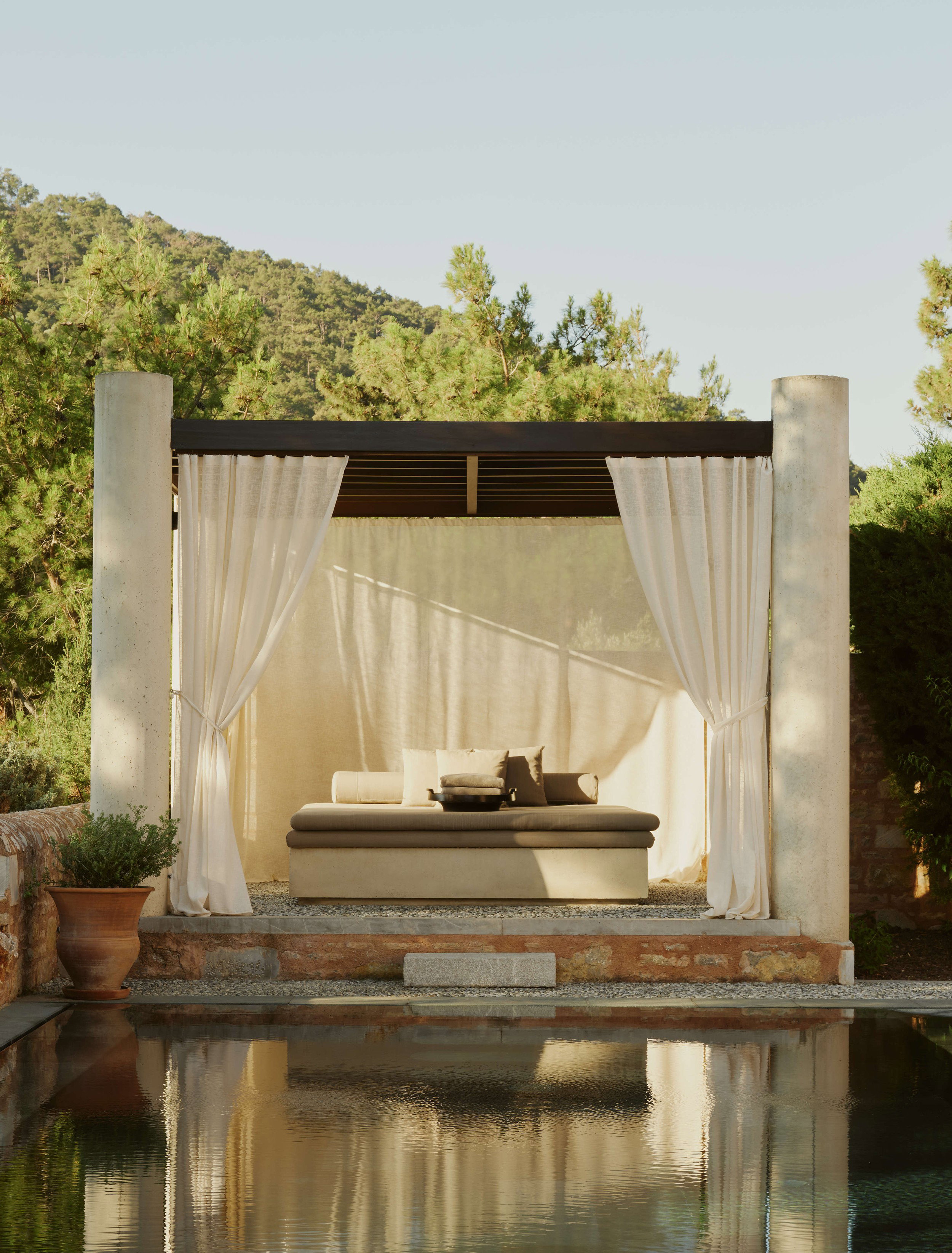
The Bodrum Peninsula's Hillside Retreat Tradition
The Aegean's Turkish shoreline has developed a distinct tier of resort architecture over the past two decades: properties that turn their backs on the beachfront sprawl model and instead press into the hillsides above the sea, trading proximity to the water for privacy, elevation, and a village-like dispersal of accommodation across terraced land. Amanruya, part of Aman's global portfolio, sits firmly in that category. Its 35 freestanding pool suites and pavilions are arranged along quiet footpaths in a configuration that mirrors the layout of a clifftop settlement rather than a conventional hotel campus. The comparison set here is not the large-scale beach clubs that define sections of the peninsula's coast, such as Lujo Hotel Bodrum or Maxx Royal Bodrum, but rather the smaller, architecture-led properties where seclusion and material quality carry the argument.
The Bodrum Peninsula itself provides a context that few Mediterranean destinations can match. Settled since the seventh century BC, it was home to ancient Halicarnassus, site of the Mausoleum counted among the Seven Wonders of the Ancient World. That layering of history sits alongside one of Turkey's most active contemporary resort corridors, making the peninsula simultaneously one of the Aegean's most archaeologically significant stretches of coast and one of its most sought-after summer destinations. For those exploring the region's hotel options, see our full Bodrum hotels guide.
Architecture and Material Choices
Resort's construction draws on Mediterranean and Ottoman precedents in a way that reads as considered rather than decorative. Floors are white marble, stone detailing is hand-carved, and furniture uses native acajau wood. The result is an interior language that connects to the regional building tradition without reproducing it wholesale. Each suite and pavilion includes a private marble swimming pool with a daybed arrangement designed for two, a traditional charcoal fireplace, four-poster bed, and hand-woven rugs. The practical amenities, underfloor heating, espresso machines, rain showers, and oversized tubs, are embedded without disturbing the tonal consistency of the space.
This approach to material authenticity places Amanruya in a different conversation from properties like Mandarin Oriental, Bodrum or Susona Bodrum, LXR Hotels & Resorts, which operate with their own architectural identities but within different ownership philosophies. Among Aman's own portfolio, the approach here echoes what the group has accomplished elsewhere, from Aman Venice to properties across Asia: the local vernacular as a serious structural decision, not surface treatment.
The Dining Programme and Turkish Table
The dining programme at hill-set Aegean resorts tends to face a specific challenge: panoramic views create an obvious focal point, but the cuisine itself risks becoming secondary to the scenery. At Amanruya, a series of dining pavilions frame a Turkish cuisine programme against views of the sea, positioning the food within a tradition that is far more complex than the resort-hotel version of it often suggests. Turkish cuisine at this end of the Aegean draws from Ottoman court cooking, Aegean olive culture, and the mezze tradition of the meyhane, the taverns that remain the living social institution of coastal Turkish towns. The meyhanes of Bodrum itself, a short drive from the property, operate as a reference point for how the local table actually functions outside resort settings.
The wine cellar forms part of the food and drink infrastructure, relevant in a country where the wine industry has expanded considerably since the 1990s, with Aegean and Thrace regions now producing varietals that appear on serious international lists. Turkish wine at a property with this level of material investment should read as an editorial choice rather than an afterthought. Guests looking for the broader Bodrum dining context beyond the resort can consult our full Bodrum restaurants guide or our full Bodrum bars guide.
On-Property Amenities and the Library Tower
Beyond its accommodation and dining, Amanruya includes an infinity pool, massage treatment rooms, a beach club, and an art gallery. The three-story Library Tower functions as a gathering and reading space that reinforces the property's orientation toward guests who treat a stay as a pause rather than a programme. That structure, a library as architectural centrepiece rather than a secondary amenity, signals something about the intended pace of time spent here. It is a detail that distinguishes Amanruya from properties organised around activity schedules and evening entertainment, and aligns it more closely with the quieter, self-directed format that characterises this end of the Aman model. For comparison with similar design-led, low-key resorts elsewhere in Turkey, see Alavya in Alacati or Ahãma in Göcek.
The Peninsula Beyond the Property
The Bodrum Peninsula's appeal to culturally oriented travellers rests on density: ruined cities, temples, and ancient baths are accessible within a short drive of most points on the peninsula. The Mausoleum of Halicarnassus, the Bodrum Castle housing the Museum of Underwater Archaeology, and the ancient theatre at Halicarnassus are among the sites that make a serious claim on a visitor's day. The old city of Bodrum, with its active meyhane culture, operates as a counterpoint to the resort experience: louder, more social, and a direct window into how coastal Turkish life organises itself around food and drink after dark.
For those using Bodrum as a base to explore Turkey's Aegean corridor more broadly, the peninsula connects to a wider network of culturally significant destinations. Further afield, Argos in Cappadocia and Ajwa Cappadocia in Ürgüp represent Turkey's interior luxury tier, while Address Istanbul anchors the city option. On the Bodrum Peninsula itself, Maçakızı occupies a different register, as does Allium Bodrum Resort & Spa. Smaller boutique options at various price points include Birdcage 33 Hotel and Bodrum Loft. For experiences beyond the hotel, our full Bodrum experiences guide and our full Bodrum wineries guide cover the broader scene. Elsewhere along Turkey's Aegean coast, KestelINN Alaçatı in Cesme and D Maris Bay in Hisarönü offer contrasting approaches to the same coastline.
Getting There and Practical Planning
Amanruya sits approximately 26 miles from Milas-Bodrum International Airport (BJV), a drive of around 30 minutes. The property offers complimentary airport transfers for stays of three nights or more during April, May, June, September, and October. In July and August, a round-trip private transfer is priced at 120 euros. Peak season on the Bodrum Peninsula runs July through August, when temperatures are high and the peninsula draws its largest crowds. The shoulder months of May, June, September, and October offer lower ambient temperatures, lighter traffic on the roads to archaeological sites, and, based on the transfer policy, the same complimentary logistics. With 35 units across the property, availability during peak weeks tightens considerably, and the Aman booking model historically requires lead time in line with other properties in the group. For comparison, Maxx Royal Kemer along the Antalya coast operates at a different scale and price architecture. Guests considering international Aman comparisons can reference The Fifth Avenue Hotel in New York for a sense of how the luxury boutique tier operates in a different geography. Casa Lavanda Boutique Hotel in Sile represents the more accessible end of Turkey's design-hotel spectrum.
Frequently Asked Questions
- Which room category should I book at Amanruya?
- Amanruya offers no standard hotel rooms. Every unit is either a Pool Suite or a Pool Pavilion, each freestanding with a private marble pool, four-poster bed, fireplace, and hand-carved stone detailing. The choice between suite and pavilion relates primarily to space and configuration rather than access to amenities, as all units share the same material and service standard across the 35-unit property.
- Why do people go to Amanruya?
- The property draws guests seeking a combination of archaeological and cultural access, a seclusion-first resort format, and the Aman group's approach to architecture and service. The Bodrum Peninsula's density of ancient sites, including ruins linked to the Seven Wonders of the Ancient World, means the surrounding region carries independent appeal beyond the property itself. The hillside location and village-like layout reinforce a quieter, less social-programme-driven pace than most large-scale Bodrum resorts.
- Should I book Amanruya in advance?
- With only 35 freestanding units, availability during the July-August peak is limited. The complimentary transfer policy applies to stays of three or more nights in April, May, June, September, and October, which is a practical signal that shoulder-season stays are the property's preferred format and likely the most available. Early booking is advisable for any summer dates, and the shoulder months typically offer more flexibility alongside cooler temperatures.
- What's the leading use case for Amanruya?
- Amanruya suits travellers who want a high-quality, low-footprint base for cultural exploration of the Bodrum Peninsula and who are not primarily oriented around beach-club activity or large-group social programming. The combination of private-pool accommodation, a Turkish cuisine dining programme, and a peninsula full of accessible archaeological sites makes it a logical choice for couples or small groups who want to divide time between the property and the surrounding region.
- How does Amanruya's dining programme connect to the local food culture of the Bodrum Peninsula?
- The dining pavilions focus on Turkish cuisine, drawing from a tradition that includes Aegean mezze culture and the meyhane format still active in Bodrum's old city. The property's wine cellar reflects a growing Turkish wine industry concentrated in the Aegean and Thrace regions. For guests wanting to extend beyond the resort's table, the meyhanes and restaurants of Bodrum town are approximately 30 minutes away by road, and our full Bodrum restaurants guide maps the wider options.
A Pricing-First Comparison
A fast peer set for context, pulled from similar venues in our database.
| Venue | Price | Awards | Notes |
|---|---|---|---|
| Amanruya | Price: No rooms available Rooms: 35 Rooms Mention the Aegean Sea and the mind… | This venue | |
| Mandarin Oriental, Bodrum | |||
| Lujo Hotel Bodrum | |||
| Susona Bodrum, LXR Hotels & Resorts | |||
| The Bodrum EDITION | |||
| Maçakızı | World's 50 Best |
Preferential Rates?
Our members enjoy concierge-led booking support and priority upgrades at the world's finest hotels.
Get Exclusive Access