Zinco Jazz Club
Zinco Jazz Club occupies a vaulted colonial basement on Calle de Motolinia in Centro Histórico, where live jazz has held the room for over two decades. The format is straightforward: drinks, music, and one of the few dedicated jazz programs operating at this depth in Mexico City. Book ahead for weekend sets.
Pearl is the En Primeur Club membership app — saves, bookings, and concierge access live there. Same editors, same standards.
- Address
- Calle de Motolinia 20, Centro Histórico de la Cdad. de México, Centro, Cuauhtémoc, 06050 Ciudad de México, CDMX, Mexico
- Phone
- +52 55 1131 7760
- Website
- zincojazz.com
- Directions
- Get directions
 Saves & bookings on Pearl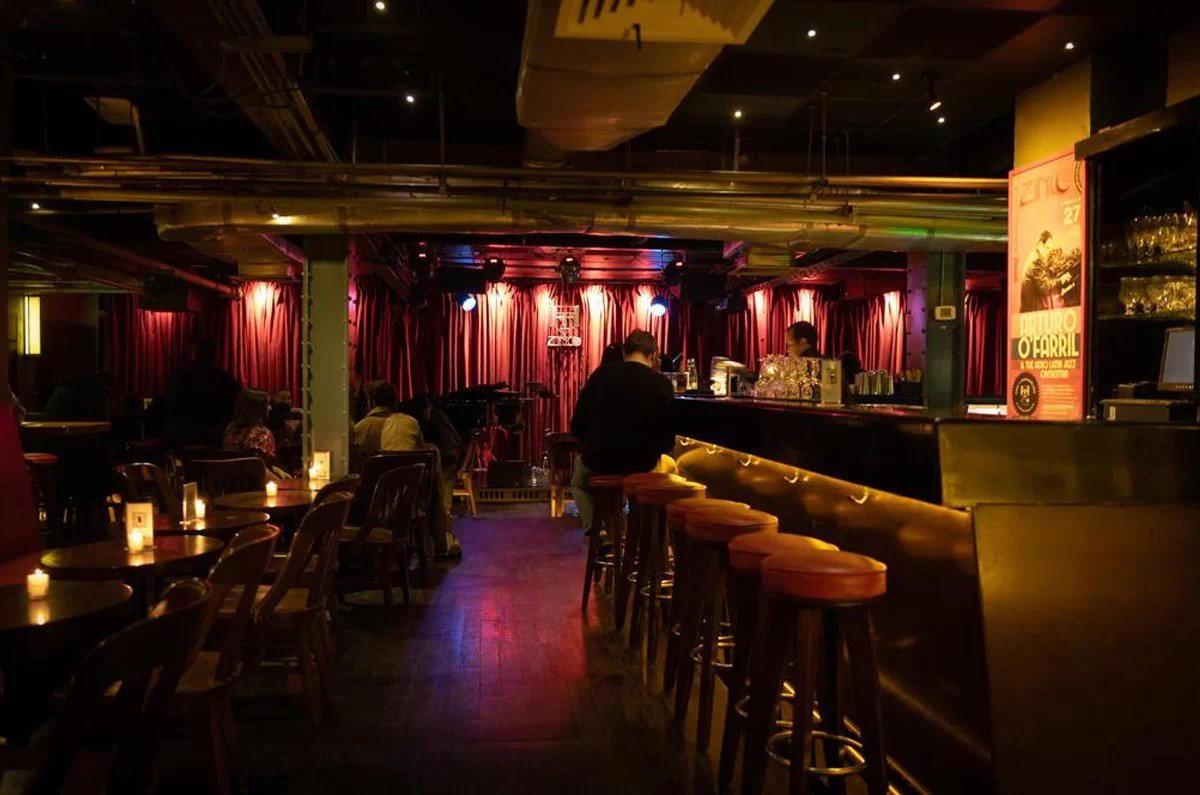
A Basement That Holds Its Ground
Centro Histórico's nightlife has shifted considerably over the past decade, with mezcal bars and cocktail programs claiming ground from the district's older entertainment formats. Against that movement, Zinco Jazz Club has remained fixed in its lane: a below-street-level room on Calle de Motolinia where the music is the architecture. The descent into the space — past colonial stone walls, into a vaulted basement that predates the venue by centuries — does more to set expectations than any sign above the door. What greets you is a room designed around listening, with the stage positioned so that almost every seat faces it directly.
That physical orientation matters more than it might seem. In a city where live music is frequently treated as ambient backdrop, Zinco operates closer to the model of a European jazz club than a Latin American nightlife venue. The audience is expected to pay attention. That expectation has shaped the kind of programming the club sustains and the kind of crowd it consistently draws, which skews toward musicians, critics, and regulars who treat weekend sets as appointments rather than afterthoughts.
How the Program Is Structured
Understanding Zinco's offer requires thinking about it the way you would a performance venue with a drinks program attached, rather than a bar that happens to have a band. The music programming carries the weight of the editorial decision-making here. Live sets anchor the schedule across multiple nights per week, with the weekend program drawing the heaviest bookings and the most established acts. The format is closer to what you would encounter at a dedicated jazz room in New York or Paris than at the typical Mexico City venue that mixes live performance with DJ sets and late-night volume.
The drinks side of the menu operates in support of that framework. This is not the context for the kind of technical cocktail programs being developed at venues like Baltra Bar or Bar Mauro, where the glass is the primary event. At Zinco, the glass keeps your hands occupied while the music does the work. Classic cocktail categories, spirits-forward drinks, highballs, a short wine list, cover what the room needs without complicating the experience. The menu architecture reflects that priority: it offers enough range to satisfy without demanding the kind of attention that would compete with the stage.
That restraint is a curatorial choice, and it places Zinco in a different competitive tier from the cocktail-forward bars driving most of the editorial conversation about Mexico City's drinking scene. Venues like Bijou Drinkery Room and Brujas are operating from a different premise entirely. Zinco's value proposition is not in the glass; it is in the room and what happens in it.
Centro Histórico as Context
The club's address on Motolinia puts it inside one of Latin America's densest concentrations of colonial architecture, a neighbourhood that has cycled through periods of neglect and reclamation since the 1990s. The area around the Zócalo and the streets running north from it toward Bellas Artes have attracted enough cultural programming and restoration investment that Centro now functions as a legitimate destination for a night out, rather than simply a transit point between other parts of the city.
Zinco arrived in that neighbourhood before the reclamation was fully underway, which means it carries the kind of institutional memory that newer venues cannot manufacture. It is not a concept that was placed in Centro to capitalise on the district's revival; it is part of the fabric that made revival plausible. That distinction matters when you are thinking about what makes a live music room credible over time. Longevity in this neighbourhood, in this format, is itself an editorial signal.
For visitors moving between Mexico City's bar scenes, Zinco sits geographically and conceptually apart from the Roma-Condesa corridor where most of the cocktail conversation is concentrated. If that corridor represents the city's contemporary bar ambitions, Centro's jazz rooms represent a longer, quieter continuity. Elsewhere in Mexico, dedicated music-bar formats operate differently: El Gallo Altanero in Guadalajara anchors its program around tequila heritage, while Bekeb in San Miguel de Allende works a smaller, more intimate register. Zinco occupies a category that neither of those quite covers.
What the Room Requires of You
Arriving without a reservation on a weekend set night is a practical mistake. The room's capacity and the nature of the programming mean that tables fill against specific acts, not just against general demand. Booking ahead is the baseline requirement; arriving close to the start of a set is advisable if you want to be settled before the music begins rather than negotiating the room mid-performance.
Dress expectations align with the venue's register: the room has enough formality that showing up in resort wear reads as a mismatch, but it is not a black-tie context. The colonial setting and the nature of the programming call for something considered. Think of the dress code less as a rule and more as a signal about how seriously the room takes itself.
For a broader view of where Zinco sits within the city's full drinking and entertainment offer, the EP Club Mexico City guide maps the full range of bar categories and neighbourhoods. Further afield, international comparisons that reward the same kind of attentive listening include Bar Leather Apron in Honolulu, which operates from a similar premise of deliberate restraint. For high-volume alternatives in Mexico when the mood calls for something different in scale, Coco Bongo in Cancun represents the opposite end of the spectrum. Arca in Tulum, Aruba Day Drink in Tijuana, and La Capilla in Tequila round out the country's range of serious drinking contexts, each operating from a distinct regional premise.
Know Before You Go
- Address: Calle de Motolinia 20, Centro Histórico, Cuauhtémoc, Mexico City
- Getting There: Walking distance from Bellas Artes metro station (Lines 2 and 8)
- Booking: Reservations advised for weekend sets; walk-in availability is limited on performance nights
- Timing: Live sets typically begin mid-evening; arrive before the set starts to avoid disruption
- Dress: Smart casual; the setting and programming call for something more considered than casual resort wear
Continue exploring
More in Mexico City
Bars in Mexico City
Browse all →
Restaurants in Mexico City
Browse all →

At a Glance
- Intimate
- Classic
- Cozy
- Sophisticated
- Date Night
- Late Night
- Special Occasion
- Live Music
- Speakeasy
- Historic Building
- Lounge Seating
- Classic Cocktails
- Mezcal
- Tequila
Current opening hours
- Monday
- Closed
- Tuesday
- Closed
- Wednesday
- 9 PM–1 AM
- Thursday
- 9 PM–1 AM
- Friday
- 9 PM–1 AM
- Saturday
- 9 PM–1 AM
- Sunday
- Closed
Hours can change for holidays and private events. Last verified .
Dimly lit underground space with retro decor in red and black, creating a speakeasy-like atmosphere.
Know Before You Go
- Getting there
- Calle de Motolinia 20, Centro Histórico de la Cdad. de México, Centro, Cuauhtémoc, 06050 Ciudad de México, CDMX, Mexico