Napoleon House
Napoleon House at 500 Chartres Street has anchored the French Quarter's bar culture for generations, trading on a Pimm's Cup so closely identified with the address that the drink functions as a calling card for the city itself. The crumbling plaster, classical music, and courtyard humidity place it firmly in the tradition of New Orleans drinking as unhurried ritual rather than spectacle.
 Discover on Pearl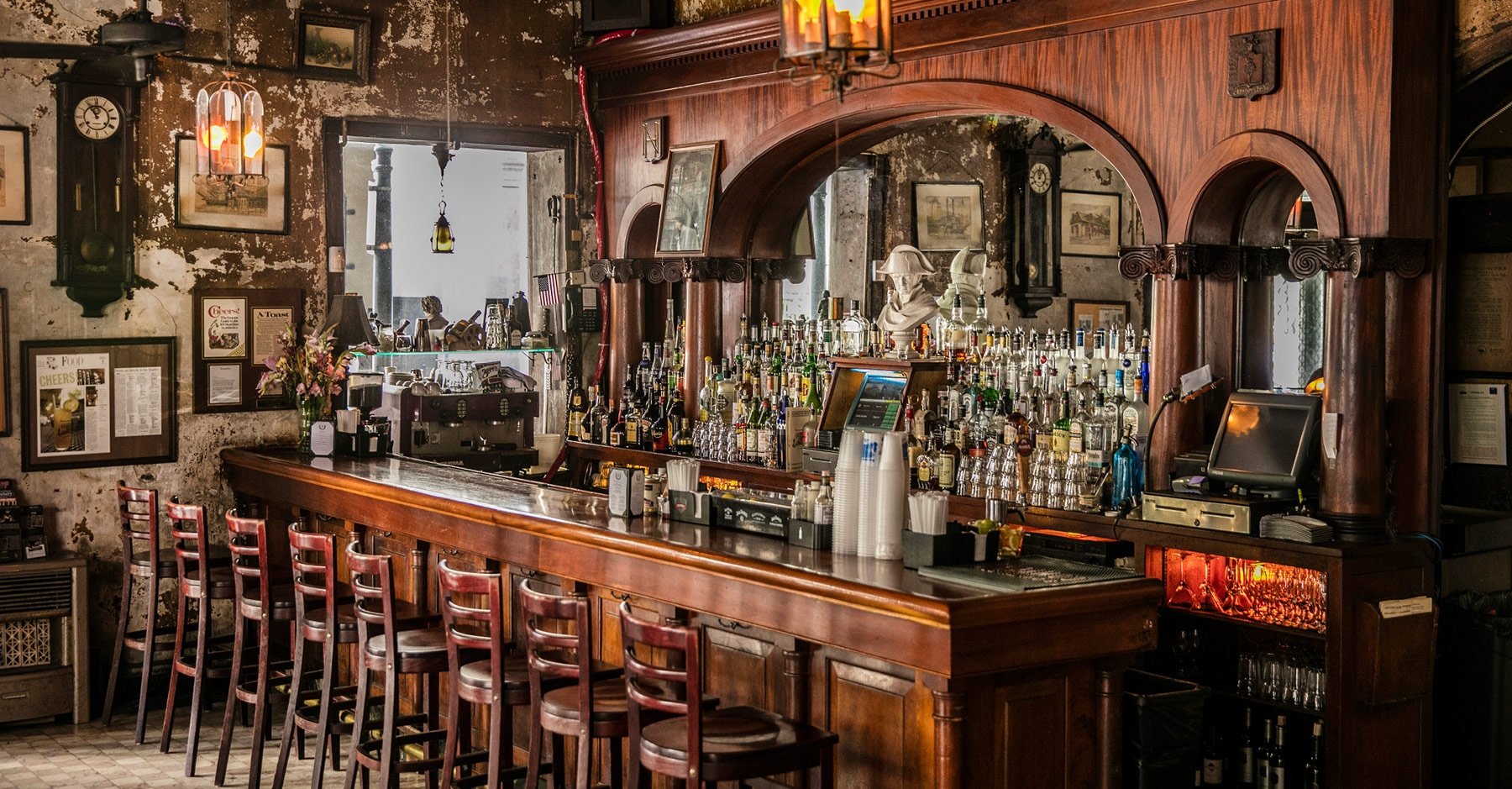
A Building That Drinks Its Own History
There is a particular quality of light inside 500 Chartres Street that resists the afternoon entirely. The shuttered windows filter Decatur Street noise into something almost abstract, the plaster walls carry the kind of earned patina that decorators spend considerable money trying to approximate, and the classical music that has played here for decades creates a counterpoint to the French Quarter's usual soundtrack that feels, on first encounter, slightly disorienting and then, very quickly, correct. Napoleon House is one of the rare drinking establishments where the atmosphere is not a set piece constructed around the bar program but a condition of the building itself, accumulated across roughly two centuries of continuous occupation.
The address matters as a locating device. The French Quarter's bar culture divides, broadly, into two operating registers: venues built around technical ambition and those built around inheritance. Spots like Jewel of the South and Cure occupy the first register, with program-led identities and cocktail lists that reward close reading. Napoleon House occupies the second, where the question is not what the bartender can do but what the room has already done, long before you arrived.
The Pimm's Cup as Civic Property
The editorial angle on Napoleon House's drink program is necessarily historical rather than technical. The Pimm's Cup, served here in a format the bar has sustained across generations, has become so associated with the address that it functions less like a menu item and more like a civic object. The drink itself, Pimm's No. 1 lengthened with lemonade and garnished with cucumber, is not a complicated preparation. Its persistence here, and the degree to which it has attached itself to New Orleans drinking identity, is a function of repetition and place rather than innovation.
This is worth stating plainly because it reframes how a visitor should approach the bar. Napoleon House does not compete in the dimension that drives recognition at, say, Kumiko in Chicago, ABV in San Francisco, or Allegory in Washington, D.C., where the merit of the program is inseparable from the craft intelligence behind it. The competition set here is temporal rather than technical: Napoleon House persists because it represents a drinking culture that predates the current era of cocktail consciousness and has not been overwritten by it.
The broader drink list extends beyond the Pimm's Cup into a range of classic preparations, wine, and beer that position the bar comfortably within French Quarter drinking tradition without pressing toward experimentation. In cities where program ambition drives the top tier, as it does at Bar Leather Apron in Honolulu or Julep in Houston, this register might read as limited. In the French Quarter, it reads as honest.
Positioning Within the Quarter's Drinking Culture
New Orleans bars sort into competitive peer sets that are not always obvious from the outside. The contemporary craft tier, anchored by places like Beachbum Berry's Latitude 29, maintains a program-forward identity that draws visitors specifically for the cocktail list. Napoleon House draws visitors for something harder to articulate but no less intentional: the experience of drinking in a room where the accumulation of time is the primary offering.
The courtyard, when accessible, extends that logic into the exterior. Humidity, flagstone, a ceiling of sky bounded by the building's upper floors: the setting reinforces the sense that the pace here is set by the architecture rather than the service. This is not a complaint. It is, for the visitor who understands the register, precisely the point.
For a full picture of where Napoleon House sits within the city's broader food and drink map, our full New Orleans restaurants guide covers the range from legacy institutions to newer arrivals across neighborhoods. The comparison with the technical energy at Superbueno in New York City or The Parlour in Frankfurt on the Main is instructive: both cities produce bars with sharply defined contemporary identities, while New Orleans continues to generate places where historical weight is the primary credential.
The food program at Napoleon House, centered on the muffuletta sandwich, operates on similar logic. The muffuletta is a New Orleans institution, not an invention of this address, but Napoleon House's version has accrued enough identification with the building that ordering it here carries a different meaning than ordering it elsewhere. That kind of transferred significance is not manufactured; it takes decades to develop and is one of the reasons the address holds the position it does within the Quarter's dining and drinking culture. Visitors looking for plant-forward alternatives in the broader city will find that 2 Phat Vegans operates in a completely different register, a useful reminder that New Orleans's food culture is not monolithic even when its legacy institutions tend to dominate the conversation.
Planning Your Visit
Napoleon House sits at 500 Chartres Street in the French Quarter, within easy walking distance of the Quarter's main concentration of bars, restaurants, and hotels. The address receives heavy foot traffic throughout the day, and the interior's capacity is sufficient that walk-ins are generally accommodated without the friction common to smaller, program-focused venues. Visiting mid-week, or arriving during the early afternoon before the evening surge, gives the room a quality of quiet that the weekends do not replicate. The building's physical character, which is the actual reason to be here, registers most clearly when the noise level is low enough to notice the music and the light properly. There are no publicized booking procedures, and the approach for most visitors is simply to arrive; the bar's long-established status in the Quarter means it operates as a neighborhood fixture rather than a reservation-driven destination.
Frequently Asked Questions
- What drink is Napoleon House famous for?
- The Pimm's Cup has become so associated with Napoleon House that it now functions as a defining emblem of the address and, by extension, a piece of New Orleans bar identity. The preparation is a classic formulation: Pimm's No. 1 lengthened with lemonade and finished with cucumber. Its significance here derives not from technical complexity but from the decades of repetition that have made it inseparable from this specific room and from the city's broader drinking culture.
- What should I know about Napoleon House before I go?
- Napoleon House is a legacy institution, not a contemporary cocktail bar, and the visit makes most sense when approached on those terms. The building at 500 Chartres Street in the French Quarter is among the Quarter's oldest continuously operating addresses, and the physical atmosphere, classical music, aged plaster, and courtyard access, is the primary offer. Pricing is consistent with French Quarter bar norms. There are no dress code requirements, and the bar functions as a neighborhood fixture that accommodates walk-in traffic throughout the day.
- Do they take walk-ins at Napoleon House?
- Napoleon House operates as a walk-in venue in the French Quarter tradition. There is no publicized reservation system, and the bar's scale means that arriving without a booking is the standard approach for most visitors. If avoiding crowds matters, the early afternoon on a weekday gives the room its most unhurried version. The French Quarter's peak hours, particularly on weekends, will push the noise level up and reduce the atmospheric quality that makes the address worth seeking out.
- Is Napoleon House better for first-timers or repeat visitors?
- The first visit to Napoleon House carries the weight of discovery, and the combination of the Pimm's Cup, the room, and the muffuletta is a coherent introduction to a particular strand of New Orleans bar culture. Repeat visitors tend to find the experience deepens with familiarity: the building reveals itself slowly, and understanding where it sits within the Quarter's competitive set, against the craft ambition of places like Jewel of the South or the tiki program at Latitude 29, adds a layer of context that makes the second or third visit more legible than the first.
- How does Napoleon House connect to New Orleans's broader history of landmark bar addresses?
- The building at 500 Chartres Street was constructed in the early nineteenth century and has been associated with the name Napoleon House since the period when, according to documented local history, it was offered as a refuge for Napoleon Bonaparte following his exile to Saint Helena. The offer was never taken up, but the name attached itself to the address and has persisted through subsequent ownership changes. That lineage places Napoleon House in a small cohort of New Orleans drinking establishments whose identity is inseparable from the city's pre-American colonial and early American civic history, a credential that neither awards lists nor contemporary program recognition can replicate or replace.
A Credentials Check
A quick snapshot of similar venues for side-by-side context.
| Venue | Awards | Cuisine | Notes |
|---|---|---|---|
| Napoleon House | This venue | ||
| Jewel of the South | World's 50 Best | ||
| Beachbum Berry's Latitude 29 | World's 50 Best | ||
| Cure | World's 50 Best | ||
| Cane & Table | |||
| The Carousel Bar |
Need a Table?
Our members enjoy priority alerts and concierge-led booking support for the world's most difficult bars and lounges.
Get Exclusive Access