Lafitte's Blacksmith Shop Bar
One of the oldest surviving bar structures in the United States, Lafitte's Blacksmith Shop Bar on Bourbon Street occupies an 18th-century Creole cottage that has outlasted virtually every institution around it. The candlelit interior, bare brick walls, and cash-only Purple Drinker make it a fixed point in New Orleans drinking culture rather than a trend-driven destination.
Pearl is the En Primeur Club membership app — saves, bookings, and concierge access live there. Same editors, same standards.
- Address
- 941 Bourbon St, New Orleans, LA 70116
- Phone
- +1 504 593 9761
- Website
- lafittesblacksmithshop.com
- Directions
- Get directions
 Saves & bookings on Pearl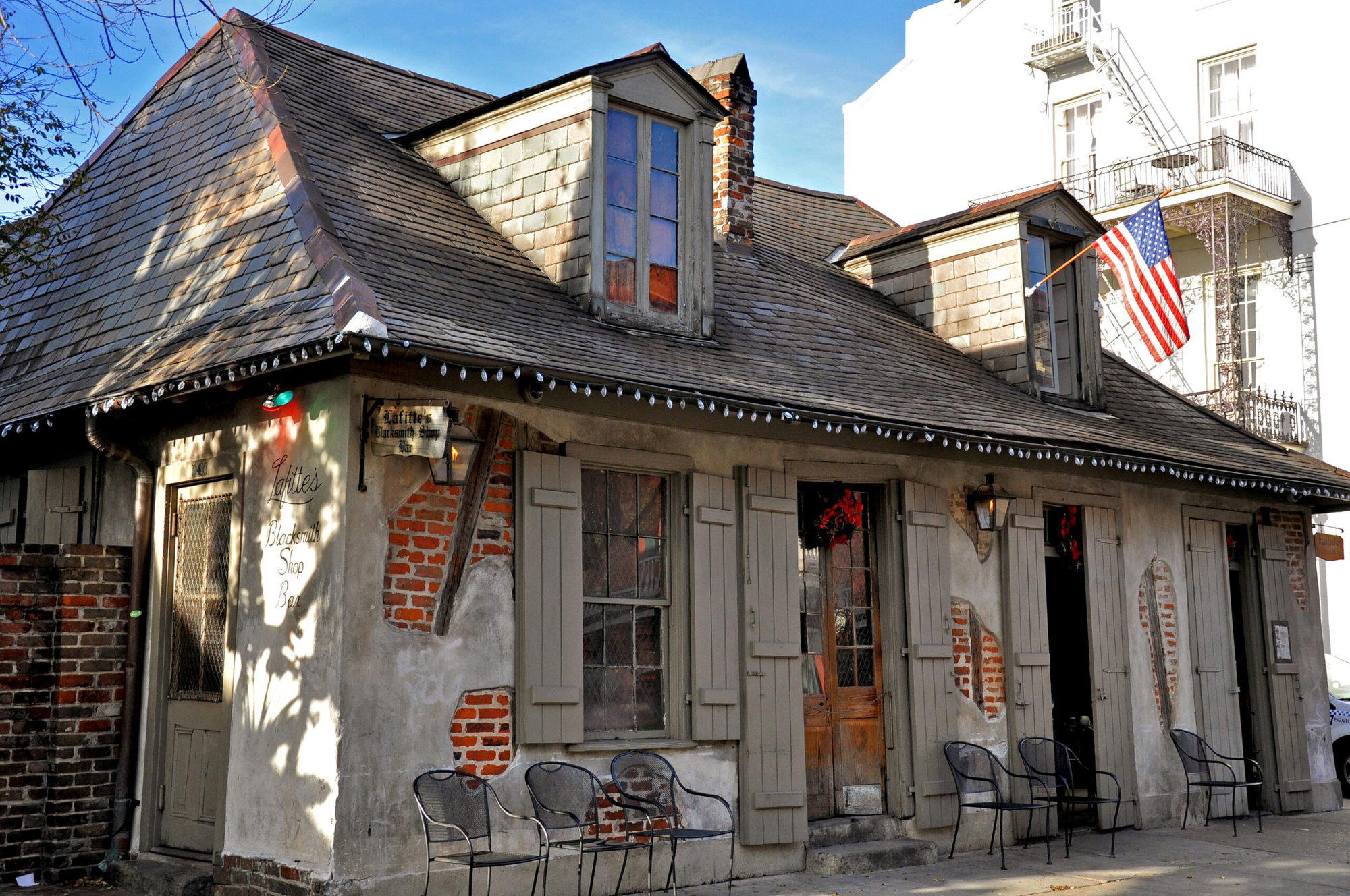
Candlelight and Creole Brick: Drinking Inside New Orleans History
The French Quarter's bar scene runs a full spectrum, from the polished craft programs at Jewel of the South to the rum-forward tiki revival at Beachbum Berry's Latitude 29 and the technique-first approach at Cure. Lafitte's Blacksmith Shop Bar at 941 Bourbon Street belongs to none of those categories. What it offers instead is something that no amount of craft program investment can replicate: a building that predates the United States itself, its soft-fired brick and heavy cypress timber intact in the way that only a structure spared by fire, flood, and redevelopment over three centuries can be.
Bourbon Street at this stretch — closer to Esplanade Avenue than to the neon-and-daiquiri corridor — carries a different register than its more photographed sections. The bar sits near the quieter, residential end of the street, where the architecture thickens and the foot traffic thins. Approaching it at dusk, the absence of electric signage is its own statement. Candles in the windows, some propped in old bottles, throw the only light visible from the pavement. That atmospheric consistency isn't a designed aesthetic decision so much as a structural one: the building's electrical infrastructure has always been limited, which makes the candlelit interior a condition rather than a concept.
The Architecture as the Argument
American bar culture tends to treat historical authenticity as a talking point. Here it functions as load-bearing infrastructure. The structure at 941 Bourbon is among the oldest extant bar buildings in the country, a late-18th-century Creole cottage built in the French colonial vernacular that defined the Quarter before the Louisiana Purchase of 1803. The thick masonry walls, steeply pitched roof, and ground-level entry without a raised foundation are characteristic features of that construction period, the same period that produced the handful of surviving pre-American structures in the neighborhood.
This matters because New Orleans' drinking culture has always been inseparable from its built environment. The city's bars are not just venues; they occupy the physical memory of the place. In that context, Lafitte's sits at one end of a long continuum, while newer, technically ambitious operations like Jewel of the South and Cure occupy the other. Both ends are legitimate expressions of what New Orleans drinking means at different moments in its history.
What the Bar Actually Is
Across the United States, bars with comparable historical credentials often become museums of themselves, preserved, sanitized, and stripped of function. Lafitte's has avoided that fate by remaining genuinely operational rather than curatorial. The crowd on any given evening skews toward a mix of locals who treat it as a neighborhood fixture and visitors who have sought it out specifically for the building. The bar is dimly lit by candle and ambient light, the floors are worn, and the atmosphere inside carries the particular weight of a space that has absorbed a great deal of use across a very long time.
The drink most associated with the bar is the Purple Drinker, a house punch served frozen. It occupies the same category of strong, oversized, signature-specific drinks that defines French Quarter bar culture broadly, placing Lafitte's within a tradition rather than outside it. For visitors accustomed to the craft bar programs at Bar Leather Apron in Honolulu, Kumiko in Chicago, or ABV in San Francisco, the drink format here will read as deliberately unpolished. That is the correct reading. Lafitte's has never been in that competitive set and has no reason to be.
Placing Lafitte's in the Broader Bar Map
New Orleans' cocktail identity is one of the oldest in America, rooted in the 19th-century Creole culture that produced the Sazerac, the Vieux Carré, and the template for what a proper American bar could be. Contemporary programs at venues like Jewel of the South and Cure draw directly on that lineage while updating technique and sourcing. Lafitte's does not engage in that conversation. Instead, it represents the experiential anchor point at the other end: the place where the cultural weight of the city's drinking tradition is most physically concentrated.
For comparison, the cocktail bar programs that have emerged in cities like Julep in Houston, Superbueno in New York City, Allegory in Washington, D.C., and The Parlour in Frankfurt on the Main each situate themselves within a defined craft tradition or culinary context. Lafitte's situates itself in time. That is a different proposition, and one that very few bars anywhere in the country can make credibly.
Within the French Quarter specifically, the bar occupies a niche that is distinct from both the entertainment-district daiquiri shops and the studied cocktail programs. It shares some geographic and cultural proximity with spots like 2 Phat Vegans, which also operates with a strong sense of local identity, but the register is entirely different. Lafitte's identity is architectural and historical first; everything else follows from that.
Planning Your Visit
Lafitte's operates as a walk-in bar with no reservation system. The French Quarter's foot traffic peaks on weekends and during festival periods including Mardi Gras and Jazz Fest, when the bar draws substantial crowds. Visiting on a weekday evening, particularly earlier in the night before Bourbon Street reaches its weekend pitch, gives the interior space and the building's details room to register. The bar is cash-friendly and consistent with the broader French Quarter norm of operating late. For a wider orientation to where Lafitte's sits within the city's full eating and drinking picture, the EP Club New Orleans guide maps the relevant categories across neighborhoods.
Cost and Credentials
| Venue | Price |
|---|---|
| Lafitte's Blacksmith Shop BarThis venue — the venue you are viewing | This venue |
| Jewel of the South | World's 50 Best |
| Beachbum Berry's Latitude 29 | World's 50 Best |
| Cure | World's 50 Best |
Continue exploring
More in New Orleans
Bars in New Orleans
Browse all →
Restaurants in New Orleans
Browse all →
At a Glance
- Well Known
- Historic
- Cozy
- Intimate
- Late Night
- Casual Hangout
- Historic Building
- Live Music
- Seated Bar
- Frozen
Current opening hours
- Monday
- 10 AM–3 AM
- Tuesday
- 10 AM–3 AM
- Wednesday
- 10 AM–2 AM
- Thursday
- 10 AM–3 AM
- Friday
- 10 AM–3 AM
- Saturday
- 10 AM–3 AM
- Sunday
- 10 AM–3 AM
Hours can change for holidays and private events. Last verified .
dimly lit by candles with a haunting historic atmosphere
Know Before You Go
- Getting there
- 941 Bourbon St, New Orleans, LA 70116